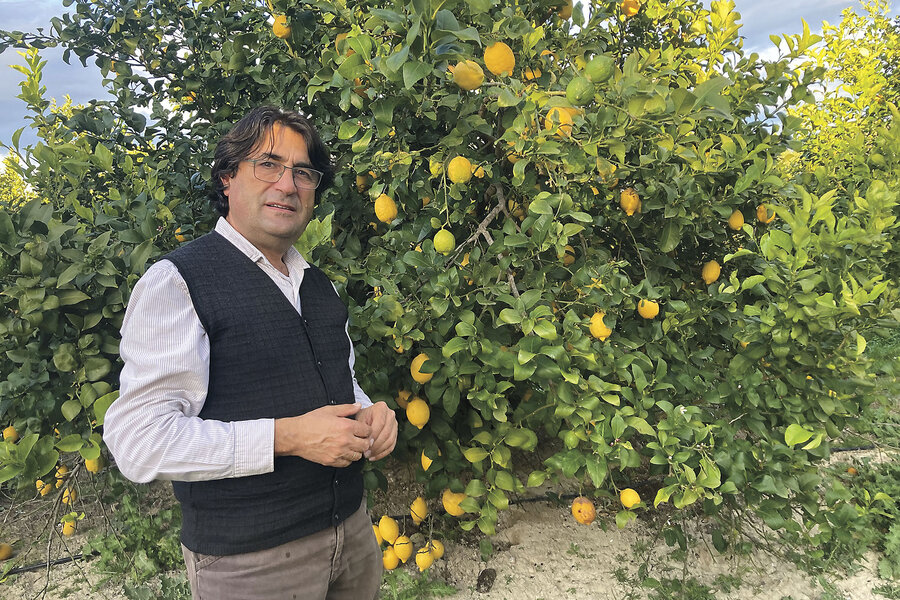
For a generation, workers from across Latin America and Africa have come to Spain’s Mediterranean coast to pick artichokes and pluck lemons from tree farms that stretch inland across rolling hills. Trucks carrying freshly picked oranges trundle past fields of almond trees flowering pink.
That reality has helped to turn this state into one of Spain’s agricultural powerhouses. It’s also positioned the country as an outlier in the West’s hotly contested immigration debate.
Once a country of emigration before joining the European Union in 1986, Spain has seen immigration soar over the past 40 years. As with elsewhere on the continent, that has caused strain. The far right, which only existed on the extremes electorally a decade ago, now has a party projected to win 20% of votes in the next general election in 2027, in part because of a brewing anti-immigrant sentiment familiar across the West.
Why We Wrote This
The United States and Europe have responded to a wave of migration with tighter border policies and efforts to expel migrants. Spain is taking a different approach: by granting migrants legal residency.
But Spain is unlike the rest of Europe as well as the United States, both of which have promoted tightened border policies. In January, the country announced that immigrants already living here could apply for legal residency, amounting to the largest regularization process in Spain in more than two decades.
Immigration advocates hail the move as a win for migrants and human rights. But for many in Spain, it’s simply the practical way forward: Spain’s economy has grown twice as fast as that of its European neighbors, and the government believes immigrants, working in everything from agriculture to construction to services, are vital to continuing that trend. Here in Alicante, a hub of this state’s agricultural industry, the highest per capita number of foreign-born nationals in Spain resides.
“Without immigrants, Spain would not eat,” says José Vicente Andreu, a lemon producer in the Alicante area and president of the Asaja Alicante farmers association.
A necessary population
The fact that Spain’s agricultural industry is flourishing is thanks in part to men like Omar, who stands outside the Algerian Consulate on a recent morning, waiting for it to open and hoping to be the first in line to get his paperwork in order.
Omar’s European dream hasn’t been what he imagined. He has constant, nagging health care needs. The money he makes doing odd jobs barely pays the rent.

“I want to stay in Europe,” says Omar, who arrived here three years ago, blinking back sleep. Because he lives illegally in Spain, he, like other unauthorized migrants interviewed, asked to use his first name only. “But without papers, I can’t work. And without work, I have no future.”
And many farmers here, like Mr. Andreu, argue that the Spanish agricultural sector has little future without him. That’s true across Spanish sectors.
A June report by the Elcano Royal Institute think tank found that in 2024’s last quarter, 31% of agricultural workers were immigrants from countries with per capita incomes lower than Spain’s. Mr. Andreu puts that number much higher, and says that up to 90% of Spain’s fruit and vegetable pickers are immigrants.
Foreigners are keeping other Spanish industries alive as well. According to the same report, immigrants from comparatively low-income countries make up 71% of domestic workers, 45% of hospitality sector personnel, and 32% of construction workers.
“Who is working in our factories, collecting our garbage? It’s the migrants,” says Mr. Andreu. “Spanish people don’t want to do this work.”
Around 62% of the country’s farmers will retire by 2030, according to government figures, and labor organizations say that 10% of jobs in the hospitality industry remain unfilled in certain regions of the country. Those numbers are expected to get worse as Spain registers its lowest birth rate in two decades.
People like Ali say they want to help. When Ali arrived from a small fishing village in Senegal last year, he thought he could find a job picking fruit or painting houses. But without a residency permit, he can’t legally work. Instead, he spends his days selling cheap Chinese sunglasses to tourists on the Alicante boardwalk, darting out of sight when police cars roll past.
“I would do anything else – farming, construction,” says Ali, pulling down his baseball hat to shield his eyes from the midday sun. “This is not a life.”
High demand, steep costs
In some respects, Ali’s situation is thanks to the fact that something here is already working. Migrants say it’s more difficult to find illegal, under-the-table work in Spain. Employers who hire people without documentation risk fines of up to €10,000 (about $11,800) per worker, and the country’s labor inspectors have the right to carry out unannounced business visits.
Such controls, however, have not reduced the number of migrants trying their chances here. Every year, an estimated 90,000 people enter Spain illegally, by boat or plane, and roughly 840,000 people live here without legal status, according to the Funcas economic think tank. Nearly 90% of unauthorized migrants in Spain are believed to be from Latin America.
The large numbers of arrivals, combined with tightened controls, have meant that people without documentation can end up in precarious work environments. Rights groups have warned of “modern-day slavery,” especially in certain sectors like domestic work, agriculture, and waste management, where illegal workers outnumber legal ones.
Last November, 19 people were arrested for employing undocumented workers for €50 ($59) per day on a farm in Villena, around 20 miles from Alicante, in squalid conditions. Research has found that women without papers doing domestic work are more likely to report sexual and gender-based violence on the job.
Daily life is also a constant challenge. Without a residency permit, it is next to impossible to get a bank account, sign a lease for an apartment, or qualify for health care and a pension through the social security system.
“These people are already living here, but their well-being and integration is suffering,” says Andrés Góngora, a member of the executive branch of the Union of Farm and Livestock Organizations (COAG), a Spanish farmers organization. The residency law “can only be a good thing.”
Providing a normal life
The new law is just the first step toward easing the daily struggles of people without papers, proponents say.
“For those of us who work on migrant rights, we’re pretty proud of our country right now,” says Pedro de Santiago Ortega, spokesperson for Accem, a human rights nonprofit in Madrid. “Spain is doing the opposite of the rest of the world. Immigrants who have struggled for years can finally have a normal daily life.”
Domingo Gómez Torres, a lawyer and consul for the Ecuadorian Honorary Consulate in Alicante, says he expects the law to be modified by April, but anyone who can prove they’ve lived in Spain for at least five months prior to Dec. 31, 2025, and has a clean criminal record, can apply for legal residency. Those accepted will qualify for a one-year residency permit, which will allow them to work.
While the latest law to grant legal work status to migrants is positive, say observers, it effectively provides only a one-off release of Spain’s migration pressures. It doesn’t address the underlying issues; Spain still needs to improve its immigration regulations and entry requirements, as does the rest of Europe, they say.
Since 1981, the European Union has introduced more than 20 regularization programs like Spain’s to provide legal pathways to migrants already living on the continent. But EU countries have struggled to control their borders and return only around 20% of people who overstay their visas.
“If you can’t prevent irregular entry and can’t return people, you’re going to have irregular migrants,” says Jasmijn Slootjes, deputy director of the Migration Policy Institute Europe.
Worries about safety and security
The new law – and migrants’ response to it – has worried some. Spain’s far-right Vox party has used the announcement of the regularization measure to warn voters of a potential “pull factor” that could cause a continuous influx of immigrants and insecurity.
Since the announcement, foreign consulates across the country have been inundated by people looking to get police-clearance certificates to complete their applications. Near the Algerian Consulate in Alicante, people like Omar are sleeping on the stoops and sidewalks outside local shops to get in line early. Others say they came from France or Belgium to give it a shot here, since they got their European entry fingerprints in Spain.
While Madrid and Barcelona count the highest absolute numbers of migrants, in smaller cities the changes that immigrants bring to once-homogeneous communities can feel disconcerting to locals. María José, the owner of a jewelry store in Alicante, has started asking her adult son to bring her to work, and is too scared to go out during the day “even to buy bread,” she says.
“I’m worried about my personal safety,” says María José, who asked to use her first name only for fear of a backlash, “but also the security of this country.”
She and local business owners have launched a petition, calling for increased police presence around the Algerian Consulate and an end to the regularization measure. By mid-February, the petition had nearly 50 signatures, including by several Vox members.
“We don’t want Spain to become like parts of France,” says a member of the Vox group visiting the jewelry store. Otherwise, “we’re going to have ‘red zones’ where you can’t even enter.”
Spain’s “different way”
Recent polling finds that 42% of Spaniards think legal migration is positive for the country, compared with 22% in France and 24% in Germany. In early February, Prime Minister Pedro Sánchez wrote a guest essay in The New York Times to introduce his country’s “different way” on immigration.
“I believe that what Spain is doing, by granting mass regularization of migrants, has huge symbolic value,” says Javier Gallego, a radio journalist and leading left-wing voice in Spain. “It shows we are a country that defends the values of democracy.”
For those who have already made it through the process, there is a sense of relief – that others won’t have to go through what they did. When Lina Vargas arrived from Ecuador 26 years ago, she was jobless for a year and lived with her in-laws until she found under-the-table work at a local church.
Now, she has Spanish nationality and runs a recycling business with her husband, selling aluminum and wiring to the Alicante scrapyard. Life isn’t easy, but it’s finally on her own terms.
“It’s been a long and difficult road,” says Ms. Vargas, hauling slabs of wood into a white van. “For other people, at least, it doesn’t have to be that way.”