Leaving Home by Mark Haddon (Vintage £25, 224pp)
About 40 pages into this remarkable book – both heartbreaking and heartwarming, hilarious and poignant – comes an image that hits the reader with the shocking force of a violent punch in the solar plexus. It shows a forearm with a deep wound sealed with five chunky stitches. The accompanying ice-cool prose reveals: ‘It’s 2024 and I’m sitting in A&E at the John Radcliffe. I cut myself earlier in the evening and accidentally chose a new scalpel to do it instead of the scissors I normally use. I feel fine now, because that’s what cutting does.
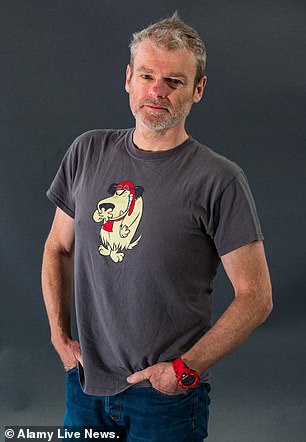
International bestseller Mark Haddon
‘It’s not the reason I do it. I do it because I’m uncontrollably angry with myself … I feel trapped and panicky and briefly lose touch with my common-sense alter ego… But the speed with which the anger turns to calm – as long as the cut is sufficiently painful – makes it easy to see how the act becomes addictive for many people.’
Mark Haddon is writing this, the multiple award-winning artist and much-loved author of the international bestseller The Curious Incident Of The Dog In The Night-Time (later adapted for a hugely successful stage production). Haddon has always been open about his struggles with depression and anxiety, but clearly this is going to be no conventional memoir. And in typically self-effacing style, the image of Haddon’s arm is accompanied by one of his very funny little cartoons. It shows a dog in T-shirt and shorts, holding a knife and bleeding arm. The caption reads, ‘And what, precisely, is this going to solve?’
To say the book is fully illustrated doesn’t really do it justice. It is made up of 87 vignettes, little chapters loosely linked by the author’s fragmented memories. Each is lovingly accompanied by pictures. There are some from childhood, and some more recent, as well as drawings, parodies, even the Weetabix Solar System Wallchart, each a rich accompaniment to Haddon’s meticulous prose and a vital tool in the gradual excavation of his past.
Haddon grew up in a comfortable middle-class home in Northampton in the 1960s and 1970s (he is 63) with his sister Fiona, to whom he is clearly very close and to whom the book is dedicated. The book is also labelled ‘An Exorcism’, but an exorcism of what exactly? Childhood memories perhaps, the ghosts of an unhappy, loveless upbringing certainly. His parents, Peter and Maureen, both recently deceased, seem ideally cut out to be anything but parents.

Photograph of Mark Haddon’s mother
His father was a successful architect and eminent sportsman who played rugby for Northampton Saints. Young Haddon enjoyed his rugby, and admits ‘even now I miss the mud and the bruises and the legalised brutality but it was not a milieu in which you could talk easily about poetry.’
But it is Mum Maureen who gets it most in the neck. My word, does Haddon go for it. And how fair is it? He says he has no memory of being hugged by his mother but right there is a picture of Maureen hugging young Mark and baby Fiona. ‘Were they performing for the camera?’ he wonders. Perhaps it’s sometimes best not to overthink these things. But it clearly wasn’t much fun for these two talented, sensitive children. ‘I think Mum and Dad embraced the idea of me as a freakishly clever child because it lessened their need to understand me,’ writes Haddon. ‘I was off in my own world of encyclopaedias and star charts, a world whose language was alien to them and in which I would know best how to look after myself. In contrast they treated Fiona as an encumbrance, and because she wasn’t as academic as me she was unable, in those early years, to earn the affirmation at school that she was missing at home.’
Some years later, he says, Fiona was taken to hospital with meningitis and was waiting to find out whether it was viral or bacterial (the latter can be rapidly fatal). ‘She rang home, but Mum said they couldn’t visit because “Your father has golf in the morning”. They carried on finding reasons not to visit for the entire week she was in hospital.’
Later Haddon was sent away to public school.
He writes with characteristic wry astringency: ‘Bullying was not simply common, it was the default relationship between teenage boys forced to share too small a space, like factory-farmed chickens with no pastoral care and discipline administered largely by older boys. You bullied or you were bullied.’ He talks about his inability to weave the patchily remembered events of his own life into a coherent narrative and that is what we have here in this wonderful book. Slices of a life brilliantly illustrated and exquisitely told.
It is the sort of book you can return to time and again for insights into life and love and the way we live, insights that come at us in a non-linear way in the book, just as in real life.
Haddon himself has built his own family, and there is a marvellous sequence – a love letter, if you like – about meeting his wife, Sos, another writer and critic. While six months pregnant she is hit by a car on her bike and Haddon’s fears and anxieties are brilliantly told. Both wife and child were fine, and soon after the accident Haddon wins the Whitbread Book of the Year prize for Curious Incident. In his speech he says ‘you never realised quite how much you loved someone until you were kneeling on a road thinking they were about to die in front of you’. Their son Zack is now a ‘huge bearded creature who is studying maths and can leg-press over 560 kg’. So no harm done…
Now Haddon volunteers for the Samaritans and realises how much this helps.
‘Certainly the organisation has been a lifeline for me especially when my own mental health has been fragile. A shift of three and three-quarter hours each week focusing entirely on other people and their concerns often feels like a holiday from myself.’
He is calmly frank about his own health difficulties. In 2019 he had a triple heart bypass, about which he writes with his characteristic sardonic calm. ‘Anyone who has sex within six weeks of a heart bypass deserves a medal as does their partner who would have to stay aroused in spite of a huge scar down their partner’s chest where the sternum has been cut with a rotary saw, cranked apart, then reclosed with loops of titanium (I asked for all the details).’ And that’s what’s in the accompanying photograph.
It is impossible to overstate the riches of this tender, transformative little book. There is magic on every page, and in the end you can only be grateful that someone as thoughtful and insightful as Haddon is among us to illuminate everything around us.