
Holy Fuck by Joseph Incardona (Bitter Lemon Press, 2026, £9.99) is a zappy satire with a high murder count, the first of the many novels by the Swiss novelist to be translated into English. Originally Stella et l’Amérique (2024), this is a story with the criminals introduced very early on and described on the back cover, so no secrets betrayed. The Pope is concerned that Stella, a prostitute who, by means of sex, cures invalids of their illnesses, is an inappropriate saint — whereas, if she becomes a martyr, then the Church can invent and use an exemplary story. The standard killers, the villainous Bronski twins, are commissioned and we are launched on a madcap chase novel through the South and on to Las Vegas, with corpses aplenty, fine writing, fascinating asides, overlapping and interacting narratives, and a Pulp Fiction vista of the bizarre, the deadly, the shrewd, and a variety of supposed purposes of life. Very much one to enjoy but also plenty to think about. And short.
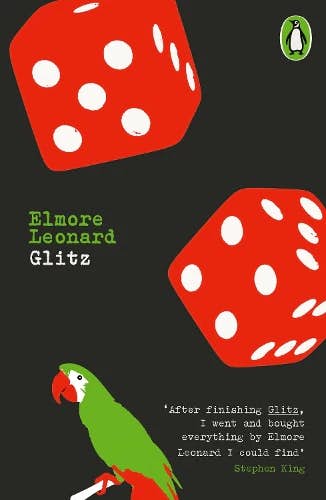
Penguin Modern Classics’ Crime and Espionage series is becoming an Elmore Leonard one. The last ten of the forty in the series are by that master and will bring a lot of pleasure to many people. I have reviewed the earlier ones. Now out are Glitz, The Hunted, and Unknown Man No. 89 (each 2026, £10.99). Glitz, originally published in both America and Britain in 1985, is a brilliant novel, at once exciting and moral, characterful and brilliant in depicting locales, from Florida to Puerto Rico and then to Atlantic City, before going south again. Leonard (1925-2013) shows anew in Glitz his ability to create atmosphere while etching scenes, and notably so in casinos and hotels. He spans social and ethnic divides in his writing and is particularly skilful in getting inside relations between men and women, whether husband and wife, lovers, or mother and son. The vulnerability of innocence is a major theme, with women particularly suffering cruelty or, at least, neglect. Vincent Mora, the protagonist, a Miami policeman recovering in Puerto Rico from being shot, falls for Iris, a young woman who is tricked into becoming an escort in an Atlantic City casino. That takes Vincent there but also the psychotic rapist he had put away, who is now out and looking for revenge.
The casino world has rivalries and crime aplenty, and we spill over into money-laundering, kickbacks, and gang warfare. In turn, after one murder In Puerto Rico, there are two more in Atlantic City, and that brings the story tumbling back to Puerto Rico. Lots of drink, sex, guns, and smoking, and an economy of writing that enables the sprawling plot to be held together with novelistic scale but without any sense of longueur. A triumph.
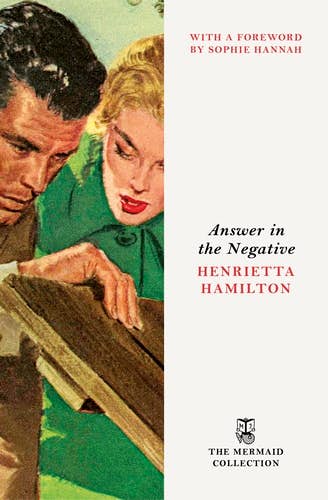
Another source of historic stories is the Penguin Michael Joseph Mermaid Collection, “forgotten female classics”. These include Helen McCloy’s Through A Glass, Darkly, introduced by Gilliam McAllister and Henrietta Hamilton’s Answer in the Negative, introduced by Sophie Hannah. The latter (2026, £12.99) was first published in 1959. Answers in the Negative is very much written in the shadow of World War Two, with characters defined by their war records, officer-and-ranker relationships surviving into peacetime, and extensive bomb damage still apparent: “Johnny’s step was always astonishingly light; his Commando training had something to do with that. Camberley’s was the brisk, firm step of the more orthodox soldier.”
The radio news is bleak: “There were the still hoped-for summit talks, a colliery strike, a by-election somewhere, an IRA raid on an Army camp on Salisbury Plain…”
Class is present: “Selina was there. Nanny, with unerring instinct, had recognised her as one of the original employer class, and had put her in the drawing room and lit the fire”.
Education is an aspect: “‘I don’t understand public-school humour. I went to a grammar school’” … “He hadn’t been to a public school, poor chap, and he was by nature a prig and a talebearer.”
There is poverty: “He stayed in the Gents’, it seems, to wash out two pairs of socks — he’s living in rooms where there’s next to no hot water.”
Some of the writing does not really work for me: “Beneath the streetlamps the pavement was black and shining like a black slug. The lamps sank broken reflections into it.”
Yet, there is much wit and the plot is good. The husband-and-wife combination works very well and is treated effectively. There is also a nice ironic echo of the genre:
“‘What on earth do you suppose he wants?’
‘I can’t imagine. If this were a detective story, he’d be bumped off before he could tell us. It’s a classic situation.’
But a quarter of an hour later a taxi drew up at the front door…”
There is a Holmesian conclusion, with the comparison explicitly drawn.
Any review leaves the process of choice unclear. Why was this choice made? Who made the choice: reviewer, editor or a policy of swopping off reviews for advertising revenue? Favour to chum, or another author with the same publisher, agent, publicist? All are the case, but what is depressing is that no-one really explains the choice or the process of choosing. For example, as far as the Times’ recommendations on 25 February are concerned, I agree strongly with Simon Lewis’ No Exit, indeed have already reviewed this very favourably, but do not share the high opinion of Catriona Ward’s Nowhere Burning, which disturbs without offering much.
My choices are the result of informed (I hope) whim, or, at least, by whimsical happenstance. I am not in receipt of any instructions from the Critic, do not have an agent or a publicist or friends who write detective novels, have only once gone to a detective novel launch party, and do not accept bungs of any sort [e.g. “do come to lunch and I’ll introduce you to this marvellous author”].
So it is whim. What about the book excites my interest? There is the very basic parameter, you might think, of what is sent for review, but you can also ask for books if you want one or see it on the shelves, or, indeed, purchase a copy.
No reviewer should fancy themselves authoritative. It is personal in terms of taste, with particular views on plot, characterisation, content, dialogue, tone, description et al. Allowing for that, there is the experience of judgment, and that hopefully provides for informed whim. So if, for example, I find J.D. Brinkworth’s The Pie and Mash Detective Agency (Century, 2026, £16.99) a failure as a facetious debut that reflects not a dislike of the humorous take, but the knowledge that there are many better ones.
A more successful novel for example, is Callie Kazumi’s second novel, Greedy (Century, 2026, £18.99). At once amusing and really sinister, it is set in Japan, where the protagonist, Ed has proved a failure as husband, employee and gambler, ending up in debt to a violent Yakuza gang and desperately in need of money. He responds to an advertisement for a personal chef for a mysterious billionaire and finds a different pattern of entrapment. Becomes a very dark Gothic novel, somewhat predictable, but with the “Digestif” a highly effective surprise. Same publisher, but far better written than Pie and Mash and much more thoughtful and interesting.
Alas, beginning reasonably (even, to a degree, comfortably), but eventually escalating to a conspiracy that adds far too many bodies and a (less macabre than Greedy) but still over-extensive plot is Sean Watkin’s Better Off Dead (Canelo, 2026, £9.99), which takes forward the plot of his Black Water Rising. The central characters, D.C.I. de Silva and D.S. Barclay, are ably realised, and the writing is clear, though only sometimes compelling. The police dynamics and set-pieces work, although Liverpool is not the brooding presence with which Glasgow is captured in similar novels. Watkins has his prejudices, but so do most writers, although at times he is led astray, as in the presentation of witches as executed for “something men disapproved of”. In fact, many accusers were women, but why spoil a comfortable prejudice. Let us hope that his next novel is less lurid.
Lottie Moggach’s Mrs Pearcey (Phoenix, 2026, £20), has attracted a lot of favourable attention, which it well deserves. An historical novel based on a true-life crime, this is a very successful attempt to rediscover the past and fill in the gaps in order to provide a resolution and meaning to the crime. The author invents Hannah in order to engage more with the puzzles of the crime. Sexual desire and emotional need are part of the story which deserves much praise.
Lisa Walker’s The Pact (HQ, 2026, £9.99) uses a mysterious invitation to take part in the Camino as a way for a “Then” and “Now” plot in which tensions at Ravensthorpe Writing College three years ago are juxtaposed to those in the same group as they plod forward on a journey described without illusion. The mysterious death three years ago of Lula, the charismatic, demanding tutor, is a point of departure, but so also are the difficulties of being a young writer, the drives within the rivalries, and the overlaps with drugs, sex, deceit and violence. Some witty satire at the expense of literary conceit and reputation, and a good story, with lots of twists and turns and no excess of death. One to enjoy.
Based on Simeon’s Maigret et la Jeune Morte (1954), Maigret (2022) is an impressive standalone film directed by Patrice Leconte. Gérard Depardieu has a strong, silent presence in a film that wins on atmosphere and character, but that lost money. Jade Labeste is excellent as the female lead Betty, and the relationship between her and Maigret is captured very well.