Will it go ahead, or should it, or even can it? King Charles and Queen Camilla are due to pay a State visit to the United States next month. For any number of reasons this was always fraught with difficulty, but it now seems quite possible, as The Mail on Sunday reveals today, that it won’t take place.
The very fact that relations between London and Washington have recently been tense seemed in itself an argument for a royal visit. The King and Queen were seen as the latest ‘Trump whisperers’, who might mollify the President and calm his rage against Prime Minister Sir Keir Starmer.
But the ferocious American and Israeli assault on Iran was obviously unforeseen when the visit was first mooted, and the wholly unpredictable outcome of that conflict increases the difficulties of a visit. That, and Trump’s even more unpredictable behaviour, as well as his unbridled tongue.
When Trump says of Starmer, ‘This is not Winston Churchill that we’re dealing with,’ he’s obviously right, although it invites the retort that Trump is scarcely an FDR himself. He grumbles that our government hasn’t given him more support in his latest, highly dangerous war, but a recent poll shows almost half of British people are opposed to the Iran conflict, against barely a quarter in favour. And don’t imagine that this response is found only on the Left. Many traditional shire conservatives are just as troubled by Trump’s radical brand of nativist populism, and where it could drag Britain. With an uncontrollable loose cannon in the White House, was this really the time for a royal endorsement?
The visit is – or maybe was – to mark the 250th anniversary of the Declaration of Independence, when American colonists shook off the rule of King George III. But that by no means ended the connection between the American Republic and the British royal family, or the endless American fascination with all things royal.
At the conclusion of the Great War in 1918 President Woodrow Wilson became the first American president to visit England. The visit was no private success, despite public platitudes. Wilson dismayed his hosts by his offhand manner and his failure even to mention British sacrifices in the war. ‘I could not bear him,’ King George V told a friend, ‘an entirely cold academical professor – an odious man’. Trump is scarcely a cold academical professor, but it’s not hard to guess King Charles is no fonder of him than his great-grandfather was of Wilson.
The first State visit to America by a British monarch may have been the most important. In 1939 King George VI and Queen Elizabeth sailed to Canada, and after a long journey across the country crossed to the United States, visiting Washington, and then staying with President Franklin Roosevelt at Hyde Park, his country house on the Hudson. Americans were pleased at the sight of the shy, stammering king eating hot dogs. He looked a regular guy.
That visit had an effect on American opinion, although not so much as to alter the country’s rigid neutrality when the war began in September. They kept out of the war until December 1941 when Pearl Harbor and Hitler’s declaration of war gave them no choice.
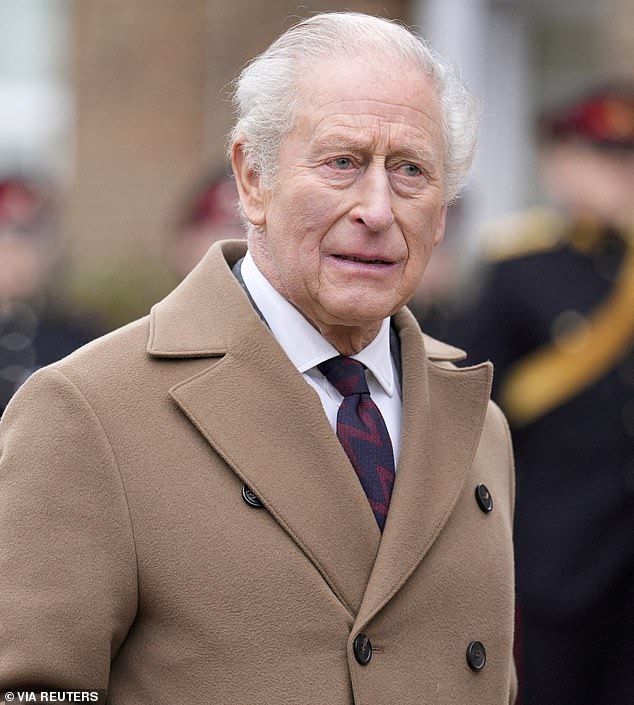
King Charles during a visit to the Royal Regiment of Artillery at Baker Barracks, Thorney Island in February
Since then the two nations have been allies, and royal visits have played a part in keeping the relationship, if not ‘special’ in the dubious phrase, then generally quite warm, despite bumps in the road. One came in 1956 with the Suez expedition, when President Dwight Eisenhower pulled the rug from under Sir Anthony Eden’s government.
But the following year Queen Elizabeth II paid her first State visit to America, which was a triumph, in public and private. She and the president found an unlikely bond in their shared love of baking, and they would go on corresponding, exchanging recipes for cakes.
She returned for the Bicentennial in 1976, and again in 1991, when she was the first monarch to address both houses of Congress. In between came a trickier royal visit in 1985, which I well remember as I was in Washington at the time. The visitors were the Prince and Princess of Wales, only four years after their wedding but with faint cracks in the marriage already just about detectable.
The visit will be forever remembered in the hallowed annals of our monarchy as the occasion when Princess Diana took to the dance floor with John Travolta.
Forty years on, Charles has married again and more happily, and inherited the throne. His and Camilla’s duty as monarchs is to do the Government’s bidding, even if that means massaging the ego of a president like Trump. In private, they must have misgivings about the approaching State visit, not least because of Trump’s recent insult to this country and our Armed Forces, of which King Charles is commander. It was so outrageous and insulting that it alone should have called the royal visit into question.
In January, the president claimed Nato troops in Afghanistan, notably including the British Army, had ‘stayed a little off the frontlines‘. Hearing that, I thought of a wildflower meadow near us a few miles south of Bath. There is a young oak tree, planted ‘in loving memory of Lt David A.G. Boyce 1st Queen’s Dragoon Guards killed in action in Helmand Province Afghanistan 17 November 2011 Aged 25’. One may imagine what David Boyce’s family thought of Trump’s words.
They would have been contemptible from any American, let alone the Great Draft-Dodger himself. Sixty years ago, when the young Donald Trump was eligible to fight in Vietnam, he used every possible means to avoid military service and stay more than ‘a little off the frontlines‘, including a plea that he had a heel spur, an affliction so grievous but he can’t now even remember which foot it was.
Last year there was a frankly ludicrous ‘State visit’ to Britain by the president. Such is Trump’s unpopularity here that the visit was effectively held in private at Windsor Castle, Trump saluting the parade stiffly with a non-combatant’s punctilio. The King didn’t salute the Foot Guards since, as an ex-serviceman, he knows that you don’t salute if you’re in plain clothes and bare-headed.
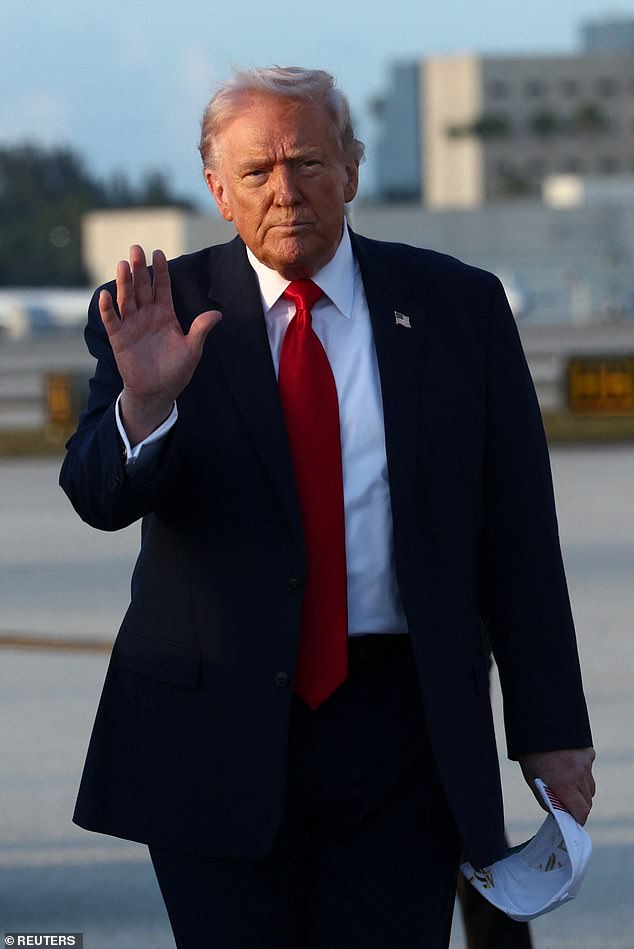
President Donald Trump waved as he arrived in Miami, Florida on Saturday
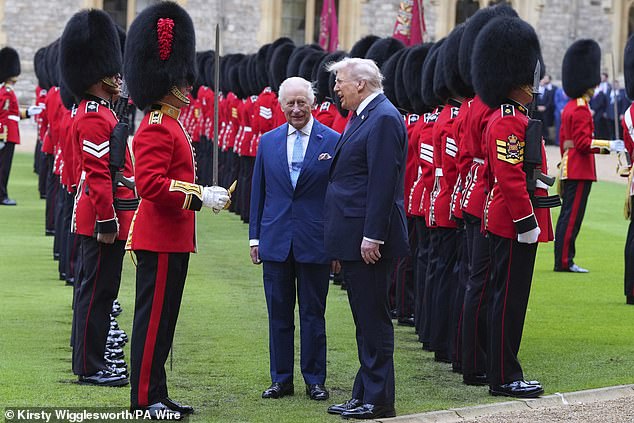
King Charles III and US President Donald Trump reviewed the guard of honour during the ceremonial welcome at Windsor Castle last year
Charles, of course, was a serving naval officer, like his father before him, and his brother, and they knew something of the frontlines. In March 1941 Prince Philip was a 19-year-old sub-lieutenant on HMS Valiant, and was mentioned in despatches for his part commanding his ship’s searchlights at the Battle of Cape Matapan south of Greece, a brilliant night action that sank three Italian cruisers.
There’s not much to be said for the disgraced Andrew Mountbatten-Windsor, but don’t forget that he served creditably as a naval helicopter pilot in the Falklands War. And the King’s wayward son Prince Harry insisted that he should serve with his regiment, the Blues and Royals, when they were sent to Afghanistan, very much not ‘off the frontlines‘.
So it is dimly that I imagine the King took Trump’s sleight against our servicemen and women.
The planned State visit was part of Starmer’s misconceived strategy of flattering Trump, as was the unfortunate appointment of Peter Mandelson as ambassador to Washington. That did not end well, and the State visit might not either.
Starmer may one day grasp that you can lick Trump’s boots and he’ll still kick you in the teeth.
For the Prime Minister’s sake and ours, this ill-considered visit should be postponed for as long as possible, if not for good.