British spies are part of a deep‑cover operation in Iran to track down chemical weapons which could be used in drone attacks on neighbouring countries such as Israel and Dubai, The Mail on Sunday can reveal.
The intelligence officers are working with French and American counterparts inside the country to locate sites which have been identified by Israel as potential hiding places for nerve agents.
Despite the intense bombing of military sites by the US and Israel since the start of the conflict, security sources say America’s CIA and Israel’s Mossad have evidence that supplies of the chemical weapons were stashed in separate locations.
A UK security source said: ‘We should not underestimate the Iranians. They are smart people and they can quickly adapt.
‘History has shown us that their culture leads them to death rather than surrender. If they are pushed into a corner they may well opt to use chemicals – most likely against Israel, but who knows where else?
‘They could kill and injure thousands in Dubai if they wanted to.
‘I am pretty certain the Iranians used some level of chemical toxins against their own people earlier this year; the symptoms they describe indicate a nerve agent of some kind.
‘We are inside the country now looking for them, across four sites narrowed down by Tel Aviv.’
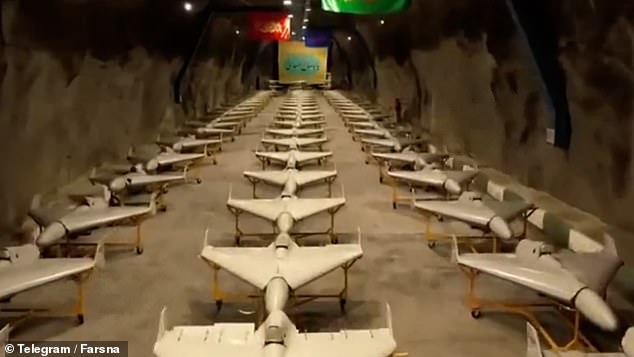
British intelligence officers are working with French and American counterparts inside the Iran to locate sites which have been identified by Israel as potential hiding places for nerve agents. Pictured: Iranian drones in an underground depot
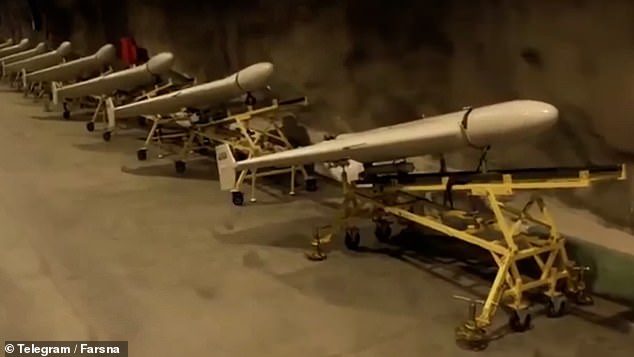
Despite the intense bombing of military sites by the US and Israel since the start of the conflict, security sources say the CIA and Israel’s Mossad have evidence that supplies of the chemical weapons were stashed in separate locations. Pictured: Iranian missiles
The World Health Organisation (WHO) has revealed that medicines designed to mitigate the impact of a nuclear or chemical attack were distributed across the Middle East ahead of the US-Israeli offensive.
Experts believe that Tehran’s traditional battlefield-capable chemical weapons programme, which began during the 1980-1988 Iran-Iraq War, has since evolved into a ‘targeted offensive’ capacity.
During the Twelve-Day War in June 2025, Israel is said to have destroyed at least one alleged Iranian chemical weapons site.
In addition, democracy campaigners have claimed the regime used lethal chemical agents during widespread protests in January to kill wounded demonstrators in the cities of Isfahan, Shiraz and Mashhad.
Israel’s deputy ambassador to the Netherlands, Yaron Wax, declared in July 2025: ‘Over the past two decades Iran has been developing a chemical weapons programme based on weaponised pharmaceutical agents.
‘These agents, primarily anaesthetics, affect the central nervous system and can be lethal even in small doses.’
The UK security source said: ‘Hopefully, if their missiles and drones are in short supply they will struggle to deploy it.
‘I don’t think Donald Trump paused to consider the culture of the regime, run according to an ultra-hardline doctrine.’
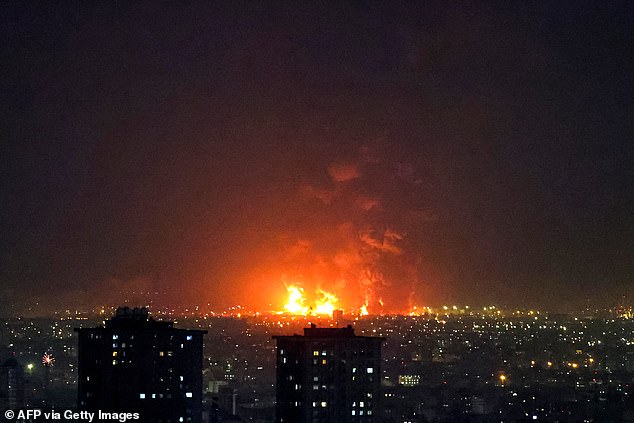
A UK security source said: ‘We are inside the country now looking for them, across four sites narrowed down by Tel Aviv’. Pictured: Explosions after a strike on Tehran on Saturday
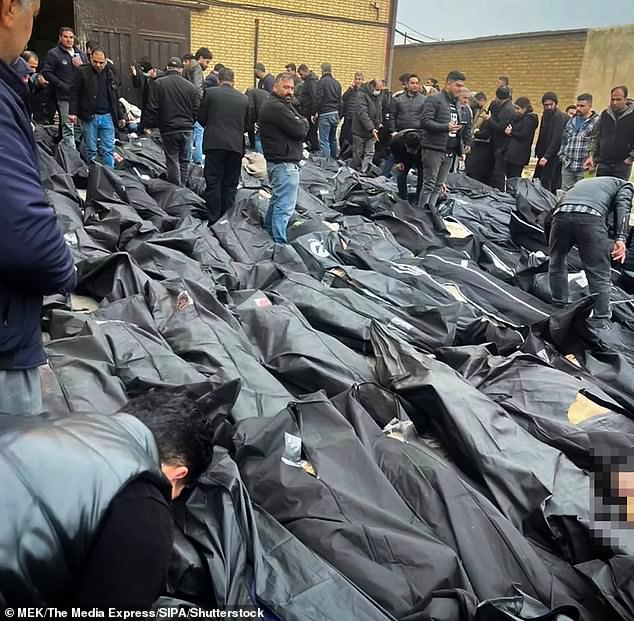
Democracy campaigners have claimed the regime used lethal chemical agents during widespread protests in January to kill wounded demonstrators in the cities of Isfahan, Shiraz and Mashhad. Pictured: Families at a coroner’s office in Tehran in January 2026 search rows of body bags for relatives killed during the crackdown
Iran supplied chemical weapons and expertise to Bashar al-Assad’s Syrian government forces in 2013, including a gas attack on the town of Ghouta which killed more than 1,700.
The Assad regime launched hundreds of attacks using chlorine and the nerve agent sarin.
Tehran is also suspected of passing nerve gas to the Houthis – its proxy force in Yemen – earlier his year.
Armed with ballistic missiles, the Houthis have attacked more than 178 ships in the Red Sea in the past couple of years and are instructed by Iran’s Revolutionary Guard Corps, based in Yemen.
Dr Hanan Balkhy, WHO regional director for the Eastern Mediterranean, said last week that the organisation had long held concerns about the risk of ‘some kind of nuclear or chemical war’ in the region, and preparations had been under way for some time.
This included the distribution of potassium iodide, which protects the thyroid gland during nuclear or radiological emergencies, and specialist training for medics.
Defence analyst Tim Ripley said: ‘It is well documented that Iran has produced and used nerve gas in previous conflicts.
‘The worrying concern for the US and Israel is that Tehran has passed these deadly weapons to their proxies.’
Additional reporting by Brendan Carlin