Criticism from the widely unpopular American president is a political boon for the Spanish prime minister
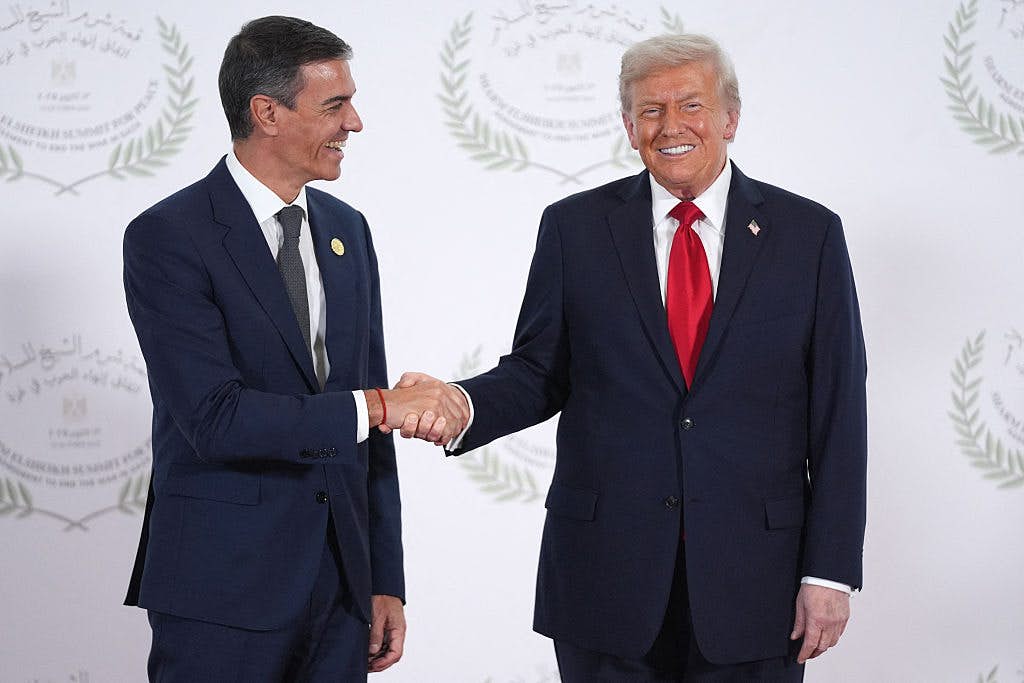
Pedro Sánchez is winning President Trump’s war. The only true victor of the latest Middle Eastern conflict is the Spanish Prime Minister. Sánchez is far too wily to ever say so, but President Trump’s excoriation of Spain has given him a huge boost. Better still for the leader known as “el guapo”, he knows exactly how to take advantage of it.
“Spain has been terrible.” Pedro Sánchez must have thought he was dreaming when he heard President Trump lambast his country. The threat to “cut off all dealings with Spain” will sink in the mire of the European Union, while the verbal assault adds a golden bullet to Sánchez’s arsenal. Spain’s Prime Minister has no right to play the patriotism card given he is supported by separatists, but the U.S. President has once again Trumped everything.
Everything Sánchez does is to try and hold on to political power. Despite the deep unpopularity of his positions, most notably on immigration, and huge corruption scandals, he is Europe’s great political survivor. This has been accomplished by an astute understanding of Spain’s political map, which gives separatists huge power, and an ability to fight electoral battles on exactly his terms. Being, as The Financial Times termed him, “Trump’s European nemesis”, is a coup for the embattled Prime Minister.
Sánchez’s equally trailblazing pro-Gaza policy didn’t have much impact on the polls, but that coincided with a truly mammoth corruption scandal which would have brought down any other democratically elected leader in his position. Also, while Gaza allowed him to pacify the left, anti-Americanism has a broader coalition than pro-Palestinian politics.
Spain’s right, meanwhile, is torn in two. Both the nationalist Vox and the establishment Partido Popular (PP) came out to criticise Sánchez, but this didn’t go down well. The PP’s leader, the awkward Galician Alberto Núñez Feijóo, who despite being pictured on yachts with drug dealers remains deeply uncharismatic, feebly asked Spain’s allies for “respect”. On the other hand, Vox’s leader Santiago Abascal went full throttle, calling Sánchez “a scavenger who feeds on wars”, firmly taking Trump’s side.
The centre-right PP are placed in the most difficult position, as it is overwhelmingly clear that they can only govern with the more extreme Vox. The PP have to play a double game of not angering Vox too much, but distancing themselves enough from them to retain voters who are put off by Abascal’s vulgar extremism. Trump’s comments on effectively invading Spain and using the American bases in Spain without permission were beyond toxic, but Feijóo had to find some sort of middle ground.
As it was in the early 2000s, Spain’s right remains incredibly Atlanticist. Vox are well acquainted with the political kaleidoscope of Trumpworld, whereas the PP are tied to the hip with establishment Atlanticism. Feijóo was briefed on the situation not by Spain’s foreign Minister but by American Secretary of State Marco Rubio. This is not a popular position when a majority of even Feijóo’s own voters believe the United States is a threat to world peace.
Debate in Spain is inseparable from the events of 2003–4. The then Conservative PP Prime Minister, José María Aznar, backed Bush’s Iraq War, even sending troops as peacekeepers in July 2003. This was incredibly unpopular, with 91 per cent of Spaniards being against it. “No a la guerra” became a defining political slogan, and that is exactly Sánchez’s message now. It could well cut through. According to El Pais, 68.2 per cent of Spaniards oppose the Iran war, and more than 40 per cent of Spaniards approve of Sánchez’s performance (compared to less than 20 per cent who support Feijóo’s).
Sánchez still faces an uphill political battle; the current polling consensus is a massive right-wing majority. A toxic blend of corruption, immigration, and handouts to wealthy separatist regions have radicalised most of those who consider themselves Spanish against him. Recent regional elections have returned large right-wing majorities in traditionally left-wing or battleground areas like Extremadura and Aragón, with the Left only remaining strong in separatist Catalunya and the Basque Country.
Trump has handed a failing government a golden bullet
Even before Trump’s outburst, Spain’s Machiavellian Prime Minister couldn’t be counted out. Running on an anti-Vox ticket has already worked for him before, and every day the Spanish nationalists take voters from a PP deemed to be too weak. The Spanish far-left, constantly at war with themselves, are also organising to be electorally efficient, which hasn’t been the case in recent local elections. Sitting at around 26 per cent, Sánchez only needs 30 per cent to have more than a puncher’s chance at remaining Prime Minister. If we see a fraction of the rally-around-the-flag effect which impacted Canada’s election, Spanish conservatives should be very scared.
Spain’s Prime Minister can be trusted to extract the maximum out of this crisis, and will back himself to win an election against Feijóo who is a mix of Keir Starmer and Theresa May on the campaign trail. No matter how bad the odds seem, Trump has handed a failing government a golden bullet. One great Spanish saying will spring to Pedro Sánchez’s mind: “En peores plazas hemos toreado.” We’ve fought against worse odds.