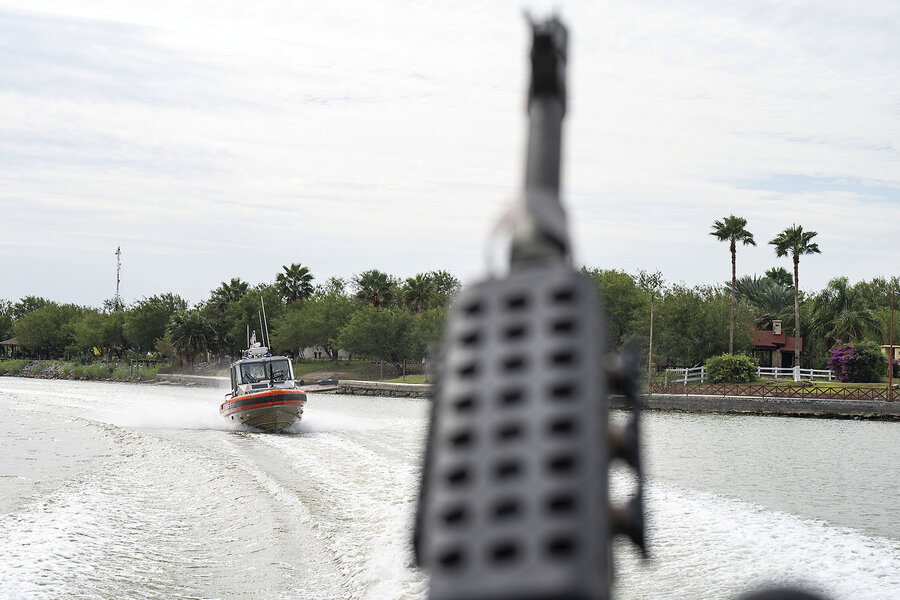
The river runs jade until the Coast Guard comes. Water ruffles up white against the boats as they gather speed.
A black vessel – open-air, with an armed crew of three – is new to the Rio Grande, where it patrols the international boundary near McAllen, Texas. Petty Officer 1st Class Markus Graham grips the wheel in his helmet and shades.
The crew member calls out that he’s riding water where the United States and Mexico meet.
Why We Wrote This
Military troops are a key presence at the southern border, where illegal crossings have plummeted. Some personnel who are normally at the border are now assigned to an interior immigration enforcement surge that is anything but quiet.
“We’re about dead center,” he says, tilting into a turn. “We’re on the border.”
The Coast Guard is used to occupying two realms at once. Part of the military, it’s the sole branch that also sits in the Department of Homeland Security during peacetime, where its mission includes interdicting migrants and drugs. Last fall, the service began sending people and boats to the southern border as part of a military buildup directed by President Donald Trump.

Yet the troops have arrived at a relatively quiet border. Illegal crossings are down to thousands a month compared with the thousands per day during the Biden era. Men, women, and children used to cross the Rio Grande en masse, linking arms in precarious human chains. Now, Coast Guard members stationed here often scout empty riverbanks. Deflated plastic rafts, from past attempts to cross, dot both shores.
Meanwhile, some federal border agents who typically patrol down here have headed north. Those interior enforcement surges have been anything but quiet, as masked arrests, tear gas, protests, and the killings of two U.S. citizens have roiled neighborhoods unaccustomed to chaos.
On the campaign trail, Mr. Trump promised to close the southern border. He counts that as an accomplishment now, even as more military muscle is sent to hold the line. But the president has yet to check off another pledge: the largest deportation operation this country has ever seen. That can only be accomplished in the interior, where millions of unauthorized immigrants have settled.
As the administration enters the second year of its whole-of-government immigration crackdown, the armed-forces escalation shows signs of shifting, but not slowing. This dual dynamic – resources swelled to the border and interior at once – seems “unprecedented,” says Reece Jones, a geography professor at the University of Hawaii at Manoa, who studies borders.
While the government may claim control of the border up to a point, he says, claiming total control would invite more scrutiny of resource use.
“Because then the next question is going to be, When do we pull it back?”

Soldiers, including National Guard members, have long aided border enforcement under Republican and Democratic presidents alike. But over the past year, the Border Patrol has partnered with an expanded military presence numbering in the thousands – including the Coast Guard – as well as deputized members of the Texas National Guard. The Pentagon has created military zones on public land.
These new “national defense areas” extend into the Rio Grande itself. Meanwhile, U.S. Customs and Border Protection (CBP) is keen to recruit, offering new Border Patrol agents bonuses of up to $60,000 over their first four years.
And on the same day that an immigration officer fatally shot Renee Good in Minneapolis in January, the Department of Homeland Security announced the arrival of over 500 miles of river-barrier buoys in Texas. (The department will soon have a new leader: Last week, the president fired DHS Secretary Kristi Noem amid mounting controversies tied to her leadership.)
As reinforcements mount, the rural isolation along much of the border highlights the dichotomy of the unprecedented immigration enforcement effort. In the interior, law enforcement has been met with protesters who the government says are impeding raids. The borderlands lack the chorus of public witnesses, cellphones in hand, documenting federal actions in cities up north. There are few places where the difference is clearer than in this part of south Texas.

***
In December, on the Rio Grande, the Monitor joined the Coast Guard and CBP for a look at the new normal. Seen from a boat, stretches of border wall blur by twice: rising from the bank and mirrored in the water.
The river’s shallow depth can complicate navigation for Coast Guard arrivals. That’s why their fleet includes a new Rock Boat, or Border Security Riverine, a vessel that Petty Officer Graham drives, which can skim over water mere inches deep. The narrowness of the river – at times a few dozen yards wide – also limits response time when an illegal crossing is quick. Towering carrizo reeds can conceal border crossers once they reach land.

For the crew members, it’s all an adjustment.
“If we’re not within a mile or two, it’s hard to catch anybody,” says Petty Officer 1st Class Christopher Bakri, wearing a beanie and driving a larger, 29-foot-long response boat. While it can take people “maybe a minute” to cross the river, he says, “in the open ocean, you got all the time in the world.”
On his bow and stern sit M240B machine guns, fed by cartridges that look like brass-colored fangs.
The plan is to “deter and disrupt illegal immigration, human traffickers, drug smugglers, and any other threats” that might try to cross from Mexico, says Capt. Christopher Cumberland, commander of Coast Guard Forces Rio Grande. “The adversary’s smart, well armed, well funded, well equipped.” By adversary, the commander says, he means Mexican cartels, criminal networks that the Trump administration now calls foreign terrorist organizations.

“We’ll support apprehensions, I would say, probably more than actually interdicting or detaining,” with handoffs to the Border Patrol for processing, he says. Since the operation started in October, the Coast Guard reports supporting 179 apprehensions and deterring 181 other individuals who, after seeing the force, turned back to Mexico. When asked in early December, the Coast Guard said it hadn’t yet seized drugs on the river. As of Feb. 20, the Coast Guard also reports it has not seized any drugs. (The DHS funding shutdown that began on Feb. 14 hasn’t halted the operation.)
Captain Cumberland is among nearly 400 people staffing Operation River Wall, which the Coast Guard says has drawn from all its districts. Even before then, a federal watchdog raised concerns about how such deployments could stretch the service’s capabilities. In June, a Government Accountability Office report said that when the Coast Guard has prioritized assets for migrant interdiction, it has had less support for other duties. A Coast Guard spokesperson said via email that its leaders make daily decisions on “how to prioritize limited assets and resources,” and that the Rio Grande surge is “structured to avoid degradation” of other missions.

The militarization of the border overall “does have a deterrent effect on certain types of illicit activities,” says Guadalupe Correa-Cabrera, co-director of the Terrorism, Transnational Crime and Corruption Center at George Mason University in Virginia.
“The problem is that these criminal networks, in a complex system, adapt. … They find new ways to continue making profit,” she says. But military intelligence could be well suited to help dismantle such networks operating in the Rio Grande Valley, she adds.
With crossings low, there’s a lot of waiting these days for people like Enrique Rodriguez, a marine interdiction agent from CBP’s Air and Marine Operations. On another boat’s bow, he turns his baseball cap backward and squints into the wind.
Over a couple of days on the water, Agent Rodriguez says he has apprehended seven people from El Salvador, Guatemala, and Mexico. Two were juveniles. The agent says that he welcomes more military support to boost security for himself and his fellow law enforcement officers.
“The more the better, right?” he says. “We want to go home to our families at the end of the day.”

There are challenges, however, including detecting threats from criminal networks on the Mexican side. In February, after the Pentagon let CBP use an anti-drone laser, an alleged misfire that may have involved poor coordination with other federal partners temporarily closed airspace over El Paso, Texas. Later that month, news outlets also reported that the Pentagon shot down one of CBP’s own drones.
DHS did not answer questions about control of the border and justification for the military surge.
Border officials point to support from locals like Wanda and Ron Liptow. The Wisconsin couple spend their winters in a Mission, Texas, recreational vehicle park next to a Rio Grande boat ramp. Since first coming in 2007, the retirees have seen Border Patrol boats, and then state vessels in recent years. Now, the Coast Guard cruises by.
“We appreciate the security,” says Ms. Liptow. “We show our appreciation by serving them lunch.” RV park residents contribute to a collection jar, which helps fund free meals for government workers in their community rec hall. On a wall, a poster lists a number to call to report “suspicious activity” to the Border Patrol.
Many border-town Texans, including farmers and ranchers, have celebrated the drop in illegal crossings that once trampled their yards and fields.
But the south Texas construction industry is faltering amid stepped-up immigration busts. Among other changes, a Catholic shelter in McAllen that once served thousands of migrants now serves more locals in need. A group that helps immigrants, where Estuardo Cifuentes works, has also shifted focus.

An asylum-seeker from Guatemala, he crossed the Rio Grande into the U.S. illegally in 2019 during Mr. Trump’s first term. Initially detained, and then made to wait in Mexico, Mr. Cifuentes created a shelter for fellow members of the LGBTQ+ community who sought protection in the U.S. Later let in during the Biden administration, he won asylum in 2024. Mr. Cifuentes works as a client services manager for Project Corazón, an initiative of Lawyers for Good Government that offers immigrant legal services.
Given current Trump administration policies, “Our focus has changed from being a border project to covering the needs of asylum-seekers inside the United States,” he says. The administration, he adds, has “blocked international rights like seeking the protection of asylum, which leaves people in places more dangerous than where they were fleeing.”
Public polling on Mr. Trump’s immigration agenda appears split-screen. In an Associated Press-NORC poll from December, half of the respondents approved of his handling of border security – the only one of eight issues for which he received more than 43% approval. But six in 10 adults now say his federal forces in the country’s interior have gone too far.

***
The day the Monitor left Texas in December, the Trump administration touted an operation some 1,400 miles north.
The latest surge of immigration law enforcement in the interior had arrived in Minneapolis, the Department of Homeland Security said Dec. 4. Beyond initial attention on fraud cases involving members of the Somali diaspora, arrests of immigrants and citizens began across Twin Cities streets. Protests swelled after an Immigration and Customs Enforcement officer killed Ms. Good while she was in her car on Jan. 7. DHS officials said that the shooting, like others in the state, was an act of self-defense. Multiple videos appeared to show Ms. Good trying to avoid the confrontation by driving away.
In some Twin Cities neighborhoods, shopping plazas stood bare, workers stayed home, and children stopped going to school. Defying subzero temperatures, protesters marched with “ICE OUT” signs, while observers blew whistles at the sight of masked agents and unmarked cars.
The face of Operation Metro Surge by then was Gregory Bovino, a longtime Border Patrol official. From his role leading the El Centro, California, sector, the administration had elevated him to “commander” of operations far beyond his home turf, including stints in Los Angeles, Chicago, and Charlotte, North Carolina. As agents accused agitators of disrupting their work, local officials reprimanded those agents for what they called excessive use of force. One woman in Chicago survived five bullets from a Border Patrol agent’s gun.

The tide turned in Minneapolis. After the fatal shooting of Alex Pretti at the hands of a CBP officer and a Border Patrol agent on Jan. 24, Mr. Bovino said the slain man appeared to want to “massacre law enforcement,” an assertion undercut by video footage. The killing caused national outrage. Border czar Tom Homan then took over, and Mr. Bovino was reassigned.
The administration claims the Minnesota operation is winding down. But the portrait of Mr. Pretti, with his glasses and bearded smile, has made headlines around the world. So has the image of Ms. Good, whose face appears on protest signs.
As interior enforcement grips the country’s attention, border enforcement – and resulting deaths – have continued in relative obscurity. Four weeks before Ms. Good’s death, on Dec. 11, a Border Patrol agent fired at a man near Rio Grande City in Texas.
That day, Border Patrol agents saw a group of people in camouflage and walking north of the river. After the agents identified themselves, the group tried to flee toward Mexico. An agent called for help, saying he had fired his gun during a struggle, according to a CBP incident summary.

Within an hour, CBP says, hospital workers pronounced the Mexican man dead. He had been shot three times. (Seemingly against its own policy, CBP bypassed this type of public summary after Mr. Pretti’s death, only sending notice to Congress.)
Local news outlets covered the shooting the same day, repeating bare-bones statements from officials.
The state is investigating. The Monitor has sought comment from CBP, the FBI, and the Mexican Consulate in McAllen, with no response.
Since the shooting, the Department of Homeland Security claimed to have made over 4,000 arrests of unauthorized immigrants in Operation Metro Surge. The government deployed more immigration personnel to a recent operation in Maine, where locals have helped those who might be targeted by shuttling children to school, dropping off meals, and alerting neighborhood networks of federal arrests.
It’s unclear whether any Texans, beyond law enforcement, witnessed the scene near the Rio Grande. Almost three months on, we have yet to learn the dead man’s name.