It is time to put aside legalistic and moralistic nonsense and focus on what is best for Britain
The most recent round of American-Israeli adventurism in the Middle East has again exposed the intellectual poverty of Britain’s debate on foreign policy.
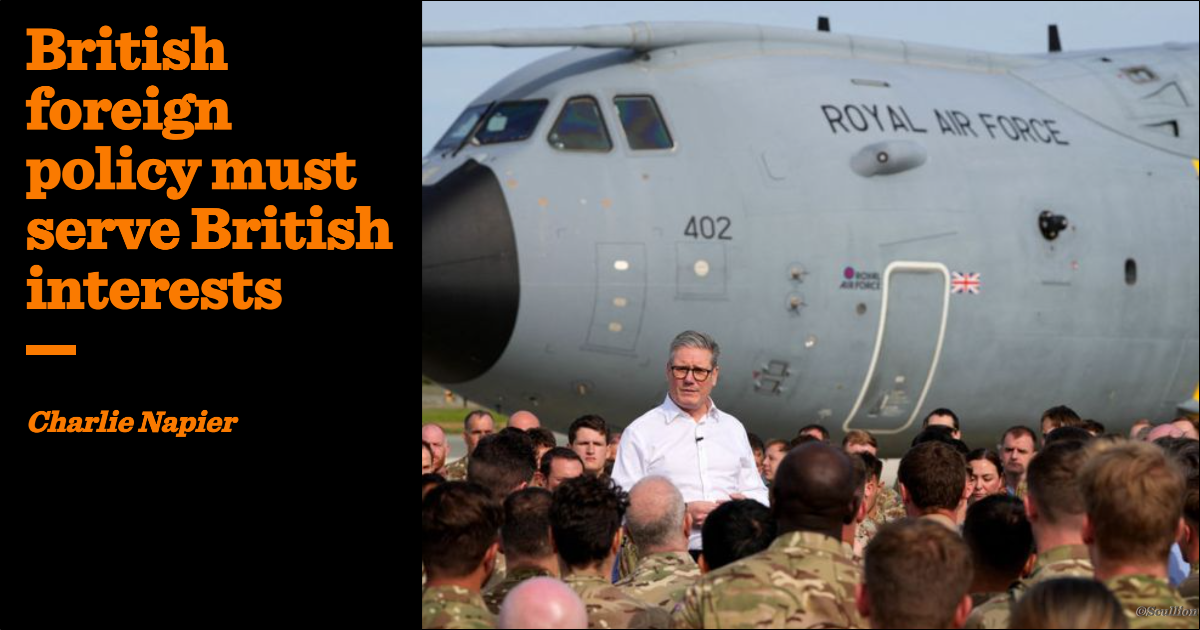
On the one side, Keir Starmer and his merry band of international lawyers. For the Prime Minister and his closest allies, the single most important question about this conflict is whether or not America’s actions comply with international law. All other questions — about self-interest, or the normative value of the intervention — are subjugated to this. This is nothing short of superstition — the notion that words-on-paper can, or should, govern the hard reality of physical force is plainly delusional.
Unfortunately, most of Starmer’s loudest critics have likewise fallen back on their own superstitions. For many on the British right, Starmer’s obsession with international law is only a problem insofar as it prevents us from rowing in behind America and Israel. While they may advance cogent criticisms of international law, they’re guilty of advocating for a kind of “international moralism”. Iran is a dictatorship, and it is therefore moral to overthrow the regime — or so the theory goes. This belief, in the absolute importance of installing liberal democracies around the globe, is its own form of superstition too.
There has been precious little space in the debate for those who recognise international law for the mirage that it is, while also believing that the only sensible basis for foreign policy is British self-interest.
The only question worth asking at a time of geopolitical crisis is this: what course of action best protects, or advances, Britain’s material self-interest?
As relates to the Middle East, our interests are fairly clear. We have a clear interest in ensuring that global energy prices remain low, for the sake of British consumers and British businesses. We have a clear interest in preventing the mass migration of people from the region into Europe, given the enormous problems that we have faced as a result of immigration from the third world. We have a clear interest in ensuring that British businesses, particularly British ships, can operate freely in the region.
We also have a clear interest in rooting out terrorist groups and criminal gangs which operate internationally. However, that work should always start at home first. Military action against another country is no substitute for a proper domestic counter-terror campaign. When we do take action abroad, we should only act on the basis of material links between foreign terror groups and domestic security threats — vague gestures in the direction of “global Islamic fundamentalism” will not do. If we’re asking British troops to risk their lives, the least that we can ask for is hard, material evidence that action abroad will make us safer at home.
Reasonable people will disagree about whether supporting America’s latest attacks on Iran further, or hinder, those interests. The problem is that, so often, these are not the terms on which the debate is had. Instead, we are forced to choose between two forms of superstition.
This failure to focus on material self-interest has real world consequences, as British personnel stationed at RAF Akrotiri will be able to attest. The base was struck by a drone earlier this week, meaning that service personnel and their families had to be evacuated.
Akrotiri, and its sister territory Dhekelia, are not merely “RAF bases in Cyprus”. They are British Sovereign Base Areas. These are overseas territories, in the same mould as Gibraltar, or the Falkland Islands. In other words, this is British territory, staffed and populated by British service personnel, often with their families.
The theory behind holding these territories is sound. It gives us a forward operating base in the Middle East, which we can use to protect crucial maritime trading lanes like the Red Sea. We can, if we choose to, allow allied countries to use the bases to conduct their own operations too, provided that we consider those operations to be in our own national interest. In return, we might be able to extract concessions, such as future use of their military bases.
This isn’t cost-free, of course. Even aside from the immediate financial cost, stationing troops in Akrotiri and Dhekelia puts them at greater risk than if they were stationed here in Great Britain. Whilst on the bases, service personnel and their families are within firing distance of numerous state and non-state actors in the Middle East.
Therefore, if we believe that maintaining control of Akrotiri and Dhekelia is in our national interest, then we must be willing to ensure that troops are adequately protected while stationed there, and that the bases are used for military action which is genuinely constructive for this country. This is so obvious that it shouldn’t even need to be said.
Right now, remarkably, neither test is being met. The drone attack on Akrotiri exposed that, in fact, thousands of British citizens — service personnel and their families — are left unprotected while staying at the base. We simply do not have the capacity to both defend British troops in Akrotiri, and defend Great Britain. This is a disgraceful derogation of duty.
We cannot defend our own interests, because most of our leaders cannot even articulate what they might be
At the same time, the base has been used, repeatedly, for operations which are plainly irrelevant to our national interest. In 2011, RAF Akrotiri was used as a staging base for NATO-led military intervention in Libya, which toppled Gaddafi and exacerbated the European migrant crisis. When Sudan fell to pieces in 2023, Akrotiri was used to evacuate refugees. Since Hamas’ October 7th attack on Israel, Akrotiri has been used to support the Israeli campaign in Gaza, with no clear articulation of why supporting the Israelis is in our national interest.
The attack on Akrotiri is a reminder that, until we can defend our immediate interests, both intellectually and physically, there’s no point quibbling over high-minded principles or great power politics. The British state, and particularly the British military, have been hollowed out and rendered impotent for decades now. In some cases, this has been the result of near-criminal negligence. In other cases, this has been the result of deliberate ideology. The net result is the same — we cannot defend our own interests, because most of our leaders cannot even articulate what they might be.