The Iran war is still widening. Yet no matter how and when it ends, one thing has become clear during its first tumultuous days: the emergence of Israel as a regional superpower intent on redrawing the politics – and the map – of a transformed Middle East.
Israeli Prime Minister Benjamin Netanyahu’s confidence in being able to do so rests not only on Israel’s own military, technological, and intelligence edge over its neighbors.
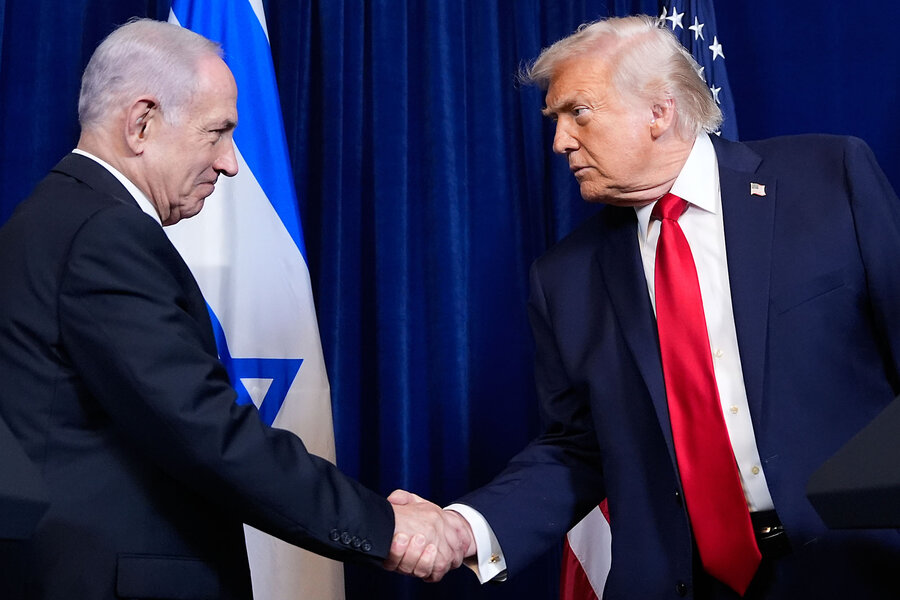
It’s because of another transformation: President Donald Trump’s break with previous administrations’ efforts to influence and sometimes restrain Israeli policy, and his elevation of the United States’ security alliance with Israel into something far closer to a full military partnership.
Why We Wrote This
U.S. and Israeli airstrikes on Iran have turned into a broader regional conflict that will change the political dynamics of the Middle East. But who drove the decision to attack – and what the vision is for a postwar Middle East – remains unclear.
The depth of that partnership was underscored by the opening strike in the war on Iran: the joint Israeli-U.S. attack on Tehran on Saturday that killed Iranian leader Ayatollah Ali Khamenei. In fact, Secretary of State Marco Rubio suggested this week that the timing of the war had been dictated by Israel, which he said had decided to attack Iran on its own.
Still, just as the war has drawn in other countries, Mr. Netanyahu’s vision of a postwar Middle East could face obstacles once the bombs and missiles finally fall silent.
His vision is clear. Presiding over the most right-wing government in Israel’s history, he has extended his country’s “security” borders in recent months by taking control of an area inside Syria and reinforcing Israel’s hold on Gaza.
This week, he moved to reassert military control over parts of southern Lebanon in response to missile fire from Iranian-allied Hezbollah.
The prime minister is also determined to quash any possibility of a Palestinian state, and to push ahead with the de facto annexation of the West Bank as a permanent part of Israel.

And he envisages that key Arab Gulf states, above all Saudi Arabia, will move quickly to establish normal ties with Israel once the war has unrecognizably weakened Iran.
There are potential obstacles, however.
One example: Saudi Arabia and the other Arab oil states in the Gulf region.
Their leaders had urged Mr. Trump to seek a negotiated deal with Tehran and to avoid war – fearing, rightly as it has turned out, that Iran would respond by firing missiles and drones not just at Israel, but at their countries, too.
They’re deeply uncomfortable with the prospect of Israel exercising unfettered regional dominance. That’s especially so after the devastation in Gaza caused by Israel’s response to Hamas’s cross-border killing and abduction of hundreds of civilians in October 2023, as well as Mr. Netanyahu’s ruling out the idea of a two-state peace with the Palestinians.
And while the Gulf states are no match for Israel militarily, they can make their voices heard. They have political, military and – above all – economic ties of their own with Washington.
The key imponderable, however, might be Mr. Trump himself.
The U.S.-Israeli alliance has a long history, underpinned by ties between the countries’ military and security sectors, and, since the late 1970s, by nearly $4 billion in annual U.S. aid.
Yet the unprecedented level of support and partnership in the past year has been rooted in the relationship between Mr. Netanyahu and Mr. Trump. They’ve bonded politically over a shared, strongman approach to domestic politics and a muscular, “great power” view of the world.
The administration’s recent National Defense Strategy called Israel a “model ally.” It had proved “able and willing to defend” itself and needed to be empowered, not reined in.
But, especially with the Iran war expanding unpredictably, Mr. Netanyahu’s ability to set the terms for a postwar Middle East could stumble if his political interests and those of Mr. Trump diverge.
Both leaders face electoral tests in the coming months: the U.S. midterms and an Israeli parliamentary election that will determine whether Mr. Netanyahu remains in office.
No matter how the war ends, the Israeli leader can claim to have vindicated his decades-old insistence on the need to confront the theocratic regime in Tehran. He has also secured the greatest level of support from Israel’s critical ally, the U.S., in the history of the alliance.
That’s a political windfall. He hopes it will cancel out many voters’ anger at his government’s inability to foresee, prevent, or quickly respond to the Hamas attack of 2 1/2 years ago.
Mr. Trump’s calculus, however, could depend on the course of the conflict with Iran – especially if market turbulence and rises in oil and gas prices persist, there’s no political exit ramp in sight, and his political opponents raise the specter of a “forever war.”
He might then disengage, or pivot to the more politically palatable endgame both he and Mr. Netanyahu cited at the start of hostilities: a wider regional peace.
That would mean moving ahead on the stalled implementation of his 20-point plan for the reconstruction of Gaza. And it could mean the expansion of the main foreign policy achievement of Mr. Trump’s first term, the Abraham Accords normalization agreement between Israel and several Arab states.
The problem for Mr. Netanyahu?
Both initiatives would require buy-in from the most influential Arab Gulf state: Saudi Arabia.
And the Saudis seem certain to insist, at a bare minimum, on Mr. Netanyahu’s commitment to keep open the path to an eventual two-state peace between Israel and the Palestinians.
And that could pit President Trump’s Middle East vision against that of his model ally.