SUVs are the most popular type of vehicle in Britain, with new models outselling traditional hatchback and saloon cars for the last two years.
But one in three people believe they are more dangerous to pedestrians and cyclists than smaller vehicles, according to the latest research by a road safety charity.
IAM RoadSmart polled 1,048 UK motorists and found that a fifth would support a ban on SUVs entering city centres, such is the perceived threat these larger motors pose to vulnerable road users.
Market analysis shows that more than half of all models in UK car showrooms today are either SUV or jacked-up crossover cars, with almost 200 different options to pick from in dealers.
Their growing popularity and availability is why the average width of new cars sold in Britain increases, on average, by a centimetre every two years.
One think tank is calling for SUVs to be stung with a ‘large vehicle tax’ to encourage car buyers to consider smaller vehicle options that are likely to cause less harm to pedestrians in collisions.
And it says funds raised from the levy should be pumped into a ‘social leasing’ scheme that offers to subsidise the cost of running a new electric vehicle for low-income families.
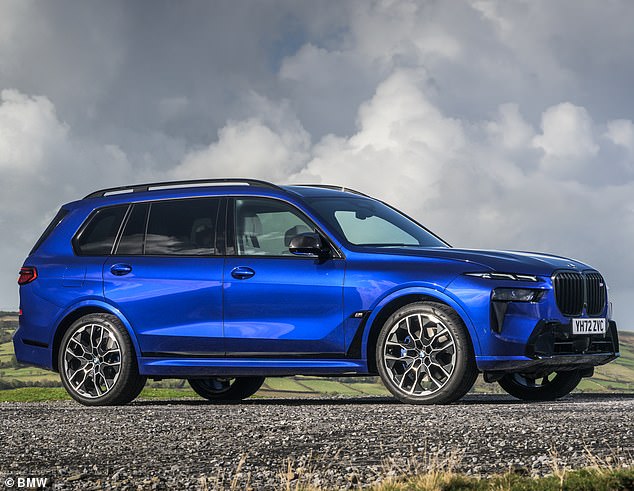
One in three UK drivers say SUVs are more dangerous to pedestrians than conventional hatchback and saloon cars. Campaigners want them to be hit with a ‘large vehicle tax’
IAM RoadSmart’s study comes in the wake of some of the world’s largest SUV models becoming available to UK drivers for the first time.
A partnership between GM Speciality Vehicles and London-based motor dealer Clive Sutton announced this month allows Britons to order a selection of luxury General Motors SUV models exclusively sold in North America.
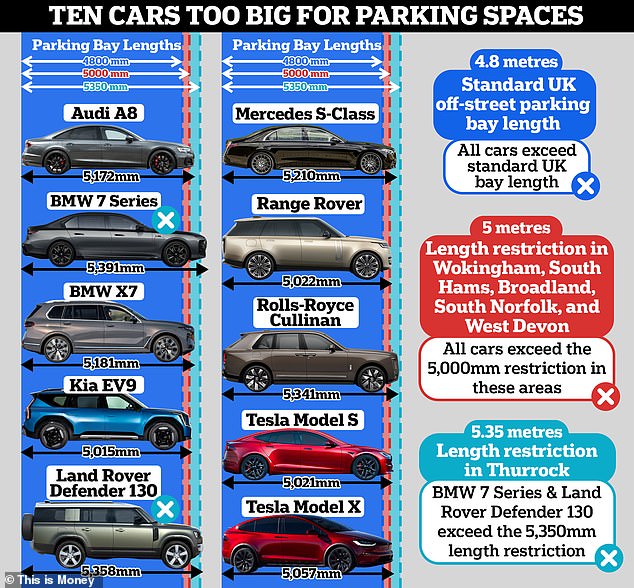
It provides access to cars like the Cadillac Escalade and GMC Yukon, variants of which are almost six metres in length making them more than a metre longer than a conventional car park space. Some weigh almost 2.8 tonnes.
Nicholas Lyes, policy and standards director at the road safety charity, said: ‘Huge cars were once associated with the USA, but car spreading is alive and well in the UK.
‘Many drivers will have noticed that fitting a car into a space has become tighter compared to 20 years ago and may also hold their breath if they see a large oncoming SUV on a narrow country road.
‘Despite the fact that these cars are growing, both in size and popularity, our roads and parking spaces are not significantly wider, and something needs to give.’
While the growth of the SUV market – which now account for more than a third of new vehicle registrations – has been blamed for a surge in ‘car spreading’ in recent years, motors of all body shapes have increased in dimension to meet stricter safety regulations and in the pursuit of better crash protection.
Studies conducted in 2024 show that more than half of motors in showrooms are wider than a standard 180cm on-street parking bay, with the average new model 180.3cm from door to door.
But Transport & Environment, which carried out the research, fired a broadside at a breed it dubs ‘mega SUVs’, which are 200cm wide on average, or 220cm inclusive of their door mirrors.
The Brussels based green campaign group says these SUVs are a ‘clear and growing threat to public safety’.
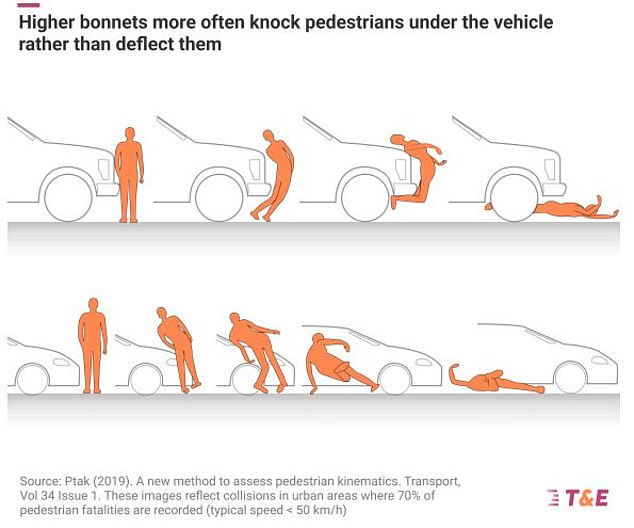
A recent report claimed SUVs significantly increases the death rate when pedestrians are struck as they are more likely to be pulled under a moving vehicle rather than bounce off them
According to an Imperial College London study – which analysed over 680,000 accidents from across the last 35 years – pedestrians are 44 per cent more likely to be fatally injured if hit by an SUV compared with a ‘regular’ car. For children and cyclists, the likelihood increases to 82 per cent.
This is because vulnerable road users are at greater risk of being dragged under an SUV rather than deflect off the bonnet, the latter of which is more likely to occur with conventional hatchback and saloon models that are closer to the ground with smaller grilles.
‘With demand for bigger cars showing no sign of abating, we believe improvements to vehicle design such as mandating bumpers and hoods from materials that reduce injury severity, and pedestrian automatic emergency breaking,’ Lyes said.
‘External airbags should also be explored to mitigate against the size and weight of the vehicle.’
Should SUVs be taxed more?
The IAM RoadSmart study also found that many Britons would support restrictions being placed on SUVs in areas with greater footfall, such as the shopping districts of city centres.
While no UK council is yet to ban SUVs, some have started to introduce increased parking fees.
Cardiff has approved the principle of an additional charge for residential parking permits for vehicles weighing over 2.4 tonnes, while some local authorities have also banned motors over 5 metres in length from using council-operated car parks.
In 2024, Paris tripled its parking charges for heavier cars after the mayor argued that SUVs are dangerous and bad for the environment.
‘While cities may opt for charges or hiking parking fees to discourage use, our view is that safer vehicle design and enhanced driver education can make the biggest difference,’ Lyes explained.
But T&E wants to go a step further, calling for the introduction of a ‘large vehicle levy’.
This would be a unique annual tax on SUVs on top of vehicle excise duty, which the groups says would discourage ownership of bigger motors.
And it has urged the Government to use funds generated by the tax to bankroll a social leasing EV scheme for low-income households.
Citing studies that suggest low earners are being priced out of EV ownership, T&E said this not only creates a class divide for battery-powered cars but is driving the slowdown in EV sales.
Registrations data shows that appetite for electric cars in Britain is waning, with sales only growing by one per cent in January.
The think tank says demand will increase if new EVs are made more affordable to low earners as it could lower the price of a new model to as little as £77 per month.
A scan of current leasing deals available shows the cheapest starting from £130-a-month for small models like the Leapmotor T03. For something that resembles a family-sized car, prices start from £144 for a Vauxhall Frontera Electric.
These costs are significantly higher than what the lowest earners in the UK typically spend, which T&E says is under £100 a month on car purchases or leasing.
By offering eight-year social leases backed by funds raised from an SUV tax and surplus cash from the Electric Car Grant scheme, monthly costs could be slashed as low as £77.
T&E says this would ‘bridge the gap’ and ‘unlock the cheaper running costs of EVs for families with less disposable income, helping to cut bills and tackle inequality’.
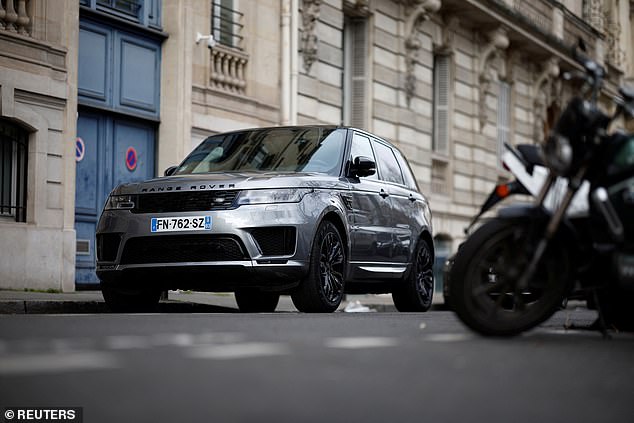
Parisians voted in 2024 to muscle SUVs off the French capital’s streets by making them three times more expensive to park, and called on London to follow suit
A similar social leasing initiative launched in France in December 2023 and proved overwhelmingly popular.
It generated 90,000 applications for just 25,000 spots in the first month and a half it became available.
‘Social leasing is the perfect next step for the UK’s EV transition,’ explains Eloise Sacares, senior researcher in UK vehicles policy at T&E UK.
‘We need to ensure that those on low incomes who need a car can access an affordable EV.
‘By bringing leasing costs down to as low as £77 a month, we can ensure that EVs are accessible and reduce bills for all.’
She added: ‘The best thing about social leasing for electric vehicles is that it can be sustainably funded by a new large vehicle levy on SUVs.
‘This could fund 179,000 households a year to take part in the scheme all the while reducing air pollution, and household bills.’