When it comes to Iran, the Conservative Shadow Cabinet are donkeys led by a donkey

It’s a little-known fact about Kemi Badenoch that years ago she must have suffered a traumatic brain injury that has left her completely unable to recall any event after 2002. That may sound ridiculous, but once you know it, it explains an awful lot about British politics.
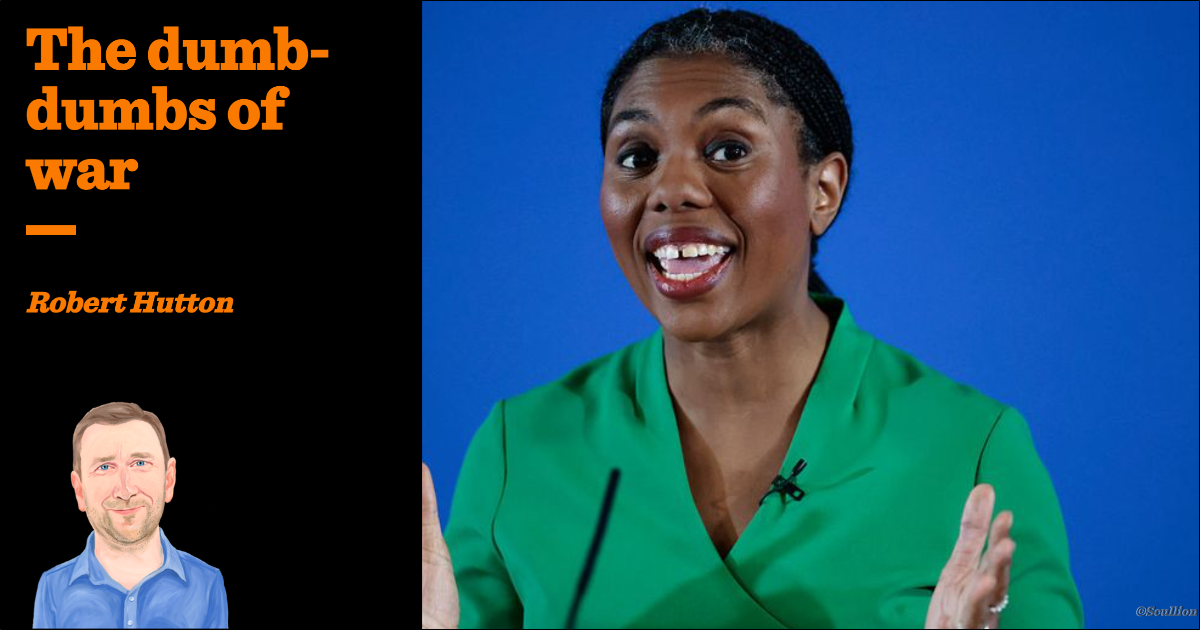
Take, for instance, Wednesday’s Prime Minister’s Questions. The Tory leader demanded to know why Britain wasn’t joining the Americans in attacking Iran. That’s a brilliant question if, like Badenoch — and apparently her entire team — you have absolutely no knowledge of “UK Involvement With Events in the Middle East: 2003 to Present Day”. Otherwise, even the most slow-witted MP would get a pretty handy clue from the first three letters of the target country’s name.
Keir Starmer was at his most headmaster-running-out-of-patience. “This is obviously an extremely serious situation, and I know the whole country is worried about the potential for escalation.” Well, not the whole country. Opposite him were a couple of hundred people who seemed pretty excited at the idea of a bit of escalation. James Cartlidge, who according to Google is the Shadow Defence Secretary, was anxiously explaining something to Badenoch. Possibly why the speed of a Mark XI Spitfire in a dive meant it would definitely be able to shoot down a drone.
“Nobody wants to see an escalation,” the Tory leader replied, before then demanding Britain escalate things. “What is the prime minister waiting for?”
Does this seem odd? Why was Badenoch taking a position that every poll shows the British public opposes? Part of the answer, of course, is that her brain injury has left her sadly unable to read polls (this also explains her irrepressible belief that she is succeeding). The other reason is that the Conservative party has taken a long, cool look at the people running the US operation and concluded: “These guys definitely have a plan that will work, and handcuffing ourselves to them will pay off when it does.” There turn out to be a lot of head injuries going around.
As Badenoch became more furious, Starmer grew ever icier. He explained at length that Britain had, for some time, been moving jets and counter-drone systems into the region. The Conservative leader wanted to know why we weren’t spending more on defence. Was she recently a member of a government that was spending even less? Hard to say. Head injury, you see.
“I’m not going to take lectures on defence from the party opposite,” the prime minister replied, and the Tory benches erupted in fury. Cartlidge angrily grabbed his lapel and pointed vigorously to the UK-Ukraine flag pin he has there. You want to talk about defence spending, Sir Keir? Do you know what a lapel pin costs these days?
The prime minister read out a long list of the return flights that have been arranged for people stranded in the Middle East. Good news for them, and good news for the taxman.
Badenoch explained that the reason the Royal Navy doesn’t have enough ships to send to the Middle East is because Labour is spending so much on welfare. Is that really the reason? Fortunately, no one knows how long it takes to build a warship, so her apparent belief that one can be knocked together over the weekend is probably right.
The Tory leader was getting quite a lot of barracking from Labour MPs by this point, and she waved dismissively at them “He’s got a sea of orcs and goons.” This was greeted by a mix of outrage and bafflement. Orcs? Goons? Was she referring to Tolkien or Spike Milligan or to some imaginary world only she knows about where the invasion of Iraq was a terrific success? I’ll just note that one symptom of a head injury is uttering apparently random words.
Lindsay Hoyle, the Speaker, rose to try to calm the chamber, and when he sat, Starmer and Badenoch both stood at once: the prime minister hadn’t realised that she hadn’t finished her question. For a moment, they faced off across the despatch boxes, and then Starmer realised his mistake and sat, laughing happily.
I was suddenly struck by the strangeness of the session. Politically, Labour is in a terrible place. Last week the party was knocked into a poor third place in a by-election in a seat it’s held for decades. Events in the Middle East are about to push everyone’s energy bills through the roof. The prime minister himself is epically unpopular. His big foreign policy goal, to stay aligned with Donald Trump come what may, is in tatters. Looking at the Labour benches, happily pointing at the Conservatives, you would have known none of this. Perhaps they all hit their heads over the weekend too.
There is a madness on much of the right in British politics
Or perhaps they see a way through. Gareth Bacon, the Tory MP for Orpington, stood. “The USA is our most important international strategic ally,” he began. “Does the prime minister believe that his dithering and equivocal response to events in the Middle East this week has made that relationship stronger or weaker?”
There it was. There is a madness on much of the right in British politics, where people are unable to grasp that Donald Trump is Not Like Other Presidents. Has Bacon also suffered a brain injury, or has he simply not noticed anything that Trump has said or done over the past year? Allow me to explain: just because diplomacy means we’re not allowed to say out loud that Trump is mad, you shouldn’t actually behave as if he’s sane. The man is a random headline generator with nuclear weapons.
The prime minister’s response was measured but damning: “American planes are operating out of British bases. That is the special relationship in action. British jets are shooting down drones and missiles to protect American lives in the Middle East on our joint bases. That is the special relationship in action. Sharing intelligence every day to keep our people safe. That is the special relationship in action. Hanging onto President Trump’s latest words is not the special relationship.” A better opposition would have positioned itself to point out that “hanging onto President Trump’s latest words” was until recently Labour’s policy. Instead, they’d managed to make Starmer look like a statesman.
Afterwards, we learned that Chinese spies have been trying to get close to Labour MPs to try to understand the government’s policy-making process. Good luck with that one, lads.