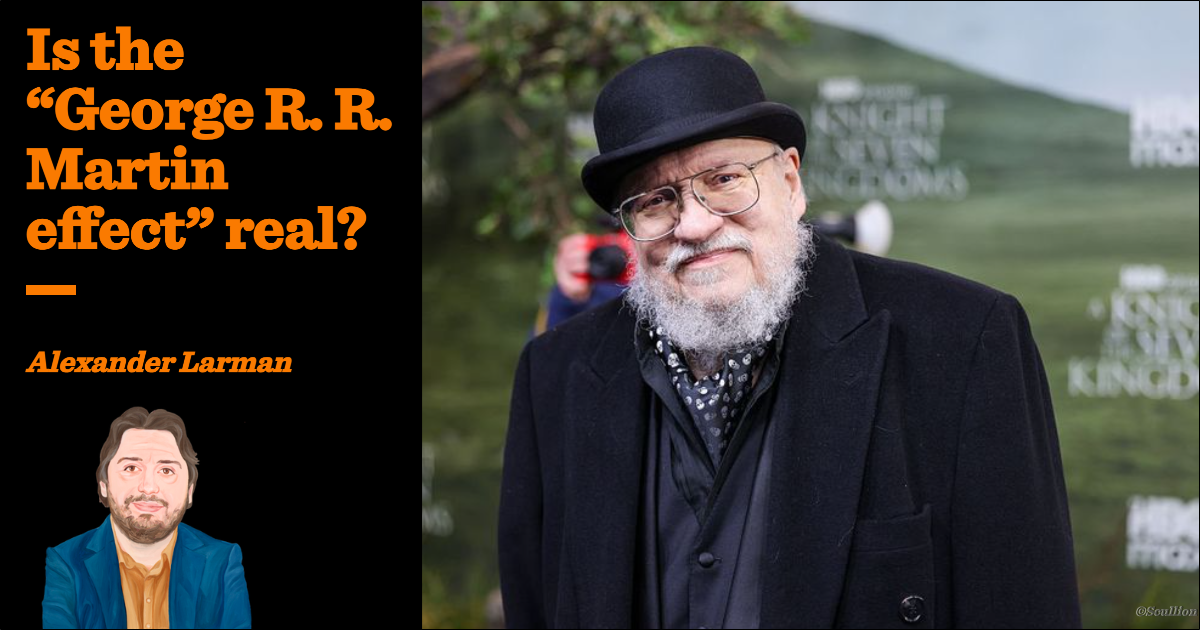

This summer, the RSC are staging another sweeping historical epic full of betrayal, jockeying for royal position and, when required, bloodshed. But what is it this year? Richard III? Henry IV Parts 1 and 2? Not exactly. Instead, the august Royal Shakespeare Company have got in bed, figuratively speaking, with the American author George RR Martin, creator of the Game of Thrones series. They will be staging the premiere of Duncan Macmillan’s adaptation of Martin’s stories and characters — there is a certain vagueness about which piece of intellectual property, precisely, is being adapted — in the form of the cumbersomely entitled George R.R. Martin’s Game of Thrones: The Mad King.
Those who are Martin or Thrones obsessives will be rubbing their hands together in excitement at the prospect of the show, which will be directed by Dominic Cooke and promises that it will be a prequel to the main events of the novels. Those who are aficionados of the RSC will be hoping for the best, naturally, but it is hard not to feel a slight weariness at the prospect of how audiences will “come face to face with familiar characters from the houses Targaryen, Stark, Lannister, Baratheon and Martell and witness the events that set the stage for the world’s most critically acclaimed series.”
Of course, there have been many successful literary adaptations on stage in recent years; the RSC’s Wolf Hall trilogy, based on the acclaimed novels by Hilary Mantel, were not only critically acclaimed, award-winning shows but also went on to be considerable box office hits. And the company’s recent play based on John Galsworthy’s warhorse The Forsyte Saga elegantly proved that a novel that many would regard as old hat can be sympathetically and ably adapted and become electrifying, fascinating theatre that offers a wholly new perspective on the original book.
Yet for every conspicuous success, there is another equally conspicuous flop. Not only was a Lord of the Rings musical one of the most notorious failures ever seen in London when it was first staged in 2006, but last year’s Conor McPherson-scripted theatrical version of The Hunger Games met with an underwhelming response, despite or perhaps because of its attempts to capture the literary and cinematic sparkle of Suzanne Collins’s original series. It is extraordinarily hard to recreate a big blockbuster show on stage, even if you bring in all the video projections and pre-recorded epic music in the world, and so while I wish Messrs Martin, Cooke and Macmillan all the best of luck with The Mad King — as it will undoubtedly be called — my optimism must come tempered with a certain degree of apprehension.
And part of this apprehension stems through the way in which Martin is clearly regarded by everyone from television producers to the RSC’s artistic directors as the figurative golden goose, with his Game of Thrones series puffed up as “the world’s most critically acclaimed series”. Well, that’s one way of describing it. Yet it is also true that the television adaptation of the books, which was mainly phenomenally successful, also muffed it at the conclusion by rushing through a perfunctory and disappointing final series that failed to do justice both to its indelible characters and to the world that Martin had created. There have been spin-offs, in the form of House of the Dragon and the recent A Knight of the Seven Kingdoms, and while both have enormous popularity, neither has captured the zeitgeist in quite the same way that the original show managed. It remains to be seen whether The Mad King can find its own theatrical purpose or if it instead seems like another attempt to cash in on the original brand.
Martin is, of course, big business. One of the major changes in the publisher the Folio Society came when they abandoned their previous apparently elitist policy of producing beautiful editions of conventionally literary books and instead issuing pricey versions of the Game of Thrones series, in the (correct) expectation that the fanbase would happily lap them up, in a way that they might have been cooler about, say, a new edition of Vanity Fair — unless, of course, Martin had been prevailed upon to add a new introduction and thereby give the novel his imprimatur.
Martin has been candid about his struggles with writers’ block and his inability to turn a vast, sprawling manuscript … into a coherent novel
Yet the author is currently occupied with the long-gestating Game of Thrones novel The Winds of Winter, which may or may not appear this year, or next year, or any time in the future. After that, there is another planned book, The Dream of Spring, which will theoretically conclude the series, hopefully in a rather different and more satisfying form than the television adaptation managed. However, Martin has been candid about his struggles with writers’ block and his inability to turn a vast, sprawling manuscript, said to be around 1500 pages and counting, into a coherent novel. Some admirers are gloomily wondering whether the now 77-year-old author will ever manage to finish the Song of Ice and Fire series that he began to such acclaim in the Nineties, or if it will end up being taken on by other hands after his death.
In any case, The Mad King will be lapped up by those who have been hoping for The Winds of Winter, and the combination of the estimable Macmillan and Cooke — as well, presumably, as a distinguished cast of RSC stalwarts — will ensure that the box office is extremely healthy. But I cannot help but wonder about whether the current belief that anything with the brand name George R.R. Martin and Game of Thrones on it is a licence to print money will endure, or if the lingering taint of the disastrous final television series and the non-appearance of the concluding novels will make all but the most obsessive fans wonder if there is just the whiff of the emperor’s new clothes to this one, too.