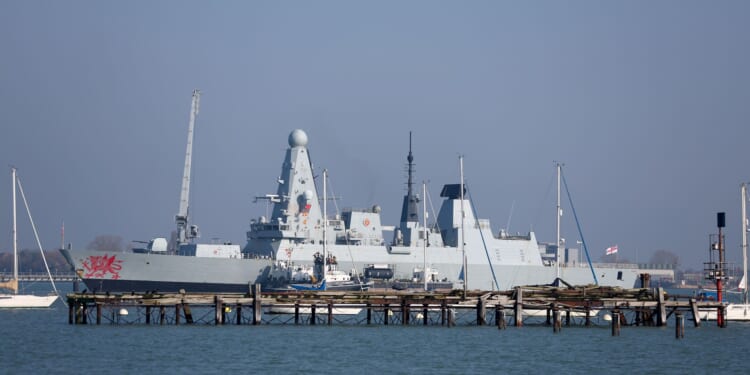
Lost in the noise of the broadening regional war sparked by the U.S.-Israeli attack on Iran was a historic turning point: Qatar shot down two Iranian jets approaching its territory.
The Monday action, the first time an Arab state militarily clashed with Iran, carried a message: Under siege, once-passive Gulf Arab states are striking back.
In less than 72 hours of this new war, the Gulf states have been transformed, evolving from dependents on American security that were pushing for peace to wartime ralliers actively fighting to defend their countries.
Why We Wrote This
Gulf Arab states lobbied hard for the United States to engage in talks with Iran. Yet in the war, 1,800 Iranian missiles and drones have been intercepted in Gulf airspace, with hundreds breaking through. The Gulf is being transformed by conflict. Will that last?
The Gulf states still hold out hope that diplomacy can end the conflict.
Until then, however, they are showing willingness to do whatever it takes, even increasingly offensive action, to protect their citizens, residents, and economies. In so doing, they are changing the way they view themselves and their relationship with the United States.
If the conversion from mediator to soldier was quick, the trajectory was long and the red lines were many.
In January, Gulf states urged U.S. President Donald Trump to engage in talks with Tehran and aggressively lobbied against war.
They denied the U.S. permission to use their airspace and territories to launch attacks on Iran, in the thinking they would be spared the worst of Iran’s retaliation.
Even as their capitals came under attack from Iran on the first day of the war on Saturday, Gulf states cautiously insisted on diplomacy to swiftly end the conflict.
Inflection point
But in the following two days, Iran stepped up its attacks on airports, seaports, embassies, hotels, residential high-rises, AI data centers, and, most importantly, Gulf gas fields and oil refineries, pushing the states to act.
In less than five days, around 1,800 Iranian missiles and drones have been intercepted in Gulf airspace, with hundreds breaking through.

The United Arab Emirates alone has been hit by more than 1,000 Iranian missiles and drones.
“Iranians are making it more difficult for Gulf states to stay neutral,” Hasan Alhasan, senior fellow for Middle East policy at the International Institute for Strategic Studies, says from Bahrain.
For Saudi Arabia, attacks on the U.S. Embassy in Riyadh, Riyadh International Airport, and Aramco oil refineries were three critical red lines, reportedly prompting Crown Prince Mohammed bin Salman to instruct his military to directly engage the Iranians.
The Saudi government did not respond to repeated requests for an official comment.
Qatar, the world’s No. 2 liquefied natural gas producer, which tirelessly mediated the Israel-Hamas war in Gaza and was a frequent diplomatic go-between for Tehran and Washington, had its own red lines. They included the targeting of residential areas in Doha, the grounding of Qatar Airways, and attacks on its LNG terminals that pushed its production offline, spurring a spike in global energy prices.
Majed al-Ansari, the Qatari Foreign Ministry spokesperson who in December described to the Monitor how mediating and peace-brokering was tied to the tiny country’s identity and security, publicly warned Iran of this reluctant shift toward military action.
“We decided to opt for peace because there was a chance for peace at the time, but this cannot happen every time,” Mr. Ansari told CNN in an interview Monday. “This cannot go unanswered; a price has to be paid for this attack on our people.”
No more good neighbors
The attacks have torn up five years of rapprochement and cooperation between the Gulf Arab states and Iran, onetime heated rivals that had frequently competed for regional influence.
The neighborly ties were built on the idea that the Gulf and Iran could not only coexist and cooperate, but also tie their prosperity and security to each other, ending a rivalry that was destabilizing Syria, Lebanon, and Iraq.

Iran’s retaliation “confirms the narrative of those who see Iran as the region’s primary source of danger and its missile program a permanent cause of instability,” said Anwar Gargash, adviser to UAE President Mohammed bin Zayed, in a post on the social platform X. Mr. Gargash, an architect of the Gulf-Iran rapprochement, also warned of “damage that extends beyond the war in our relationship with Iran.”
The conflict is particularly stinging for Saudi Arabia, which went to great lengths to understand Iran’s psychology and threat perception in regard to Gulf states’ hosting of U.S. troops, and which tried to accommodate Tehran, observers and insiders say.
“Now there is a sentiment in Saudi: ‘We invested in Iran; we defended Iran enough for them not to do this. And for them to strike us, there is a feeling that all this was a waste of time,’” says Aziz Alghashian, a Saudi researcher and fellow at the Gulf International Forum.
The attacks against the states that weeks ago were advocating for peace, and against neutral Oman, which brokered U.S.-Iran talks to avert the war, are likely to have a long-term impact on how Gulf states view diplomacy.
“I think one of the clear lessons to be drawn here in not just this conflict, but Israel’s targeting of Qatar [in a 2025 strike on a Hamas negotiating team] is that mediation brings no protection,” says Dr. Alhasan, the International Institute for Strategic Studies analyst. “Mediation offers no immunity.”
Military options
While there has been some American and, as of Wednesday, French assistance in defending Gulf skies, most Iranian drones, missiles, and jets are being taken down by local Gulf missile defenses and air forces.
Now, the Gulf states are considering more offensive options.
First is what is being billed by Gulf officials and observers as “forward defense” or “offensive defense.” That is the mobilizing of jets and military assets at their borders and near infrastructure to not only shoot down incoming rockets, but also strike Iranian jets that approach their territory, as Qatar did this week.
Another scenario Gulf states are discussing is opening up their airspace and territories for U.S. military operations against Iran, making such operations more efficient.
“There are other options that come with risks, difficulties, and merits,” says Dr. Alhasan.
“One would be for the Gulf to take part in preemptive strikes on Iranian missile launchers pointing in our direction,” he says. “A more extreme option is fully joining the U.S. in this campaign.”

2026 Planet Labs PBC/Reuters
Axios reported Tuesday that the UAE was preparing to conduct bombing runs on Iranian missile launchers, an option that one Gulf official who requested anonymity says was “still under serious consideration” as of Wednesday.
In a statement late Tuesday, the UAE Foreign Ministry denied such a decision had been made. Also late Tuesday, the ministry said, “The UAE reiterates that it is not a party to this war and has not permitted the use of its territory, territorial waters, or airspace for any attack against Iran,” but “retains its legitimate right to self-defense.”
The risks of joining war
For Gulf states, taking the fight to Iran remains complicated and fraught with risks.
“If the Gulf states join this war, they risk joining a war they did not start and did not want, whose direction and cadence is being led by the U.S. and Israel, and that they cannot control,” says Dr. Alhasan.
“Without a clear mission and goals, Gulf states risk being drawn into an open-ended confrontation that [is] … literally right next door.”
Then there is the role of Israel and its right-wing Prime Minister Benjamin Netanyahu, who Gulf states say is carrying out simultaneously a genocide in Gaza and destabilizing military actions across the region that have now plunged their countries into war.
Saudi Arabia, which is pressuring Israel for concessions on Palestinian statehood, does not want to appear as if it is coordinating or fighting alongside Israel and remains wary of Israeli military dominance in the region.
“Using any outright offensive measures would allow Israel to say, ‘Finally, Americans, Saudis, and Israelis are fighting side by side against Iran’ – the whole basis of their normalization drive in the first place,” says Mr. Alghashian.
“We need to be careful not to set precedents that will be difficult to undo in the day after of the war,” he says.
This has left Gulf states attempting to strike a delicate balance: mobilize enough forces in their skies to act as a deterrent, but for now, avoid being seen as joining America’s and Israel’s war.
“There are off ramps available,” Omani Foreign Minister Badr al-Busaidi said in a statement on X Tuesday, calling for regional diplomacy. “Let’s use them.”