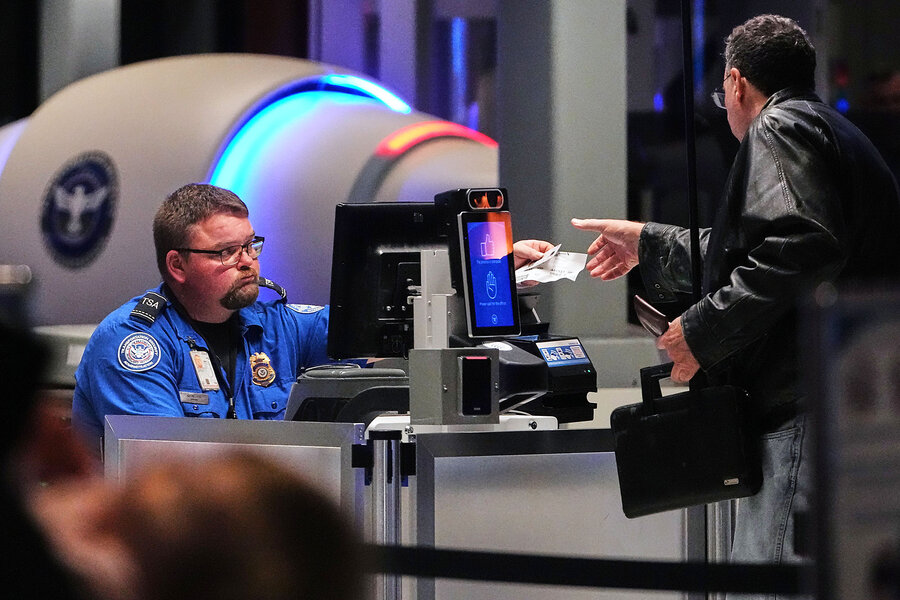
Just as the FBI and Department of Homeland Security are bracing for possible terrorist attacks on the United States, federal security officers at the nation’s airports are working without pay. Again.
The shutdown of DHS funding last month, because of an impasse in Congress over the Trump administration’s immigration policies, is beginning to take its toll on unrelated agencies within the sprawling department, including the nearly 65,000 employees of the Transportation Security Administration.
The result, experts say, might be increased national security risks for the country alongside paycheck woes for essential workers.
Why We Wrote This
In times of war, heightened security at home is fundamental. Yet, with a shutdown currently affecting the TSA, workers tasked with safeguarding air travel will be without pay – and perhaps staying home or seeking other jobs.
“When we have conflicts overseas, we see that the ramifications are that there are higher threats here at home as well,” Department of Homeland Security Kristi Noem said at a Senate Judiciary Committee hearing Tuesday. “I’m grateful for our TSA officers that are still showing up and doing their jobs.”
Sen. Jon Ossoff, of Georgia, the only Democratic senator up for re-election this year in a state won by President Donald Trump in 2024, also noted the importance of maintaining government services.
“We want to ensure that the agencies that protect the American people are funded,” he said. Congress can still fund DHS while imposing basic standards on immigration agents, and the Senate could vote to ensure that TSA personnel are paid while negotiations continue, he added.
Some Republicans in Congress are working on a plan to shift federal funding so that TSA workers are paid during this partial shutdown. Some Democrats have signaled they’re open to the idea. TSA workers will miss their first paycheck this week.
“The Department of Homeland Security needs to be operating at full capacity right now,” said Rep. August Pfluger, a Texas Republican, in a statement released on Tuesday, urging Congress to fund the department promptly.
Because 95% of TSA personnel are designated as “essential” employees, they have to work. But if last fall’s record-long federal shutdown is any example, the strain of no-paycheck labor will begin to reduce the number of employees who show up at the airports for work.

“AFGE members are tired of being forced on this roller coaster every time their elected officials fail to do their jobs,” Everett Kelley, president of the American Federation of Government Employees, said in a statement on Friday. The union represents TSA security officers, who screen an average of 2.5 million passengers a day at nearly 440 U.S. airports.
During last year’s 43-day government shutdown, some left. Others stayed home from work in increasingly greater numbers and scrambled to make ends meet.
“During a shutdown, the ability to pay for rent, bills, groceries, child care, and gas just to get to work becomes very challenging,” Ha Nguyen McNeill, the TSA’s acting administrator, told a House subcommittee last month. Absences doubled or tripled at some airports. Rising absences, in turn, “can result in longer wait times at checkpoints, leading to missed or delayed flights, which has a cascading negative impact on the American economy,” she said.
The last shutdown caused flight delays and cancellations, as well as long lines at airport security checkpoints, costing the travel industry more than $6 billion in permanent losses, according to the U.S. Travel Association. It also slowed the economy, though losses were largely made up in the months that followed when the government reopened, economists say. But some $7 billion to $14 billion in economic activity was permanently lost, estimated the Congressional Budget Office during the shutdown.
This time, the effect might prove more muted, analysts say, because other federal employees, such as air traffic controllers, will continue to be paid. Almost all of the controllers work for the Federal Aviation Administration, which is not subject to the DHS funding cutoff.
Also, some – but not all – TSA workers got a $10,000 bonus that DHS chief Kristi Noem awarded starting last November to those with “exemplary service” during the shutdown.
The Republican solution, reportedly floated by Senate Majority Leader John Thune of South Dakota and others, would shift some funding from border security and immigration enforcement (under last year’s One Big Beautiful Bill Act) to airport security. This would allow TSA workers to continue getting paid.
The prospect of long airport lines, not to mention the potential erosion of safeguards against terrorist attacks, is making politicians eager to find a solution.
Airline travel typically picks up in March as spring break season swings into action.
Staff writer Sophie Hills contributed to this report.