Household energy bills could rise by more than £500 in the summer if the Middle East crisis drags on, a think-tank has warned.
Gas prices have surged to a three-year-high and oil has shot up since the Iranian military threatened to blow up any vessels trying to pass through the Strait of Hormuz.
Iran continues to hold the world hostage by ‘closing’ the globe’s busiest oil shipping channel – where the Persian Gulf flows into the Arabian Sea – amid its escalating conflict with the US and Israel.
Last night Donald Trump said the US Navy will begin escorting tankers through the strait ‘if necessary’.
In an online post, he said: ‘No matter what, the United States will ensure the FREE FLOW of ENERGY to the WORLD. The United States’ ECONOMIC and MILITARY MIGHT is the GREATEST ON EARTH – More actions to come.’
But households could see more than £500 added to their energy bills this summer if the fighting continues for a prolonged period, according to the Resolution Foundation.
‘If overnight increases to oil and gas prices are sustained, we could see inflation back at 3 per cent by the summer with typical energy bills £500 higher,’ its chief executive Ruth Curtice warned.
‘Events in the Middle East have made support for families struggling with the cost of living more urgent.’
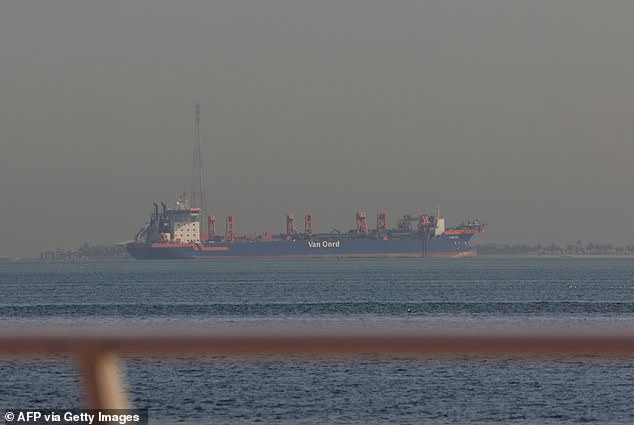
Iran has threatened to blow up oil tankers in the Strait of Hormuz (Pictured: An oil tanker offshore in Dubai on Sunday)
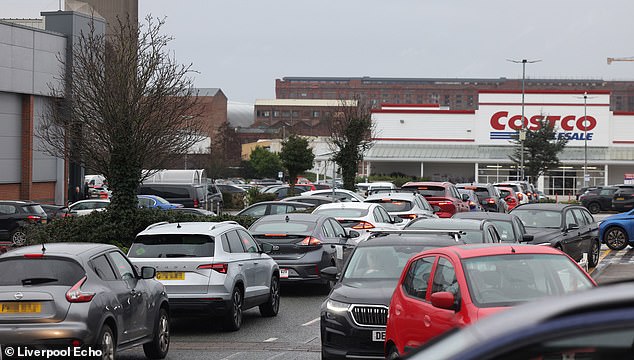
Pictured: Long queues for petrol at Costco in Liverpool as fears grew over oil prices following the attack on Iran
There are fears the conflict could have a similar impact to Russia’s invasion of Ukraine in February 2022.
The US yesterday warned of ‘imminent’ missile and drone attacks over the Saudi Arabian city of Dhahran where the country’s oil company Aramco is headquartered. ‘Do not come to the US consulate,’ a warning sent out read. ‘Take cover immediately in your residence on the lowest available floor and away from windows. Do not go outside.’
In Britain, motorists were urged not to panic-buy petrol amid fears the conflict could drive up costs.
Maritime activity in the Strait of Hormuz has been brought almost to a standstill, sending markets tumbling, as Iran continues to target Gulf countries including the UAE, Qatar and Bahrain.
There are large clusters of tankers, capable of carrying millions of barrels of oil, anchored on large ports on either side of the strait, ship tracking data showed.
Iran declared the channel – which is just 24 miles wide at its narrowest point – ‘closed’ and warned it would fire on any ship trying to pass through it.
‘If anyone tries to pass, the heroes of the Revolutionary Guards and the regular navy will set those ships ablaze,’ a senior official said.
Oil prices subsequently increased, with the global benchmark Brent crude hiking by more than 13 per cent to just over $85 (£64) a barrel, the highest level recorded since July 2024. Analysts said a prolonged conflict could see it hit $100 (£75).
It is estimated that a sustained rise in Brent to $100 could add up to 20p per litre to petrol and diesel within weeks.
UK gas prices surged by 46 per cent yesterday to over 165p a therm following the sharp rise seen on Monday, before falling to 146p in the afternoon.
The surge in gas prices came after QatarEnergy, one of the world’s biggest exporters, halted production following ‘military attacks’ on its facilities in Ras Laffan and Mesaieed.
The Financial Times reported that Iraq’s crude oil production was close to collapse as its biggest fields were shut down due to a lack of transport vessels and storage capacity.
Petrol stations in the UK appeared to be running out of fuel as Britons scrambled to fill up their vehicles before pump prices go up. Valero Garage in Beckenham, south London, ran out of petrol on Monday evening after dozens of locals rushed to fill their tanks up. A worker said some even arrived with petrol cans.
Signs reading ‘Sorry out of use’ were also spotted at the nearby BP fuel station in Croydon.
But drivers were urged to remain calm by the Petrol Retailers’ Association. ‘To ensure we have adequate supplies to go round, exercise restraint and buy normally,’ its chief executive Gordon Balmer told Sky News yesterday. ‘Rising fuel prices hurt the economy in the form of higher inflation, impacting already hard-pressed household budgets.’
The RAC said there shouldn’t be a ‘shock jump in prices at the pumps’ because it takes time for rising costs to show up in petrol prices.
It came as Chancellor Rachel Reeves was accused of ignoring support for drivers in her Spring Statement. ‘This was a missed economic growth opportunity for the Chancellor amid a new damaging oil crisis,’ FairFuelUK founder Howard Cox said.
‘With refineries, oil tankers, and the Strait of Hormuz being targeted, oil prices will continue to climb relentlessly. For over two decades, our clueless politicians have not planned to be self-sufficient in oil and gas production.
‘FairFuelUK continues to call on Rachel Reeves to cut fuel duty, but at the very least keep it frozen for the lifetime of this parliament.’