The Iranian university student had risked his life in protests in Tehran for regime change, so when news broke of the first waves of American and Israeli strikes in late February, he felt shock – and overwhelming disbelief.
“I was having breakfast and checking my phone without concentration. My eyes popped out when I saw news about the attack: That was it, the very moment I had been longing for,” recalls the civil engineering student. He gave the name Mohammad, a pseudonym, for security reasons.
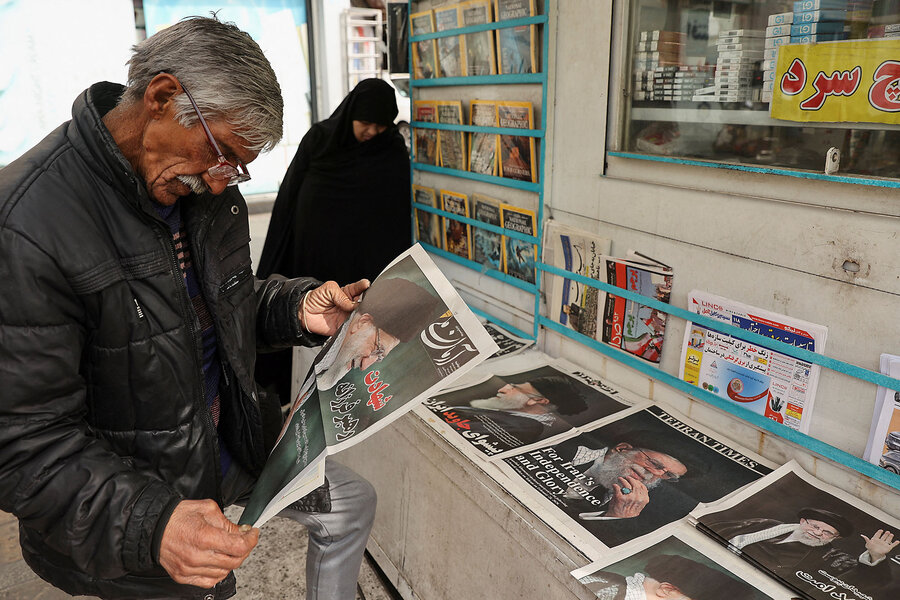
The death of Iran’s supreme leader, Ayatollah Ali Khamenei, in the first moments of the attack was an even greater shock. Not only to the majority of Iranians tired of the Islamic Republic’s smothering influence on their lives since 1979, but also to the vocal minority of Iranian loyalists who regarded Mr. Khamenei’s rule as divine.
Why We Wrote This
For many opponents of Iran’s regime, news of the supreme leader’s death at the start of the U.S.-Israeli war on Iran brought elation. But, says a Tehran student who risked his life in protests, there are concerns that the job of regime change is incomplete.
U.S. President Donald Trump and Israeli Prime Minister Benjamin Netanyahu have both cast their attack as paving the way for regime change, and – without providing how-to details – have called upon Iranians to topple their government. Iranian security forces, Mr. Trump said, should “lay down their arms” or “face certain death.”
Along with eliciting sheer joy from many Iranians, the assassination – accompanied by the continuing U.S.-Israeli air campaign – presents an especially risky moment for those on the ground, if such a key first step does not lead to regime collapse. Iran retaliated regionwide with hundreds of missiles and drones fired at Israel and Gulf Arab countries hosting U.S. bases and troops.
“My roommate and I were screaming in joy from our [east Tehran apartment] balcony when Trump officially confirmed [Mr. Khamenei’s] death,” says Mohammad. “The entire alleyway was blasting in excitement; all the neighbors were screaming from the bottom of their hearts. An incredible moment, one of those I will never forget.”
Protesters’ new calculations
The Monitor first spoke to Mohammad just days before the U.S.-Israeli strikes began. He described taking part in nationwide protests in January that were summarily crushed. The crackdown killed more than 7,000 people in two days (with nearly 12,000 more fatalities still under review, according to a detailed Human Rights Activists News Agency report) – a toll that included two of his friends.

Majid Asgaripour/WANA/Reuters
The tall, bespectacled student at Amirkabir University of Technology in Tehran was part of a daring renewal of protests on half a dozen campuses. The message they were sending was that “this regime cannot get away with its crimes,” he said in late February. Students aimed to “keep the momentum for its downfall,” so that security forces could not “breathe,” regroup, and “return with greater savagery.”
Now, the U.S.-Israeli attempt at regime decapitation has changed Iran’s trajectory – and altered the calculations for activists like Mohammad.
“I still feel like this is a dream. Who could believe his 37-year rule could be over in the blink of an eye?” says Mohammad, of the assassination of Mr. Khamenei.
“Of course, justice is not served, because I wanted … to see him on trial,” adds Mohammad. “But I’m not going to ruin the joy with idealistic imagination. The reality is that he is no more. All those families who lost their loved ones, especially in the recent massacres, when I think of them, I can’t help choking up. I hope Khamenei’s humiliating death can at least heal some of their wounds.”
Mr. Trump has framed the U.S.-Israeli strikes as dealing a blow to Iran’s nuclear program and missile arsenal, both of which were targeted during a 12-day Israel-Iran war last June that included U.S. strikes on deeply buried nuclear installations. This time, Mr. Trump has deployed a significant naval and air armada, built up around Iran for months.
“The hour of your freedom is at hand,” the American president told Iranians as the assault got underway. “When we are finished, take over your government. It will be yours to take. This will probably be your only chance for generations.”
Fearing “an unfinished job”
But the risk of failure to achieve such dramatic change tinges Mohammad’s joy with a deep concern.
“Without regime change, this will be an unfinished job, a horrifying nightmare,” he says. And he predicts despair “if there’s a ceasefire and the regime stays, one way or another. … I know many young people who believe this is the only and last chance.”

“We, the protesters, made it clear we want [the regime] gone – I mean kicked out in the most humiliating manner possible,” says Mohammad. He notes that even the uncertainty of war, the risk of collateral damage, and the lack of clarity about the day after are preferable to regime survival.
“Isn’t it ironic that we want war on our own country? Doesn’t it tell you about the level of our frustration?” asks Mohammad. “I personally believe marg yek baar, shivan yek baar, ‘either die once, or mourn once.’ We cannot suffer forever, so fleeting suffering in war is better than the destruction of another generation by allowing this regime to maintain control and ruin every single aspect of our lives.”
Many steps remain before such an outcome will be possible, not least requiring Iranians to get through the current air campaign. Mohammad says he helped his parents in their home village locate two weeks’ worth of provisions of emergency food and supplies.
But many other Iranians started with much less, a reminder that economic grievances triggered the January protests. Prices since then have tripled.
“I know many, many people who might have wanted to buy and store food for two weeks, but they couldn’t afford it,” he says.
“That only gets me back to the argument that this war is the last resort for survival for many Iranians,” says Mohammad. “It’s all about the tiniest remaining hope, which we cannot afford to see dashed again.”
An Iranian researcher contributed to this report.