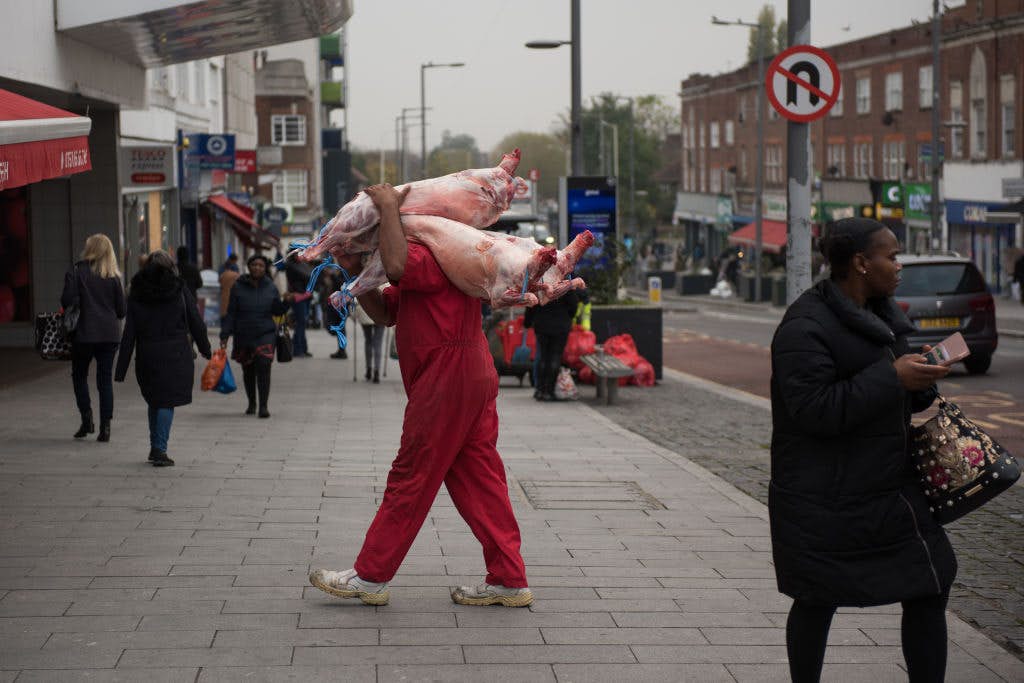
There has been a wave of heated discussion around halal and kosher meat since Rupert Lowe MP launched Restore Britain as a national political party and announced that he would ban halal and kosher slaughter. Good — a ban is well justified. Since Lowe’s announcement, we have seen other MPs spring into action. This week, the Conservative MP Esther McVey introduced a Ten Minute Rule Bill for the compulsory labelling of halal and kosher meat. Also good — this is a step in the right direction and is likely as far as the issue will go under a Labour government.
This article draws upon four major issues with religiously slaughtered animals that have been overlooked for too long. First, our legislation on animal slaughter is not being enforced or observed. Second, the Islamification of the British meat industry has silently swept across our country. Third, the British people are consuming halal meat on an industrial scale without their knowledge or consent due to a lack of clear labelling. Fourth, animal welfare is being sacrificed to appease imported religious freedoms.
First, according to a reasonable interpretation of the law, halal meat should only be consumed by Muslims, and Kosher meat should only be consumed by Jews.
The Slaughter of the Animals Act 1933 states that,
… every such animal shall be instantaneously slaughtered, or shall by stunning be rendered insensible to pain until death supervenes, and such slaughtering or stunning shall be effected by means of a mechanically-operated instrument in proper repair.”
Dissecting what this legislation means in practice, there are two clear obligations. First, the animal must be fully stunned before slaughter so that it does not suffer any pain. Second, a mechanically-operated tool, such as a captive bolt pistol (also known as the “humane killer”) or the electric stunner, must be used to render the animal immediately unconscious. This is the British way to treat animals; deploying the most humane methods to prevent any animal suffering. Regrettably, however, these legal obligations are being violated on a mass scale as they are traded for the exploitation of religious exemptions.
The Slaughter of the Animals Act 1933 includes religious exemptions for Muslim and Jewish communities only. The legislation states:
… the slaughter of any animal slaughtered without the infliction of unnecessary suffering—
(i) by the Jewish method for the food of Jews and by a Jew…
(ii) by the Mohammedan method for the food of Mohammedans and by a Mohammedan.
This religious exemption allows animals to be slaughtered without stunning, while conscious, and without a mechanical tool, to accommodate Muslim and Jewish communities. What seems clear in the religious exemptions, however, is that kosher meat should only be consumed by Jewish people and halal meat should only be consumed by Muslim people.
Frustratingly, this law is not enforced, which has led to the widescale abuse of the religious exemptions. Legally, halal meat should only be served to Muslims, yet it is very often served to the wider British population. While kosher meat is not served to the British people on as large a scale, it still enters traditional meat supply chains because the hindquarters (rear ends) of kosher meat are typically rejected for kosher sale and then sold on to the general meat market.
It is important to note that when the Slaughter of the Animals Act 1933 came into force, the Muslim population in the UK stood at around 10,000 people. As such, it can be inferred that the religious exemption of this Act was only initially intended to cater for a relatively small number of Muslims. As of the 2021 population census, the Muslim population of England and Wales stood at 3.9 million people (6.5 per cent of the population). Today, in 2026, this is likely to be much higher.
While Muslims form at least 6.5 per cent of the population in England and Wales, the fact that 72 per cent-8 per cent of all sheep, and 20 per cent-30 per cent of all chickens, are slaughtered under halal processes is evidence of the silent halalification of the British meat industry.
Frustratingly, many Brits — be they Christians, atheists or other — are consuming meat that was killed in the name of Allah on a regular basis without their knowledge or consent. This is because halal meat is quietly served in public institutions and restaurants, and sold in supermarkets, on a mass scale without adequate labelling.
Multiple investigations over the years have revealed that many public institutions, such as hospitals and schools, serve only halal meat. One example is the Jack Paget University Hospital in Great Yarmouth, which only served halal meat in its catering facilities. This only stopped when the local MP Rupert Lowe took action to restore traditional British meat back on the menu. Another example is the St Johns Church of England Primary School in Reading, which only served halal meat despite being a Christian school. In both cases, halal meat was served to hospital patients and school students without their knowledge or consent.
Halal meat is also being sold in supermarkets in packaging that presents it as normal meat. Currently, one of the only ways to determine if fresh meat is halal-certified, or even linked to a halal abattoir or processing facility, is to identify and trace the “GB 4 digit” code on the package. Another issue is that halal meat can be found in pies and ready meals, as highlighted by Lord Alexander Trees, the former President of the Royal College of Veterinary Surgeons. Since pies and ready meals do not have this “GB 4 digit”. code on the packaging, it is nearly impossible to trace the halal meat.
The production of halal meat demands brutal animal cruelty. There is a widespread statistic claiming that 88 per cent of all halal meat in the UK is stunned before slaughter. However, this is dubious. The Islamic method of “stunning”, known as “reversible stunning”, uses a head-only low-voltage electrical current, which causes the animal to suffer an epileptic seizure. It is called “reversible stunning” because the animal must be capable of regaining consciousness. This is because the animal must be alive, and under some interpretations conscious, during the invocation of Allah’s name when its throat is cut in order to sanctify the slaughter.
This is, of course, incomparable to the humane British method of stunning. The captive bolt pistol, for instance, ensures that the animal is fully unconscious immediately. It cannot experience any pain, and it cannot regain consciousness.
What is even more disturbing is that 12 per cent of all halal meat, and 100 per cent of all Shechita (kosher meat), is non-stun slaughter. The RSPCA reported that in 2024, 26.7 million chickens, 3.1 million sheep and 35,000 cattle were slaughtered without stunning. Non-stun slaughter is inhumane, as the animals must be fully conscious when their throats are slit. They are left to bleed to death in severe agony, which can last between 20 seconds to 2 minutes. Many countries across Europe have already banned non-stun slaughter: Denmark, Sweden, Norway, Switzerland, Iceland, Slovenia, Liechtenstein and parts of Belgium. Britain is late to the club.
Not that any further justification is needed at this point, but it is important to note that CCTV cameras have caught staff members in halal abattoirs severely abusing the animals, with examples being “T&S Abattoir” in Arley, Warwickshire, and “Bowood Yorkshire Lamb” slaughterhouse in Thirsk, North Yorkshire. Moreover, data from the Food Standards Agency (FSA) found that 53 per cent of non-stun slaughterhouses failed inspections, with 68 per cent having major hygiene issues.
Britain is a nation of animal lovers. No form of religious slaughter, be it non-stun or reversible stun, should be tolerated on British soil. A promising first step in the right direction is to support the Bill (presented by Esther McVey MP on 24th February 2026) to introduce compulsory labelling of halal and kosher meat.
Weak legislation, along with political correctness, has allowed these unethical practices, and the suffering they cause, to spiral out of control. Enough is enough.