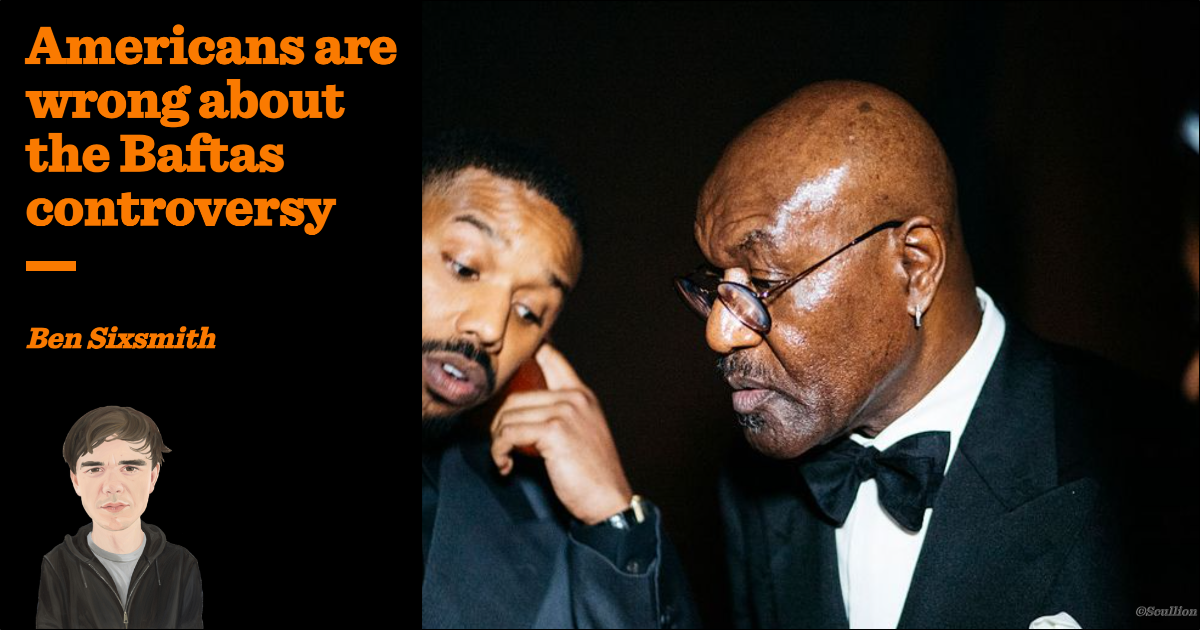

For all of the disagreements people have in Britain about race, language and offence, almost everyone agreed that John Davidson, the Tourettes-suffering subject of the film I Swear, could not be blamed for shouting the n-word at the BAFTA awards when the African-American actors Michael B. Jordan and Delroy Lindo took the stage.
It was unfortunate, and any civilised person should sympathise with Jordan and Lindo for being in an uncomfortable situation, but Davidson’s outbursts are involuntary. He can’t help saying things that he doesn’t want to say. This is a man who once yelled “fuck the Queen” at the Queen.
There have been occasional attention-seekers like Shola Mos-Shogbamimu who have given Davidson a hard time, but most people in Britain, whatever their ethnic background or political opinions, have understood that he is not responsible. There might be legitimate debate about how far inclusion should be extended to people with Tourette’s, or about how the BBC approached the case, but it is wrong to make Davidson feel worse than he does.
Unfortunately, a lot of people in America have thought differently. Their sense of the preeminent evil of slurs is so acute that saying that Davidson has an involuntary tic is like saying that Adolf Hitler couldn’t help invading Poland.
For them, Davidson should have felt bad. Indeed, potentially he should have been beaten up. “If there are any white men out here in the audience with Tourette’s,” said the comedian Deon Cole while hosting the NAACP Image Awards, “I advise you to tell them they better read the room tonight.” To be fair to Cole, I’m sure this was a joke. But the joke makes no sense. Davidson wasn’t being careless — he literally couldn’t stop himself. As he has been beaten up for saying things he didn’t want to say, this seems especially gruesome.
Meanwhile, on Saturday Night Live, a sketch featuring the cast portraying various “cancelled” celebrities blaming their misdeeds on Tourette’s. That the skit featured Bill Cosby, who raped various women, and J.K. Rowling, who has dissenting opinions on sex and gender, was peculiar enough. But the tone of the sketch also seemed to be implying that attributing anything to Tourette Syndrome was preposterous. To be fair, I’m sure you could write a funny bit about some pretending to have Tourette’s so they can have an excuse to say appalling things. (It sounds like a fine Curb Your Enthusiasm episode.) But the skit, as it is performed, very much makes Davidson sound like the butt of the joke.
Others were more straightforwardly idiotic. “Black people are just supposed to be ok with being disrespected and dehumanised so that other people don’t feel bad,” scoffed the writer Jemele Hill. Yes, you are supposed to be okay with being “disrespected” by someone who literally can’t help saying “disrespectful” things. Granted, again, I think that there could be a substantive debate about inclusion here. If someone couldn’t help being violent, one could not blame them for being violent, but one might be justified in not wanting to be around them. Me, I think words and deeds are different, but there are grey areas to be explored here. To imply that Davidson was being disrespectful, though, and that he should have been issuing frantic apologies, is dumb and obnoxious.
I think that Hill can’t tolerate the idea of not being the most righteous and authoritative voice in a debate about equality and offence. The idea that a white man — even a white man who has had a lifelong disability that has meant that he has been excluded and assaulted on numerous occasions — is not the most privileged party in the situation is impossible for her to compute. It transgresses against her sacred hierarchy of victimhood.
I do wish that the BBC had edited the slur out of its broadcast. Being at the centre of this controversy must have been painful for Davidson — and at a moment when he should have been enjoying mainstream respect after a lifetime of struggle. It is good how many people have sympathised with him, but I’m sure that he would have preferred it if he hadn’t needed their sympathy. I’m also sure that Messrs Jordan and Lindo would have preferred to bask in plaudits for their new film Sinners.
If two good things come out of this controversy, though, I hope that they are greater awareness of what it means for someone to have Tourette’s, and less of an automatic assumption that if someone is offended that means they get to dominate a conversation. That doesn’t mean that no one gets to be offended (if nothing else, few of us actually have Tourette’s). But it shouldn’t dictate how a dialogue goes.