Iran‘s retaliatory campaign has exposed a growing imbalance between the production of drones and the exorbitant cost to shoot them down.
A single Iranian drone can cost as little as $35,000 to produce, while intercepting it can cost anywhere from $500,000 to $4 million.
This issue has come into focus during the latest escalation, known as Operation Epic Fury, with Iran launching attacks at Israel and at US and allied bases in the United Arab Emirates, Kuwait, Bahrain, Qatar and Saudi Arabia.
By spreading strikes across more than five theatres at once and sustaining over 2,500 drones per day, Tehran is forcing its adversaries to divide their defences.
Every interceptor deployed to protect one base is one that cannot be used elsewhere, since interceptors are finite.
This leads military planners to stretch their resources across thousands of kilometres, leaving weaker protections in each location.
Iran’s advantage lies in scale, according to data gathered from open source intelligence and defence analysts.
Rather than a few thousand long range drones, its total Shahed fleet is estimated at between 80,000 and 100,000 across all variants.
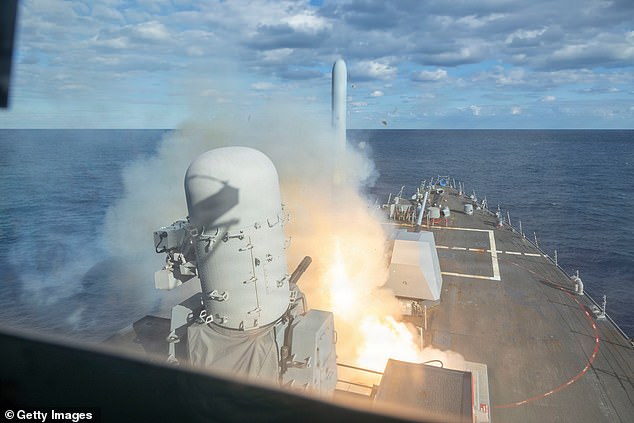
Arleigh Burke-class guided-missile destroyer USS Bulkeley (DDG 84) fires a Tomahawk Land Attack Missile (TLAM) during operations in support of Operation Epic Fury
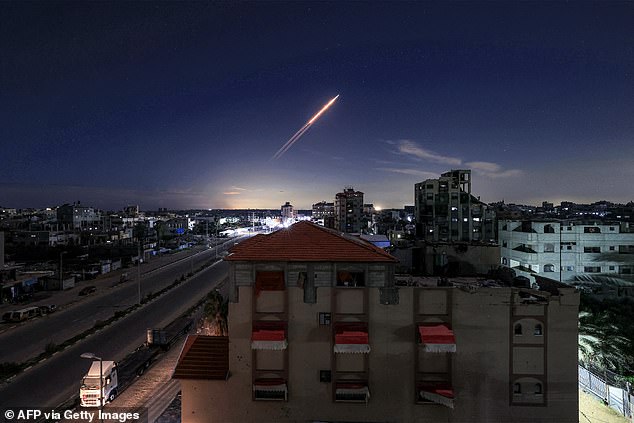
A missile launched from Iran is pictured in the sky from the Bureij camp for Palestinian refugees in the central Gaza Strip
Combined with an ongoing production rate of around 500 a month, if used at full capacity, those numbers could translate into waves of more than 2,500 drones a day for a month.
Western officials and analysts warn that interceptor stockpiles would struggle to keep up with that pace, adding that the strain is already showing.
Last year’s fighting in June 2025 saw inventories severely depleted.
During the conflict last summer, The US alone fired around 150 THAAD interceptors to defend Israel over just 12 days, using roughly a quarter of its stockpile.
Each of those interceptors costs about $15 million and can take three to eight years to replenish.
Now, the same systems are being relied on across multiple countries at once as the intensity of Iranian attacks continue.
Interceptors aren’t the only munitions in short supply, with the US expanding sea-launched Tomahawk cruise missiles (TLAMs) and aircraft launched weapons.
And with US President Donald Trump saying the war could go on for the next four weeks, dangerously low stocks can prove to be a problem.
Yesterday, the President told the Daily Mail: ‘It’s always been a four-week process. We figured it will be four weeks or so. It’s always been about a four-week process so – as strong as it is, it’s a big country, it’ll take four weeks – or less.’
Speaking to Bloomberg, Kelly Grieco, a senior fellow at the Stimson Center, said: ‘Missile interceptors are a big concern, particularly anti ballistic interceptors. We are using these interceptors faster than we can make them.’
The way these systems are used adds another layer of pressure, as they require several interceptors.
Standard military practice is to fire two or even three interceptors at a single incoming target to increase the chances of a successful hit. That means even a relatively small wave of drones or missiles can quickly drain supplies.
William Alberque of the Pacific Forum said that ‘magazine capacity was already low’ after last year’s fighting. If the current pace continues, officials fear stocks could run dangerously low within days.
In April 2024, a coordinated defence effort managed to intercept 99% of incoming threats. However, that attack was slower and more predictable and involved a smaller number of weapons.
Meanwhile, this week’s attacks are faster, less predictable, and span a broader area, making that level of success far harder to repeat.
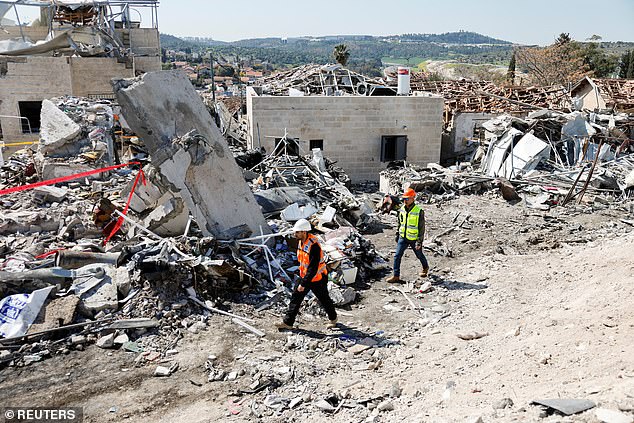
Debris lies at the site of a fatal Iranian missile strike in Beit Shemesh, Israel on March 2
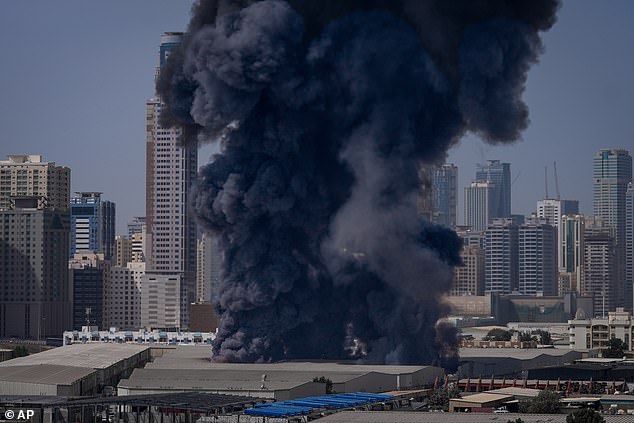
A black plume of smoke rises from a warehouse at the industrial area of Sharjah City in the United Arab Emirates following reports of Iranian strikes in Dubai on March 1
Using that data alongside the the current exchange rates between cheap drones and expensive interceptors, a prolonged campaign could run into tens or even hundreds of billions of dollars.
However, cheaper solutions are also being considered, with one option being the use of APKWS guided rockets, which only cost about $28,000 per shot.
They have shown strong results in testing with a 100% hit rate and now account for a significant share of drone interceptions in the region, with thousands already deployed.
Another is Israel’s Iron Beam laser system, which can destroy targets for just a few dollars per shot.
However only 1-2 of these systems are operational and all are based in Israel, leaving other parts of the region without access.
At the same time, Israel is also low on Arrow 3 air-defense interceptors and air-launched ballistic missiles, which were used to take out Iranian missile launchers in 2025 and attack Hamas leaders in Qatar, according to a US official
Eyal Pinko, a former Israeli naval commander, said the key question is which side will manage to outlast the other.
He said: ‘A lot more attacks are coming.’
‘They have thousands of missiles and drones, huge stocks. They will do everything to maintain the regime. This is now an all out war for their survival.’
This comes as Iran vowed it will never surrender as it rejected an ultimatum from Donald Trump to lay down its weapons.
Trump told Iran’s leaders to give up the fight which has exploded across the Middle East, with missiles raining down on the region.
A total of 555 people have been killed across Iran since the start of the strikes that killed Ayatollah Ali Khamenei and other senior leaders, the Iranian Red Crescent said Monday.
Israel’s rescue services said nine people were killed and 28 wounded in a strike that hit a synagogue in the central town of Beit Shemesh, bringing the overall death toll in the country to 11. Another 11 people were still missing after the strike, police said.
‘These intolerable threats will not continue any longer. I once again urge the Revolutionary Guard, the Iranian military police, to lay down your arms and receive full immunity or face certain death,’ Trump said.
He urged the Iranian people to rise up and overthrow the Islamic regime. ‘Be brave, be bold, be heroic and take back your country,’ he said.
‘We’re undertaking this massive operation not merely to ensure security for our own time and place, but for our children and their children, just as our ancestors have done for us many, many years ago,’ the President said.
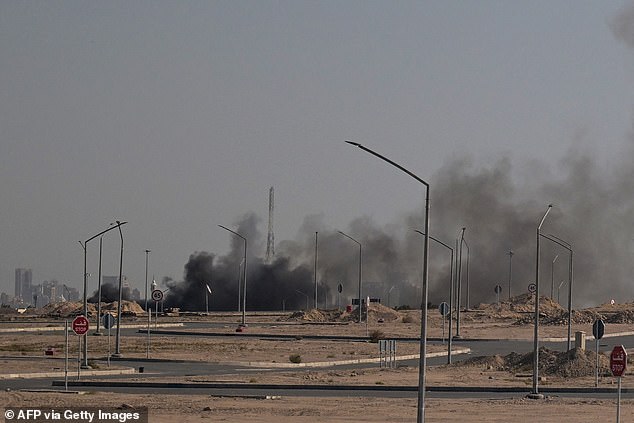
Smoke rises from a reported Iranian strike in the area where the US Embassy is located in Kuwait City on March 2
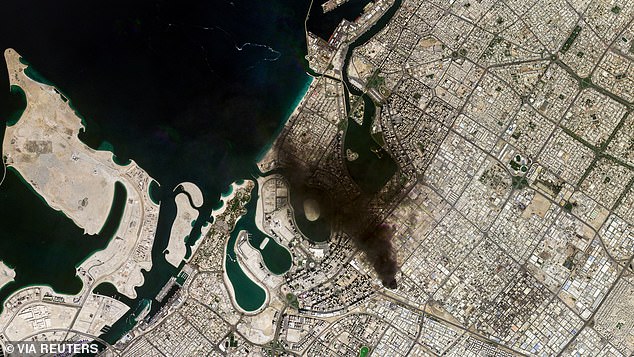
A satellite image of an industrial area covered in smoke in Dubai, UAE on March 1
But Iranian national security official Ali Larijani confirmed the country will not negotiate with the US.
Donald Trump said the US-Israeli war with Iran could go on for the next four weeks, revealing that the US and Israel’s attacks have taken out so many Iranian leaders that the succession line may lead to a surprise new leader.
‘The attack was so successful it knocked out most of the candidates,’ Trump told ABC. ‘It’s not going to be anybody that we were thinking of because they are all dead. Second or third place is dead.’
On Monday, loud explosions were heard across the Gulf cities of Dubai, Doha and Manama on Monday as Tehran pressed into a third day of strikes against Gulf neighbours.
Saudi Arabia was also targeted, intercepting two drones that were launched during an attempted attack on an oil refinery in Ras Tanura.
The Saudi defence ministry has confirmed two missiles were intercepted and destroyed at the plant in Eastern Province along the country’s east coast.
According to Al Jazeera, the site has now been temporarily closed.
Iran’s army has confirmed it targeted the American Ali Al Salem air base in Kuwait as well as vessels in the Indian ocean in retaliation of US and Israeli strikes.
‘Missile units of the army’s ground and naval forces operating from various locations targeted the US Ali Al Salem air base in Kuwait as well as enemy vessels in the northern Indian Ocean over the past hours,’ the army said in a statement.
It added that ’15 cruise missiles’ were used in the attacks.
Several American warplanes crashed in Kuwait earlier today but their crew survived, Kuwait’s defence ministry said.