Saudi Arabian capital Riyadh has become a key exit route for the super-rich fleeing Iranian bombs raining down on Dubai and Abu Dhabi.
The billionaires’ tax haven went from sunny paradise to deadly warzone within hours of the US-Israeli ‘pre-emptive’ strikes on Iran on Saturday morning, with Iranian bombs raining down on the UAE in retaliation, killing at least three civilians in the Dubai blitz.
Iranian drones and missiles also hit Israel, Qatar, Bahrain, Kuwait and Oman in retaliatory strikes, so the airspace in the region has gone into a massive lockdown with nearly 6,000 flights being cancelled worldwide and almost 30,000 delayed.
However, the Saudi capital’s airport is now one of the only remaining in operation in the Middle East, so executives and their families are flocking to Riyadh in droves, where private jets and commercial airliners await to rescue them from the chaos.
Fleets of SUVs have been booked to ferry wealthy VIPs along the 10-hour-long desert roads from Dubai to Riyadh, Semafor said. Private jet chartering prices and SUV rental costs have skyrocketed due to the massive demand, sources close to the matter said.
A private jet flight from Riyadh to Europe now costs up to $350,000 chief executive of private jet brokerage Vimana Private, Ameerh Naran, told Semafor.
He said: ‘Saudi Arabia is the only real option for people who want to get out of the region right now.’
Saudi Arabia intercepted missile strikes aiming for Riyadh’s airport – King Khalid International Airport – on Saturday, Iran International reported, but the airspace remains open.
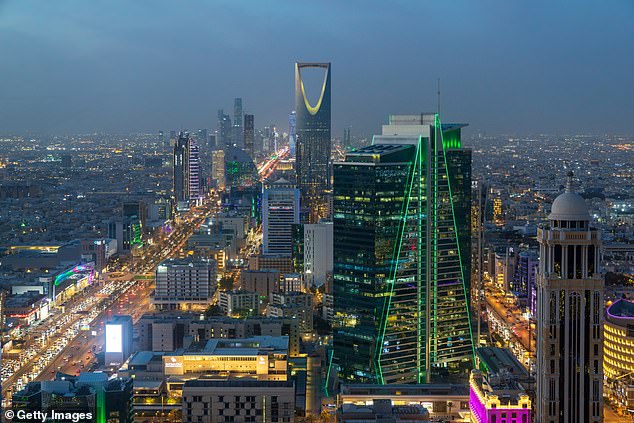
Saudi Arabian capital Riyadh has become the unlikely safe haven and escape route for the megawealthy caught in the crossfire in the Middle East
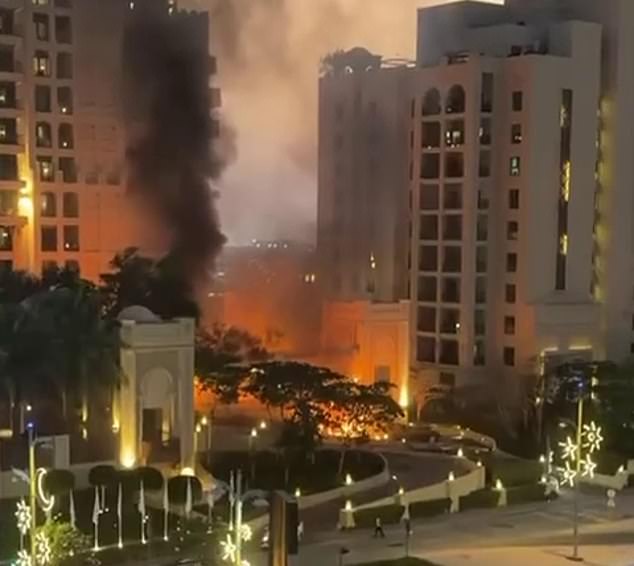
The Palm Jumeirah hotel in Dubai was engulfed in flames yesterday after being hit, with four people injured. Since the strikes, fleets of SUVs have been ferrying rich magnates and their families to private jets from Riyadh airport
Senior executives at global financial firms and high-net-worth individuals have been seen in increased numbers fleeing the region at the Saudi capital’s airport.
Previously, these finance magnates looked south to Oman for an escape route, but the option was swiped away when Iran bombed an oil tanker in the Strait of Hormuz and bombed Oman’s Duqm port.
Desperation turned their sights west from Dubai, towards Riyadh, in the centre of Saudi Arabia. Historically, the city has not been seen as the safe haven it has become as of the last 24 hours.
It saw bombings by the Houthis from Yemen in June 2020 which closed the airspace around the city, as has happened across other parts of the Middle East now.
The super-rich have often fled through other cities when unrest appeared in the region in the past, like during the Arab Spring in 2011 to 2012 and the 12-Day War between the US and Iran last June, when nuclear facilities were blown up in the country by America.
A director at UK-based security firm Alma Risk Ian McCaul told Semafor: ‘We’ve been approached by a mixture of clients including families, individuals, and corporations that want to get out of the region either because their fear for their safety, or for business reasons they just need to be able to travel.’
Saudi Arabia has also recently loosened visa requirements which means that many nationalities can now get a visa on arrival rather than arranging one in advance, often taking weeks.
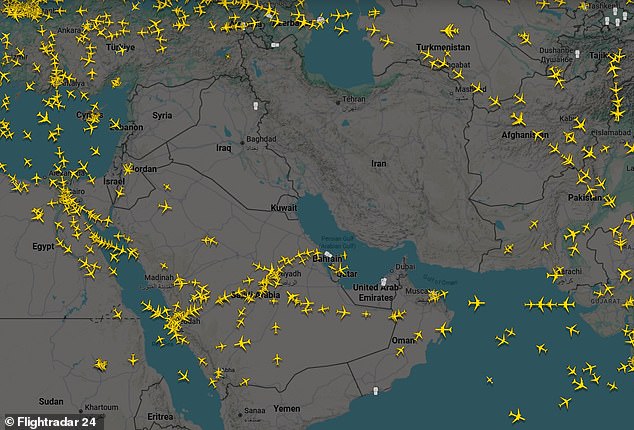
A huge hole in air traffic appeared above Iran and the surrounding areas as the conflict escalates but Saudi Arabian capital Riyadh, pictured here in the lower middle left, is busy with plenty of aircraft coming and going, similarly to Jeddah in the west which is also running many flights will other airspaces remain locked down
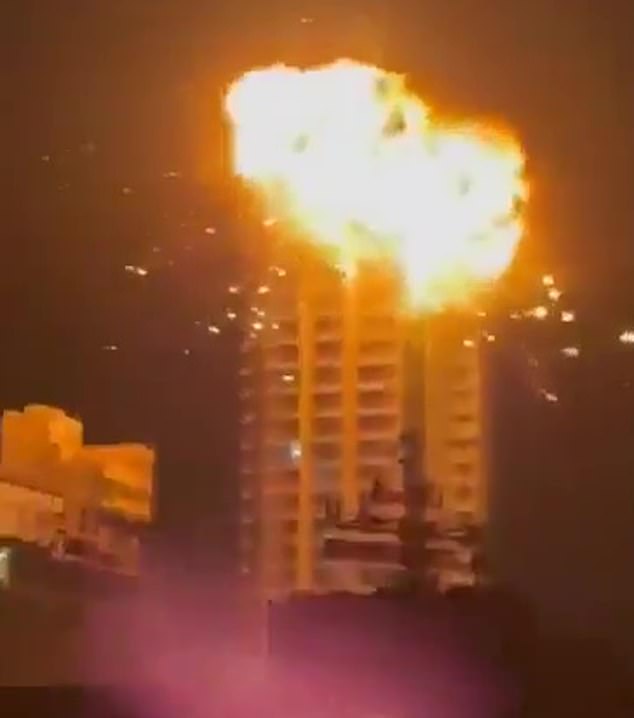
A fireball explosion erupts from a building in Manama, Bahrain, after an Iranian drone attack. Attacks like this across the Middle East has meant a huge amount of airspace has been locked down with Riyadh’s King Khalid International Airport being one of the only ones still operating in the region
This has put Riyadh in a good position to serve as safe passage for those stuck in the region, despite previous perceptions of the city being associated with strict religious rules and terror attacks post 9/11.
Amid the frantic escapes made by these high-flying members of society, some still maintain they feel safe in Dubai, in spite of the raining bombs and drones.
Socialite influencer Hofit Golan, 40, insisted Dubai ‘still feels like a very safe place’ on Sunday, just hours after Iranian missile struck the nearby Palm Jumeirah hotel leaving her terrified and forced to hide in a bath.
Though many have decided to leave the region as violence increases and, despite reports that Saudis repelled missile attacks on the capital, the country has been spared the full force of Iran’s retaliation, so it seems like a logical exit point.
Saudi Arabia is host to several military bases, so it is unclear as to why it was spared the intensity of attacks neighbouring countries suffered.
However, Crown Prince Mohammed bin Salman distanced himself from the initial strikes on Iran, declaring he wouldn’t allow his kingdom’s airspace or land to be used for an attack on Iran.
The US-Israeli strikes on Tehran and in several other locations across Iran killed the dictator Ayatollah Ali Khamenei on Saturday, after he had served as the country’s supreme leader since 1989.
The US and Israel described the bombings as ‘pre-emptive’ strikes aimed at halting Tehran’s nuclear ambitions.