There are many different kinds of suffering to acknowledge when it comes to disabilities

At the start of December my father died. It was unexpected and left me dealing, not just with the usual bereavement admin, but with the care of my disabled older brother.
Had this been a film, I would’ve sorted it all through montage. Sad funeral scene, dramatic grief scene, poignant, growing-as-a-person scene where I come to terms with changed circumstances. Lots of long walks and crying into pillows as I overcome my own sadness by becoming more empathetic. Since it’s not a film, I’ve still had to do boring, everyday stuff such as looking after my kids, doing the housework and going to work. This is why, towards the end of January, I found myself in the foyer of a hotel on a company team building day, ringing the hospital where my brother was then an inpatient.
I’d hoped to catch the doctors but as usual I’d failed. As usual, one of the nurses was telling me that I’d find it easier to get information if I could be there in person. As usual, I considered explaining how many hours’ drive away it was and that I was using up annual leave already, aware all the time how flimsy this sounded. Before the call ended, the nurse commented on how “sweet” my brother was. All the nurses do this, probably just to be nice, but I always feel as though they’re trying to advertise him to me — as if I haven’t known him all my life and it’s just my total ignorance of his superior character which means I’m not at his bedside all the time.
Maybe it was the corporate setting, but I found myself thinking of the 1988 film Rain Man. In it, Tom Cruise’s character Charlie finds himself taking charge of his disabled older brother Raymond, played by Dustin Hoffmann, following their father’s death. At the start of the film Charlie is a money-obsessed arsehole, but contact with Raymond, who is not just severely autistic, but a genius and pure of heart, makes him a much better human being. The nurses, I decided, think me and my brother are like Charlie and Raymond, or at least a rubbish version thereof. I’ve got all the arseholery but none of Charlie’s good looks, while my brother is pure of heart but lacks savant status (the only reason I haven’t packed in my job and whisked him away to Las Vegas to make me a fortune).
I haven’t watched Rain Man in years. It was the kind of film people could watch while feeling their awareness was being raised, and that therefore, had they been in Charlie’s situation, they would have been kind and giving from the word go. They wouldn’t have got annoyed with Raymond or tried to exploit him. They’d have been patience personified. It’s why the film annoyed me. However messy and honest such things try to be, the underlying message seems to be that everything comes down to being a nice person as opposed to someone who’s funny about difference. Overcome your selfishness and you’ll be sorted. Viewers see themselves as Charlie at the end of the film, never at the start.
Growing up with my brother, I often felt people believed they’d be better at being “the other sibling” than I was. When you have a sibling with much greater needs than your own, the belief that you are incredibly, inordinately privileged to be you and not your sibling never seems to extend to anyone else, even though they are not your sibling, either. One acquaintance told me that if she had a brother like mine, she’d be “much more carpe diem” than I was. I’ve never quite known what that meant, beyond a sense that I’d stolen all of the sibling good fortune and would be squandering it if I didn’t make more of it. This acquaintance would have done so, had she been assigned my role in the great film of life. But she hadn’t been so she didn’t have to.
My irritation at Rain Man may be one of the reasons why, though I thought the trailers looked great, I haven’t yet watched I Swear, the film about Tourette’s sufferer John Davidson. It’s not that I don’t think Davidson has done amazing work in increasing understanding of the condition, or that the film itself can be part of it. I just worried — particularly given my current situation — that I’d watch any character being extra-specially tolerant and forbearing thinking “yeah, but in real life? And if it was all the time? And it wasn’t a choice?” I accepted this may be me being hypersensitive and bitter (I’ve also avoided H is for Hawk for fear I’d be thinking “well, my dad died, too, but I don’t have time to train a bird of prey. Too busy having nurses think I’m ugly, rubbish Tom Cruise”).
What if sometimes, including means absorbing rather than challenging?
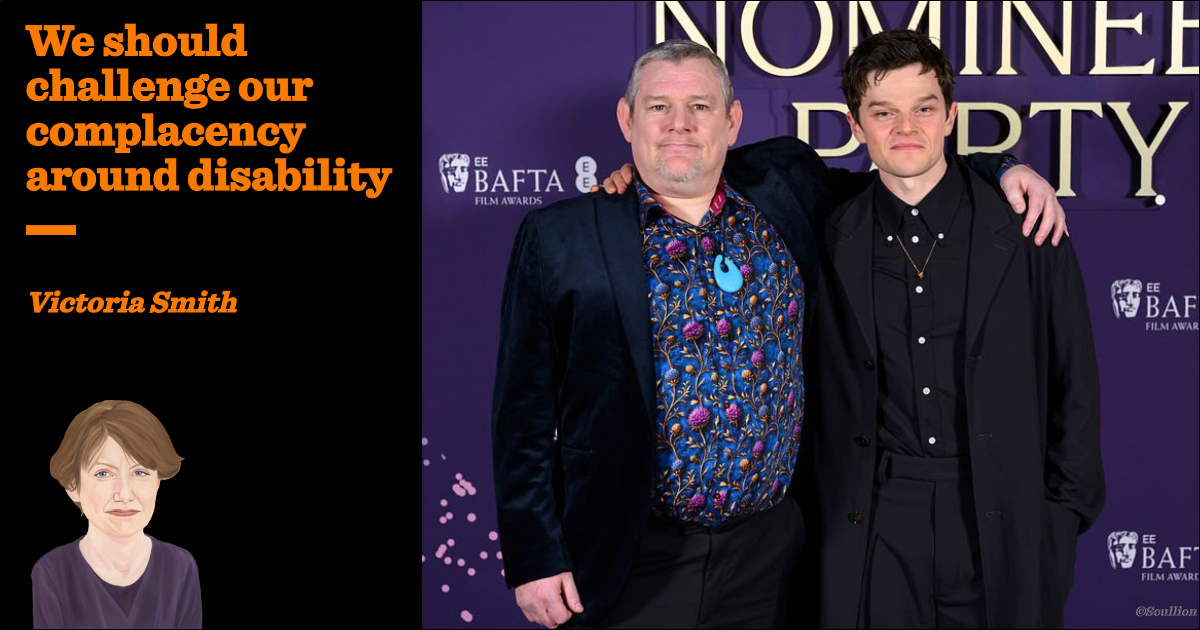
Yet if ever I wanted proof that it’s not all in my head — that how people imagine they’d respond to disability in film is not necessarily how they’d respond to it in real life — then the response to Davidson’s involuntary use of the N-word at the BAFTAs seems to provide it. Though far from universal, there was an insistence from many that Davidson should have been able to control his tics, or that they revealed what he was “really” feeling, or that disability was being used as an excuse to mask racism, or that even if he couldn’t help it, the distress he risked causing to others meant he should have stayed at home rather than attend an awards ceremony featuring a film about his own life. The reaction exposed a deep flaw in the kind of “inclusive” politics which prioritises identity over relationality, knows who the one true victim is in every scenario and insists intent isn’t magic. You can watch a film and identify as the kind of person who’d challenge ableism in the same way you’d challenge racism. But what if you’re in a situation where there’s no one to challenge? What if sometimes, including means absorbing rather than challenging?
Following my father’s death, I’ve sat in various meetings where it is agreed that the most important person now is my brother. I know the loss is more devastating for him than for me for all sorts of reasons. That doesn’t stop the “Tom Cruise at the start of Rain Man” part of me from thinking, “Anyone notice that I’m bereaved, too? That people with siblings who don’t need care aren’t expected to put their grief on hold in this way?” There’s nothing to do with this resentment, no one to whom I can appeal. It’s hardly an offence anyone is committing against me. “I have been out-victimed” seems such a pathetic complaint, yet if it is something for which the pain is deep — bereavement, public humiliation, hate speech — it is difficult to switch off. Knowing what the better person looks like — you’ve seen them on screen — doesn’t make it easy to be them at all times.
There are those who have used the BAFTAs incident to showcase the degree to which “progressive” politics has become an excuse for bullying — the people who, to quote Aldous Huxley, find destroying “with good conscience […] the height of psychological luxury, the most delicious of moral treats”. For others, though, there is genuine hurt. It’s not nothing to stand on a stage and hear a slur with deep historical resonance called out. It doesn’t become nothing if you know there’s no intent to cause harm. There’s imagining you’d be like the tolerant people in a film before failing in real life, then there’s imagining you’d be better than the people who fail in real life — because in relation to them, you’re still just a viewer. You don’t really know how you’d feel.
At some point, we all fail. Or at least, that’s what I tell myself. For all the pain it has caused, hopefully the BAFTAs incident will make some people see things with a little more nuance. Sometimes there’s no one to fight. Sometimes what you feel matters, but it just doesn’t matter the most.