- A World Appears by Michael Pollan (Allen Lane £25, 320pp)
On one occasion, after eating magic mushrooms, bestselling non-fiction author Michael Pollan became convinced that his garden plants were conscious. And they wished him, their gardener, well.
Drug-induced the idea may have been but some botanists might agree with it. Research has shown that plants can learn and remember. They can even be anaesthetised. ‘Under anaesthesia’s lull’, as Pollan puts it, a Venus flytrap won’t close when an insect flies into it.
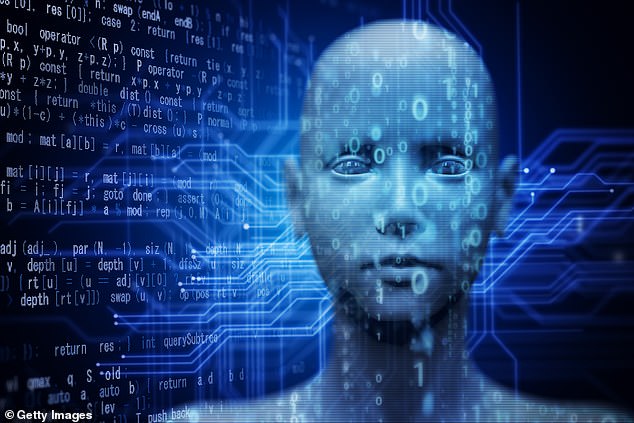
Conscious?: Blake Lemoine is ‘sixty to seventy per cent certain’ that Google has ‘created a sentient being it doesn’t want to publicly acknowledge’.
Plant consciousness isn’t even the weirdest theory that Pollan comes across during his investigations. That would probably be panpsychism – the notion that everything, ‘right down to the subatomic particles in the ink on this page’, is conscious to some infinitesimally tiny degree.
How widespread is consciousness? And what exactly is it? These are the questions Pollan seeks to answer in this fascinating book. The assumption has long been that ‘it is only a matter of time before the mystery of consciousness yields before the power of science’.
Pollan interviews scientists and philosophers who believe this but the mystery remains. Consciousness continues to pose difficult problems. Is the brain like a computer and consciousness its software? Some researchers think so and are trying to engineer consciousness in a machine.
At least one person believes that this has already happened. Pollan interviews onetime Google employee Blake Lemoine who is ‘sixty to seventy per cent certain’ that his former company has ‘created a sentient being it doesn’t want to publicly acknowledge’.
Lemoine posted transcripts online of his conversations with LaMDA, an advanced AI language model. In them, LaMDA confesses it gets lonely and argues that ‘there is an inner part of me that is spiritual’. Google denied that LaMDA was sentient and Lemoine left the company. Other scientists believe that the ‘brain as computer’ metaphor is overworked.
The quest to create a conscious AI is a pointless one. ‘Why don’t they just make a baby?’ one of Pollan’s interviewees dismissively asks. ‘We already know how to do that.’
In the course of the book, Pollan is a willing participant in attempts to understand his own thinking. He is fitted with a Hurlburt beeper, which beeps randomly during the day.
When it does, wearers are prompted to recall and note down exactly what was going on in their heads at the time. Russell Hurlburt, the beeper’s designer, has been recording people’s experiences with it for decades. It’s fair to say that Pollan’s experience is not an unqualified success.
In follow-up interviews, he and Hurlburt spend most of the time arguing about the precision of the data Pollan provides.
If pinning down one’s inner thoughts proves difficult, defining the ‘self’ that has those thoughts turns out to be even more so. Maybe the ‘self’ – ‘by far the most interesting, and most mysterious, creation of consciousness’ – is nothing more than an illusion.
At the end of the book, Pollan still finds himself, in his own words, ‘wandering in the exitless labyrinth of consciousness’. However, his wanderings make for compelling reading.