President Donald Trump’s Board of Peace was formally established at the World Economic Forum on 22 January 2026 as an alternative United Nations. A month later, Trump declared himself bored of peace, and has gone to war. It exploded onto our screens in a day of reporters clad in body armour and helmets, bearing mobile phones chirruping air raid alerts. Operational code names often hint at underlying reasons for military action. The current action against Iran is called “Lion’s Roar” by Israel, a successor to the “Rising Lions” airborne attacks of 12-24 June 2025, and “Epic Fury” by the US. This is because President Trump is furious with the Tehran regime for not doing a deal with him over its nuclear capability. Talks over Iran’s ballistic and nuclear aspirations were ongoing in Geneva as recently as Friday. Oman’s foreign minister, the mediator in Iran-American talks, appeared stunned by this development.
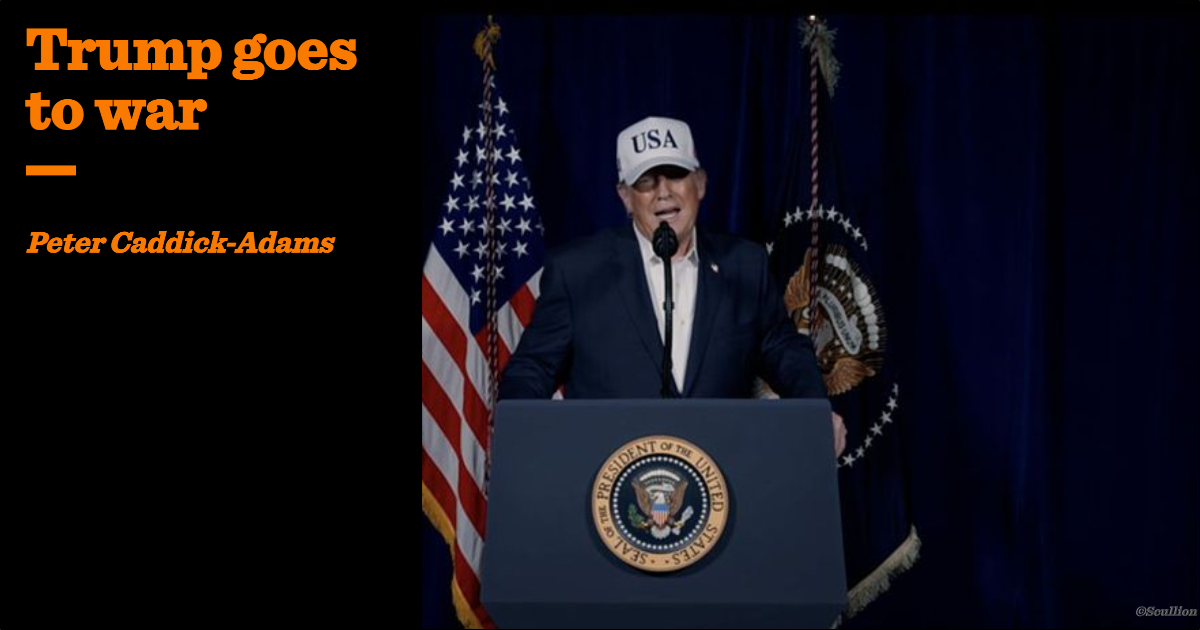
Trump’s robust declaration of “major combat operations” (his euphemism for war) on domestic television, while wearing a signature white “USA” golfing cap, listed 47 years of humiliating attacks on US forces, and his determination that Iran will never possess a nuclear weapon. Rapidly burning up international diplomatic goodwill, he has made no effort to form a coalition of western or other regional players, particularly Saudi Arabia, all of whom are nervous of regional destabilisation. The UK has issued a statement of support, but confirmed its bases were not used and it will not take a military part in the strife, although RAF jets are airborne in a protective role.
For America this is a very high-risk strategy. President Trump has been emboldened by his successful action in Venezuela. American lawmakers will be anxious that Congress, let alone the UN, has not debated this move, nor were either even consulted. It is significant that the president’s war room is not in the White House, but at Mar-a-Largo, and his announcement was not accompanied by the usual array of bemedalled admirals and generals. Missing, for example, was General Dan Caine, the current Chairman of the Joint Chiefs of Staff, suggesting this was Trump’s own initiative, and made despite military advice to the contrary. Although Australia is supportive, questions are being asked at the United Nations by Spain and France about the legality of this preemptive strike. Democrats will be suspicious that this is a distraction from the domestic crisis of ICE raids on immigrants and rumblings over the Epstein files. The action may split Trump’s MAGA-America First base, many of whom remain resolutely isolationist, and who may assess that Israel pushed their ally into war. Iran, of course, is sworn to Israel’s destruction. Not least because of the 7 October 2023 attacks, Israel interprets this in terms of an existential war to the death. So does Iran.
The stakes for America are different. This is not a necessary war, or one to fight to the death for Washington. Trump’s boast of “solving eight wars” will be compromised by starting a major new one. Therefore, the president needs a swift conclusion, rather than a regional Vietnam-type forever conflict. In his presidential address, he warned his nation to prepare for casualties, leaving some suspicious as to how far Trump will push his war. Overriding substantial objections from the Pentagon, he has chosen the most dramatic of a range of options presented to him by civilian advisors who concluded that Iran’s military power and that of its Hezbollah, Hamas and Houthi proxies is degraded.
In the UK, prime minister Starmer went into a COBR (Cabinet Office Briefing Room, pronounced “cobra”) conference, perhaps indicating he has not been consulted. However much his party may dislike the rule of the Tehran mullahs, following Tony Blair’s intervention in Iraq in 2003, Labour would find it near-impossible to back any military support of US forces in Iran. The so-called E3 (France, Germany and the UK) issued a joint call for “regional stability” and condemned Iran’s strikes in the Middle East. The Greens, victors of Thursday’s Gorton and Denton by-election, criticised the action, though the Conservatives and Reform’s Nigel Farage have backed it and demanded Starmer support the Israeli-American combat effort. This will surely play out on Britain’s streets, just as the streets of Baghdad and Istanbul are currently seeing pro-Shia demonstrations, and others supporting Sunnis of the region.
Unlike previous missile exchanges, most recently last June, this is being portrayed as an all-out war to destroy Iranian-inspired Shia Islamic terrorism, its ballistic missile, naval and nuclear power, and its leadership. Iranian press statements are equally angry. Both Trump and Netanyahu have spoken in terms of regime change, and guided by Mossad, targeted senior Iranian officials, including the 86-year-old Ayatollah Khamanei, which has not happened before. Defence Minister Amir Nasirzadeh and Revolutionary Guard commander Mohammed Pakpour are confirmed as killed, but not so far the Ayatollah or President Masoud Pezeshkian, though their quarters have been destroyed.
The risk of wider regional conflict and threats to UK interests is very real
Surgical strikes have also hit and destroyed Iranian air defence and missile systems. Russia is too enfeebled to protect its ally. However, Iran is not Venezuela. Far more military effort will be required to subdue this potent adversary of over 600,000 square miles, housing a population of 90 million, and which has many covert allies across the Middle East. Any of them could mine the sea lanes paralysing the movement of oil tankers, swarm naval vessels with suicide drones, conduct sabotage, initiate vehicle bombs, and assassinations using sleeper cells. Iran was in conversation with China about acquiring powerful anti-ship missiles, but events have far overtaken this aspiration. The Straits of Hormuz, through which a quarter of the world’s oil passes, is already reported to have been closed. Shipping, insurance and oil prices rise in the short term, as will gold, always a safe haven in times of tension.
The risk of wider regional conflict and threats to UK interests is very real. Iran had obviously made defensive plans in advance, expressed in several hundred missile strikes, launched in five initial waves on Tel Aviv, Jerusalem plus US bases and other infrastructure in Kuwait, Qatar, Bahrain and Dubai in the UAE, where 130,000 expatriate Britons live, along with 60,000 each from France, Canada and the USA. This resulted in regional airports closed, and flights grounded. The Bahraini State News Agency BNA reported that Vice Admiral Curt A. Renshaw’s US Fifth Fleet maintenance base at Manama came under missile attack. This is also home to a state-of-the-art Royal Navy facility, HMS Jufair, which had one Hunt-class mine countermeasures vessel, HMS Middleton in port.
The luxury Fairmont Palm Hotel in Dubai was damaged and holiday-makers injured by falling rocket components. Iran is estimated to possess a stock of about 2,000 offensive munitions, besides sea mines, so there will be days more of attacks to come. These wider air assaults may be an effort by Tehran to pressure America into a ceasefire via attacking its allies. British RAF Typhoons were active in destroying missiles that intruded into Qatar’s airspace. They were aiming for Al Udeid air base outside Doha, where I once worked and is currently home to Admiral Charles B. Cooper II’s multi-service Central Command (Centcom) Forward headquarters. Other munitions have been downed over Jordan. As in the past, falling debris has proved as fatal as a weapon impacting.
It is difficult to understand what US and Israeli airpower can achieve alone, without boots on the ground. I am old enough to recall the distinguished American war professor, Theodore Reed “T. R.” Fehrenbach, teaching my group in a military academy, “You may fly over a land forever; you may bomb it, atomize it, pulverize it and wipe it clean of life—but if you desire to defend it, protect it, and keep it for civilization, you must do this on the ground, the way the Roman legions did, by putting your young men into the mud.” Airpower has never achieved a decisive result without the use or threat of use (as in Kosovo in 1999) of land power.
The current methodology of air attacks doesn’t match the end state of regime change. However, a replacement regime is not ready and waiting in the wings, even if Reza Pahlavi (born on 31 October 1960), son of the last Shah, is impatiently kicking his heels in the United States. To achieve success may take months, time which might be available to Israel but not to the USA, whose combat power is more vulnerable, based on the Abraham Lincoln and Gerald R. Ford carrier support groups at sea. They carry about two week’s supply of munitions with them, but both need extensive logistical support.
There are, additionally, around 100 heavier land-based aircraft in the region, including AWACS airborne command craft, Boeing KC-135 Stratotankers, Lockheed P-3 Orion maritime surveillance aircraft, and C-5 and C-17 Globemaster transport airframes. Trump will need a clear military result by 3 November, the date of the US midterm elections, when contests for seats in the House of Representatives and Senate will be interpreted in terms of his policies.
The Prussian war theorist Carl von Clausewitz would remind Trump and Netanyahu that wars rarely unfold as the initiators anticipate. The US option to attack comes at a time when its arsenals are emptying fast, supplying equipment to Ukraine. President Trump’s invitation to Iranians to “seize control of your destiny” feels too late. His bombastic appeal for the fanatics of the Islamic Revolutionary Guard Corps (IRGC) to “lay down your arms or face certain death” will be ignored. Trump is light on detail. Who will accept the surrender of the IRGC, or run Iran after the Ayatollahs? Rather like Hitler’s SS in 1945, Iran’s loyalist fanatics will defend beyond all logic, and believing they have already been pushed into a corner, will welcome martyrdom.
We are in the early moments of a potentially very serious war, whose end-state is difficult to visualise
The most opportune time for US and Israeli intervention in Iran was in January during the uprisings across most Iranian cities. Now attempts to topple the regime will be more difficult. Surgical strikes by American and Israeli aircraft and missiles alone may be insufficient. There will be a balance to strike between removing the Mullahs, IRGC and other leaders, and crushing a wider range of Iranian targets. Too many attacks, and anti-regime citizens may feel their very existence is under attack, rather than their leaders. Persians are rightly a proud people, whose state dates back to c. 500 BC. Though they, and wider regional players, may wish to see the back of Tehran’s oppressive, murderous regime, no one wishes the destruction of their nation by a country which celebrates only its 250th anniversary this year.
The world is torn between wishing the end of the Tehran mullahs, and wanting any kinetic action to be conducted within the rules of war and with a keen sense of its long-term prospects. We are in the early moments of a potentially very serious war, whose end-state is difficult to visualise.