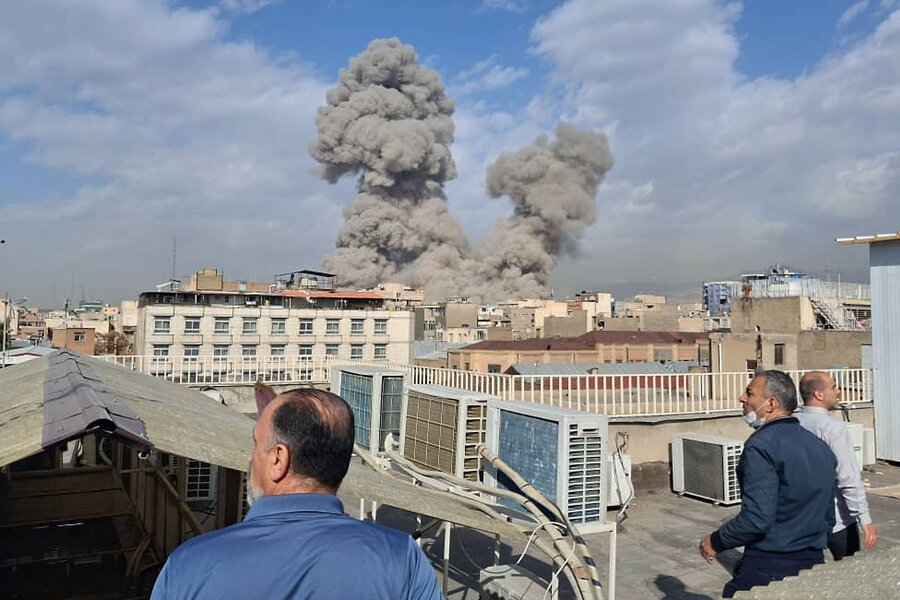
Choosing war over diplomacy on Iran, the United States and Israel launched waves of airstrikes against military and civilian targets in cities across the Islamic Republic on Saturday.
The first U.S.-Israeli strikes came at 9:45 a.m. local time in Tehran. Iran’s supreme leader’s complex and offices of the president and Supreme National Security Council – among a multitude of missile and nuclear targets across the country – were targeted, according to reports.
Iran immediately struck back, firing volleys of missiles at Israel, as well as Arab and Gulf nations Qatar, Kuwait, Bahrain, Saudi Arabia, United Arab Emirates, and Jordan, which have hosted U.S. forces or facilitated the strikes. Loud explosions could be heard as missiles impacted or were shot down by air defenses from Tel Aviv to Abu Dhabi.
Why We Wrote This
Nearly a half-century into its existence, the Iranian regime – already weakened by targeted US and Israeli strikes last summer – is now facing a potentially existential threat.
President Donald Trump and Israeli Prime Minister Benjamin Netanyahu both emphasized that the goal is regime change.
The American attack was “massive and ongoing,” Mr. Trump said in an eight-minute video posted on Truth Social and warned Iranians to take shelter because “bombs will be dropping everywhere.
“Now is the time to seize control of your destiny,” he said, addressing the Iranian people, “and to unleash the prosperous and glorious future that is close within your reach.”
Mr. Netanyahu said that the U.S. and Israel had “embarked on an operation to remove the existential threat posed by the terrorist regime in Iran,” which had “spilled our blood, murdered many Americans, and massacred its own people.”
The joint strikes, he said, would enable the “brave Iranian people to take their destiny into their own hands” and “rid themselves of the yoke of tyranny.”
Mr. Trump said the campaign would ensure that Iran would “never have a nuclear weapon,” and offered a broader context of retribution, noting a list of anti-American actions by the Islamic Republic during its 47 years in power. The U.S. would destroy Iran’s missile arsenal, “annihilate” its navy, and stop the threat of Iran’s regional militia allies, he said.

Majid Asgaripour/WANA/Reuters
“The goal is to create all the conditions for the downfall of the Iranian regime,” a senior Israeli official told Israeli journalist Barak Ravid of Axios. “We are targeting the entire Iranian leadership – political and military – past, present, and future.”
“This is a regime change war,” says Ali Vaez, director of the Iran Project at the International Crisis Group.
“From what the president says – and every indication here is this is going to be a massive deployment and use of air power to bring down the Iranian regime – it’s not aimed at resolving a narrow set of problems, or any specific problem with Iran; it’s to resolve the problem altogether by getting rid of this regime.
“The fact that there is no precedent for regime change with the sole use of air power is a different question,” says. Dr. Vaez.
As U.S. forces built up around Iran in recent weeks, Mr. Trump warned Iran’s leadership they would be “hit hard” if street protests in January were put down with lethal violence. At least 7,000 people were nevertheless killed in an unprecedented two-day crackdown.
The White House has since expanded its reasons for striking Iran to include not acceding to stated U.S. demands to give up its nuclear program, limit missile ranges, and dismantle its regional network of militia allies.
In a bid to deter attack, Tehran vowed that even a limited strike would be met with a ferocious, all-out response that would target Israel, U.S. bases across the Middle East, and U.S. allies in the region.
Iran has been preparing for this since June, when Israel assassinated a top echelon of Revolutionary Guard commanders and the U.S. hit nuclear sites with bunker-busting bombs during a 12-day military campaign. The regime has put measures in place to ensure that its command structures – from Supreme Leader Ayatollah Ali Khamenei on down – identified in advance at least four layers of successors to carry on the fight, in case top-level leaders are killed.

“This is a ‘use it or lose it’ moment for the Iranians,” says Dr. Vaez, contacted in Geneva. “It’s not a question of calibrating their response, because if they don’t respond with everything they have, they will not get a second chance.
“From their perspective, this is an existential threat, and therefore they would have to go out with everything that they have,” he says. “If they don’t, it means that they can’t. And if they can’t, it means that the U.S. has succeeded in neutralizing their e capacity before they could use it.”
The American-Israeli strikes began just hours after Oman’s Foreign Minister Badr bin Hamad Al Busaidi, who has been mediating nuclear talks in Geneva between the U.S. and Iran, announced “significant progress” had been made in the third round on Thursday. He told CBS News late Friday that a deal was “within our reach” – if the primary goal, in fact, was to ensure that Iran could not build a nuclear weapon, “forever.” Discussions had been scheduled to resume Monday.
The Israel Defense Forces issued an “urgent warning” to Iranians to vacate weapons production factories and military infrastructure or risk their lives.
Analysts say the risks of a prolonged Iran campaign echo those of the American 2003 invasion of Iraq, which successfully toppled dictator Saddam Hussein, but led to a years-long military quagmire that left more than 4,000 U.S. servicemen dead. Mr. Trump has railed against such foreign intervention and the “forever wars” waged by the U.S. in Iraq and Afghanistan.
If the Islamic Republic is toppled, success for the U.S. also depends on the day after. Mr. Trump told Iranians that “this is the moment for action. Do not let it pass.” Mr. Trump called upon Iranian security forces to “lay down your weapons” in exchange for “total immunity,” or face “certain death.”
“This is a war of choice with consequences that could last for a generation,” which “clearly shows that the U.S. has not learned the lessons from Iraq,” says Dr. Vaez.
If the Islamic Republic is toppled, success for the U.S. also depends on the day after. Mr. Trump told Iranians that “this is the moment for action. Do not let it pass.”
“I think it is wishful thinking, that the people will come out in the aftermath of this war and will finish the job,” says Dr. Vaez. “It is quite unlikely that the U.S. would be able to disarm and dismantle the Iranian state completely. If there are even remnants of the security forces that survive, they would still have the upper hand, in terms of monopoly of force.
“Yes, people are frustrated with the Iranian regime, and would like to see its back, and some would welcome intervention,” he adds. “But foreign intervention without boots on the ground has never resulted in regime change anywhere in the world – there is simply no precedent for it.”