The morning I was due to meet Steve to hand over my milk I felt physically sick. My instinct was to cancel, but I had promised. So off I went, with my husband following at a safe distance.
A 60-year-old lorry driver who suffered from crippling irritable bowel syndrome (IBS), Steve was waiting by the side of the road in a high-vis jacket. His story was that only human breast milk could calm his digestive symptoms and had begged me for help.
I handed over my zip-lock bag containing pouches of frozen milk – around 500ml, my last remaining stock – like a mother handing a child a lunchbox. We chatted, and Steve drove away.
The next morning, he sent me an email, thanking me: ‘Your milk was very creamy and very sweet, a bit almond to the taste but very nice. When I got up this morning [my stomach] was good. No pain, so your milk works.’
Why did I feel like crying when I picked up Steve’s message? Perhaps because I had given away my child’s milk, my life force. And perhaps because this was the culmination of a strange and unsettling journey into a hidden, global marketplace.
Until I gave birth to a child and found I was surprisingly efficient at producing milk – more than my daughter would ever need – I had no idea there was a commercial trade in breast milk.
It was while I was researching how to donate my surplus milk to the NHS that I happened upon Only The Breast, one of the main online sites serving the US and, to a lesser extent, the UK.
Though ostensibly set up to allow successfully breastfeeding mothers to help others who were struggling, I was intrigued to see that most of the customers seemed to be men.
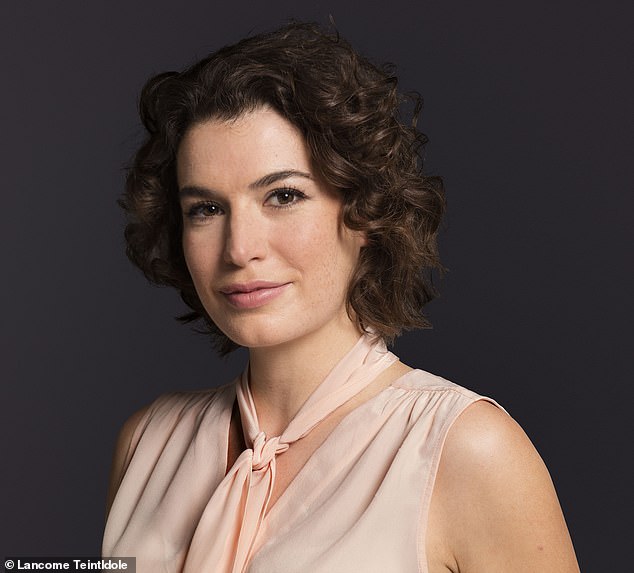
Alev Scott produced more milk than her baby needed and, while researching how to donate her surplus milk to the NHS, she discovered a selling site called Only The Breast
As part of a wider study of the global fertility industry, I set up an account under a pseudonym and posted an ad. Late at night, as I slumped over my laptop at the kitchen table with a plastic funnel pumping milk attached to one breast, emails began pinging through from men wanting to buy my milk.
Some were bodybuilders, who prize breast milk for enhancing muscles. Others were milk fetishists hoping to be aroused. ‘Erotic lactation’ was a genre of porn that was new to me.
Some men asked politely if I would breastfeed them. Others just wanted videos of what was happening: the pump, the tubes and the slowly filling bottle.
Chris, an American, offered me $5 a minute for a video showing ‘hand expression, breast and face only, self-suck if possible’.
When I declined, he asked simply: ‘What would make you do it?’
I had no intention of selling my milk to any of them.
Let me take you back to where this story starts, with the birth of my first baby in January 2021.
It was mid-pandemic and we were in lockdown. Cut off from family and friends, I was daunted by motherhood and particularly by breastfeeding.
Irrationally convinced my milk supply would dry up, I bought a hospital-grade pump and the more I pumped, the more I produced, just like the midwife had told me. Soon, despite feeding my hungry daughter, I had an oversupply of milk and a freezer full of earnestly marked little sachets (‘150ml, 15 February, 6pm’).
I started looking at how to donate my stores and one sunny morning at home in Somerset, I handed over a freezer bag containing four litres of breast milk to a smiling woman who would convey it to Bristol’s Southmead Hospital.
There, it would be unfrozen, screened for pathogens, screened again, then stored in Southmead’s milk bank, ready to feed to premature babies in the neonatal intensive care unit or distributed to other hospitals around the South West of England.
Getting to this point had involved several trips to my GP. I’d had my blood tested for sexually transmitted diseases, filled out hygiene protocol forms and promised to forgo ibuprofen (as well as harder drugs).
I was gladly donating for free, but I learned that on the open market, my milk could fetch $50‑60 (£37-44) per litre if sold to private buyers, and $189 (£140) per litre if bought by a pharmaceutical company, screened, then sold on to private hospitals – just one aspect of a global fertility industry which includes IVF treatment, donor eggs and surrogacy, which it is estimated will be worth more than $200billion by 2030.
It’s the only major legal industry in which one person’s biological bad luck can be another person’s gain.
Only The Breast is a bamboozling place, somewhere between Tinder and an a la carte human dairy farm. Prices vary according to the seller’s diet – vegan/organic/gluten and caffeine-free being at a premium – but the downside for the buyer is that the milk is unscreened. Breast milk is the only bodily fluid legally classed as a food by the Food Standards Agency (FSA) in the UK and the Food and Drug Administration (FDA) in the US, so its sale is legal in both countries, though neither agency endorses it.
The safety risks are considerable – potential drug or bacterial contamination – which is why both the FSA and FDA advise against buying online. But plenty of people disregard that advice.
The market is unregulated and I was about to find out how wild it can get.
The popularity of online breast milk sales is partly due to the wellness industry. The colostrum that women produce in the first few days is touted as ‘liquid gold’, not just for babies but also for adults, convinced its elixir-like qualities extend beyond infancy.
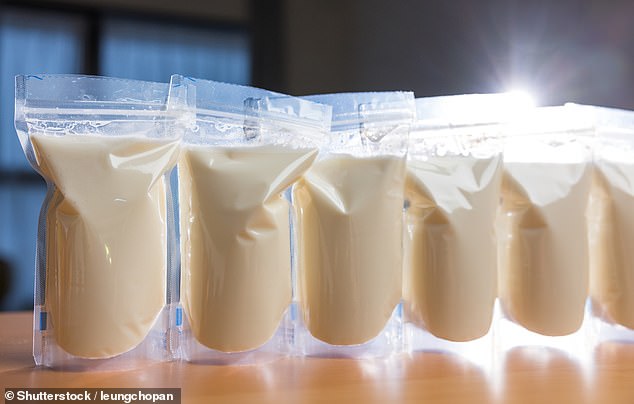
After giving birth in 2021, Alev bought a hospital-grade pump and soon had freezer full of breast milk sachets. She heard her milk could fetch £37 to £44 per litre if sold to private buyers
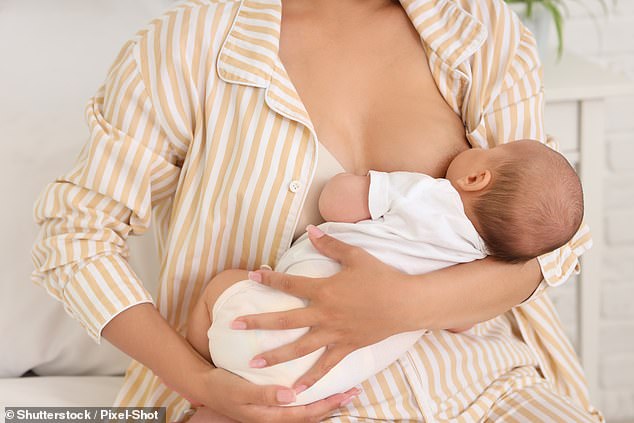
The milk women produce in the first few days (colostrum) is dubbed ‘liquid gold’, not just for babies but for adults too – making it popular with many, from bodybuilders to cancer survivors
Bodybuilders buy colostrum and breast milk, as do cancer survivors and those who suffer digestive complaints such as IBS.
When I started my research on Only The Breast, one of the most popular categories of sellers’ adverts was ‘Willing to Sell to Men’. Meanwhile, among the buyers’ adverts, ‘Men Seeking Breast Milk’ had the most traffic. When I contacted the website asking whether the founders’ original stated purpose of milk-sharing between mothers had been complicated by the obviously high number of male customers, I got no reply.
Not long afterwards, I noticed both categories mentioning men had been removed. Now, sellers state in their ads whether they are willing to sell to men and men post requests in the ‘Seeking Milk’ category. So, it has become less obvious, but men still seem to be well-represented.
Scrolling through the existing ads, I noticed that photos of cleavage or faces got many more views than pictures of neatly arranged milk bottles, as did ads posted by women who said they were in their 20s.
I decided to appear as clinical and non-sexual as possible. I posted an offer of fresh or frozen milk at a relatively low UK price (£1 per ounce) accompanied by a no-nonsense photo of a full bottle I had just pumped. Nothing about my age and appearance, only that my baby and I were healthy and that I had previously donated excess milk to a hospital.
Of the many requests I received within hours, all but one were from men and most were overtly sexual.
One 25-year-old ‘athletic’ man from London initially said he was a gym-goer wanting fresh milk, before asking – almost in passing – if I would wet-nurse (breastfeed) him. With some trepidation, I asked exactly what he proposed.
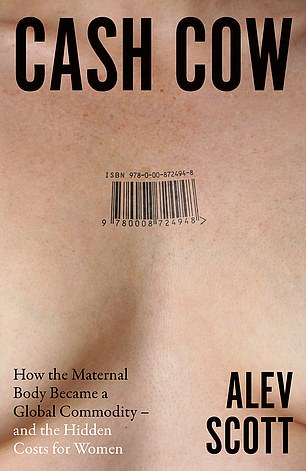
Alev’s book, Cash Cow, details her investigation into the world of selling breast milk which, alarmingly, was dominated by male buyers seeking arousal
‘If you want, I can host somewhere and we can go from there if you wish to?’ he offered. As a surreal afterthought he added ‘I understand your child comes first.’
I asked if this was strictly a health thing or for pleasure. His unconvincing response was that there was ‘some pleasure with it but strictly for my health’, echoing the words of a man called Mark who said he wanted the milk for bodybuilding but admitted in a later email it was a ‘turn-on’. I wondered if they told the women in their lives about their purchases.
A third man, Paul, claimed he would pay me in advance on a regular basis if I sent him ten-minute videos of myself using my electric pump. He sent me videos of previous commissions ‘for inspiration’.
Paul told me he wanted to ‘listen perfectly [to] each drop that flows with the sound of the milk into the big bottle’. He wanted proof that I was creating the video especially for him, so to include a written note saying ‘Paul, I am fully engorged for you’ – a common feature of bespoke porn.
I felt out of my depth, so I talked to Karen Pollock, a psychotherapist and kink specialist who happened to have once worked as a breastfeeding counsellor.
When I told them I found it strange that men should be turned on by such a quintessentially maternal act, they said it was probably as instinctive as it gets to be attracted to someone who has proved her fertility. Similarly, some men are attracted to pregnant women.
As for those interested in being breast-fed, Karen said: ‘These are men with a mummy fetish, including “adult babies”. There are sexualised adult babies and non-sexualised. Some people really do just want to return to infancy. Some of the men who contacted you will have just wanted that. They have no interest in children – they’re not paedophiles – they want to be the child.’
On Pornhub, adult wet-nursing is a sub-category of the surprisingly popular ‘pregnancy’ search term.
This all sounds very strange to us in an age where wet-nursing is largely a thing of the past. But, of course, people have bought and sold human milk for millennia. Before the advent of formula, breastfeeding was essential for infant survival. Wet nurses were in demand for centuries to feed babies whose own mothers could not, or did not want to, breastfeed.
As a new mother in a world (almost) devoid of wet nurses, the practise having died out in Britain in the early 1900s, it was difficult for me to imagine breastfeeding a stranger’s child.
Indeed, in my early days as a mother, when I shared my fears about not being able to produce enough milk for my baby on a local WhatsApp group and got a message from another mother – would I like some of her milk, frozen not long ago? – I was shocked and mildly disgusted.
Steve was the only man I felt guilty about when I was advertising my milk with no intention of selling it. He seemed to be in pain, and distressed.
He told me he bought milk once or twice a month, paying anything from £1 to £2.50 per ounce. He collected it from across Somerset, Wiltshire and Wales and he emailed me – several times a day sometimes – asking if I could help.
By this time, more than a year after Steve had first contacted me, I was breastfeeding my second child. I checked my freezer stocks – about 500ml, more than three months old, therefore useless to the milk bank, which required a minimum of 2-3 litres produced within a strict three-month time limit.
Ordinarily, I would throw it away, but I offered to give it to Steve for free if he would talk about his history of buying milk online. ‘I’ve had stomach problems for years,’ he told me. ‘When I met [his ex] a couple of months after she had a baby, she said: “Why don’t you try my milk?” ’ Steve ploughed on like a sommelier, talking about how different women’s milk tasted: ‘Some milks are quite fatty, others gravelly… you can notice the difference if it’s pumped in the morning or the evening.’
Steve revealed he had also once paid a woman in Kent £100 for 90 minutes of wet-nursing. He claimed it was not a sexual experience: ‘It was a comfort thing; it was quite nice. The warmth of a human body… it’s always nice to cuddle someone… It was relaxing, she had some nice music on.’
He was obviously lonely and his account of this experience reminded me of Japan’s ‘cuddle cafes’ where you can pay to cuddle and sleep (literally) with a stranger.
I also found my conversations with women selling their milk upsetting. Some ads placed by women on Only The Breast hint at real desperation for money. One told me it was ‘literally a second job’. Most women I spoke to confirmed they were almost exclusively contacted by men. ‘Freaks’, one called them.
Sellers are aware that many people regard the breast-milk market – even when selling to other women – as immoral, even disturbing. Many of these critics are other mothers; I’ve seen the most vicious condemnation on supposedly supportive forums like Netmums.
Jessica, one of the sellers, argued that: ‘If women are OK buying formula, why wouldn’t they be OK buying fresh, healthy milk from women who spend a large amount of their personal time toward producing it?’
I saw her point, yet I still felt uncomfortable with the idea of selling my milk, even to other mothers.
Maybe it had something to do with the mysterious alchemy of breast milk. The baby’s saliva interacts with the mother’s milk to create ‘biochemical synergism’ – in other words, your milk is tailored precisely to your baby’s needs. It is a strange substance to have a market value.
I’m still conflicted about the ethics of selling milk, a substance so crucial for vulnerable babies. The commercialisation of breast milk disturbs me more, in some ways, than the fetishists.
Commercial providers are part of a biotech industry that has grown at a dizzying rate in recent years. They sell frozen breast milk and its derivatives – powders, liquids and fortifiers – for prices that exceed those of high-end champagne.
In 2022, NeoKare, a UK-based subsidiary of a US company, was charging £45 for 300ml, or roughly £150 per litre, using donations from lactating mothers bought at 50p per ounce, or £17 per litre. Its strapline, ‘Become a Milk Provider, Save a Life’ implied that donors’ milk would always go to babies in the direst need, using the language of a charitable enterprise.
But there are no easy answers. The weakness of the NHS milk-banking system was made clear to me by Marta Staff, a fellow mother from Somerset.
Marta, a former molecular biologist who creates models of milk-banking systems to help policymakers plan infrastructure, was turned down when she offered to donate her surplus milk to three NHS milk banks because they did not have the capacity to process it.
She told me she ended up pouring it all down the drain. We shared a moment of silence. What a waste.
Adapted from Cash Cow by Alev Scott (HarperCollins, £22). © Alev Scott 2026. To order a copy for £19.80 (offer valid to 07/03/2026; UK P&P free on orders over £25) go to mailshop.co.uk/books or call 020 3176 2937.