The government must clarify how the Higher Education (Freedom of Speech) Act 2023 is going to be enforced
The question of how the Higher Education (Freedom of Speech) Act 2023 (HEFSA) is to be enforced has now become a matter of sustained parliamentary scrutiny. On Monday, Lord Robert Skidelsky raised the issue during Oral Questions in the House of Lords, asking the Government what assessment it had made of the open letter coordinated by the Committee for Academic Freedom and signed by more than 350 academics and campaigners, calling for the commencement of the Office for Students’ (OfS) free-speech complaints scheme.
The main duties in HEFSA came into force on 1 August 2025 and are supported by published guidance from the OfS. But with the statutory tort not available (and slated for repeal) and the scheme still not commenced, there is no practical route for staff, students and visiting speakers to enforce those duties. In practice, then, universities can disregard their new statutory free-speech obligations with little risk of effective legal challenge. Recent cases that would plainly have fallen within the scheme’s intended scope include an academic suspended for noting that “controversial” words can have a range of meanings depending on the context of their utterance; another who was suspended after defending a gender-critical academic against accusations of “transphobia”; and a leading professor instructed to cease research into supply chains and forced labour in China.
Speaking for the Government, Baroness Smith of Malvern confirmed that she and the Secretary of State for Education, Bridget Phillipson, “have considered the letter and the concerns raised in it”, and that she had met “many of the signatories”. Although she could not “comment on the future legislative programme”, peers could rest assured that the Government was “considering options”.
This has, unfortunately, been the Government line since at least January 2025, so it was entirely understandable that Skidelsky pressed her on the point, noting that the Department for Education’s June 2025 policy paper promised to “seek a legislative vehicle at the earliest opportunity”. If that was indeed the case, did the Government have any timetable for legislation to amend and implement the Act for this purpose?
Smith, now in full-on Sir Humphrey mode, again declined to offer anything that could be mistaken for a date, and responded: “I expect us to be able to introduce the amended complaints scheme sooner rather than later.”
Is “sooner rather than later” an upgrade on “considering options”? As Sir Humphrey himself might have said, it would no doubt “be premature to construe the formulation as a pathway to a workable timetable; but it would be equally rash to dismiss it as being wholly without substantive implication.”
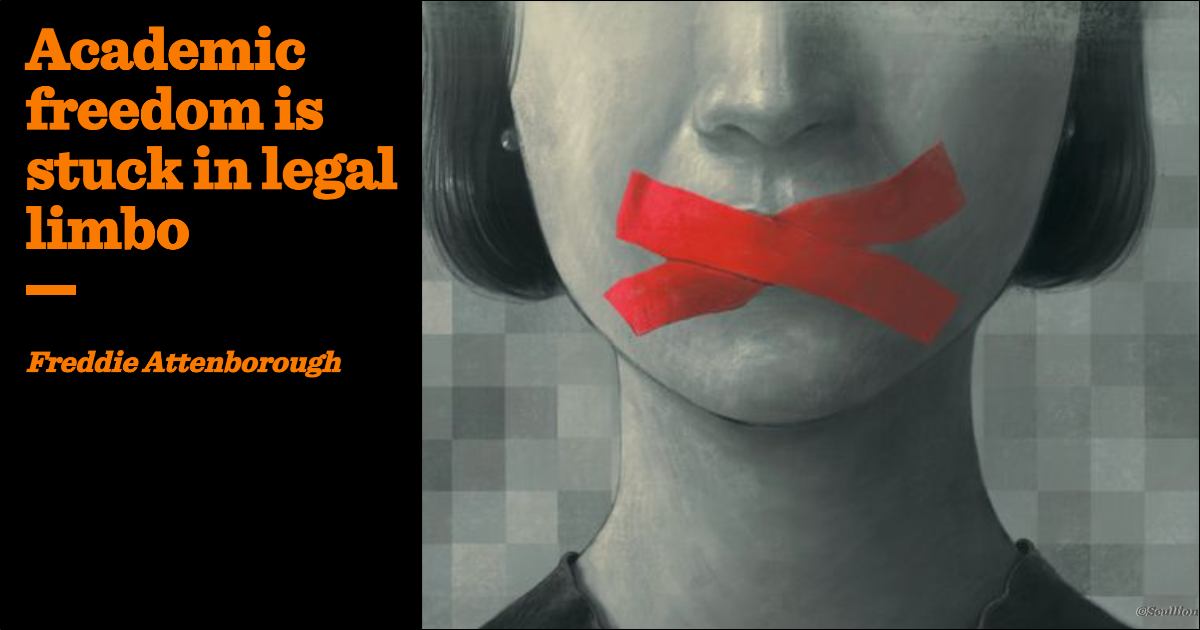
Lord Mohammed of Tinsley asked why, if freedom of expression is a priority for the Government, ministers had not considered short, stand-alone legislation – “similar to the medical training Bill” scheduled later that afternoon – so that any issues could be resolved quickly and academics were not left “in legal limbo for years to come”.
“We will not be leaving academics in legal limbo,” Smith replied, immovably.
Strictly speaking, she may be right. But in the absence of the scheme HEFSA envisaged, staff and visiting speakers who wish to vindicate their rights must ordinarily be prepared for the costs and friction of litigation.
Judicial review is a remedy of last resort, tightly constrained and prohibitively expensive. As long ago as 2016, public law practitioners cited in a Ministry of Justice consultation were estimating costs in the region of £30,000–£50,000 to take a claim from permission to a substantive hearing, with the additional risk of being ordered to pay the other side’s costs. The fact that the Public Law Project has recently documented instances in which public bodies have submitted costs schedules of up to £40,000 for pre-permission work alone indicates how significantly costs have increased, and makes clear that the potential total exposure in a fully contested case can now easily exceed £100,000.
Employment tribunals, meanwhile, have no jurisdiction to enforce HEFSA duties and are already struggling with a heavy caseload. Taking a high-complexity discrimination claim all the way to a final hearing typically involves legal fees running into tens of thousands of pounds. The number of tribunal claims has risen markedly in recent years, and according to HMCTS management information the Employment Tribunal open caseload – effectively the backlog of unresolved cases – rose from around 49,800 at the end of 2024 to over 61,000 by September 2025, an increase of more than a quarter in nine months. On some estimates, those cases involve roughly 450,000 individual claimants, and employment lawyers now report that unfair-dismissal and discrimination claims typically wait around 12 months just to be listed for hearing.
This was a point picked up by Baroness Barran, who noted that “even in the last few weeks we have seen academics required to go to court to vindicate their rights”, forced into “expensive proceedings”. Referring to “authoritative legal advice that has been sought by academics, lawyers and Members of this House” on how to introduce the complaints scheme in a way that meets the Government’s concerns about its width, while “ending the otherwise unstoppable rush to the courts”, she asked whether officials would review the proposals as a matter of urgency.
Smith replied that she was “in constant conversation with officials” and then, after a brief search through the ministerial lexicon for a reassurance sufficiently platitudinous to suggest motion without implying movement, added: “We will make progress on this.”
Yes, Minister – but will that be “sooner”, or “later”?