Political allegiance amongst young right-wingers is increasingly determined by aesthetics, not ideology
At the end of Tinker Tailor Soldier Spy, Soviet mole Bill Hader offered his reasons for crossing the ideological Iron Curtain; “it was an aesthetic judgement as much as anything…partly moral”. John Le Carre’s Smiley felt an understanding, he conceded that he “might in other circumstances have agreed” with Hader’s reading of the bleakness of 1970’s Britain; but for Smiley, ultimately it was “the tone (of the Soviet Union), rather than the music, which alienated him”.
In this short exchange, Le Carre reveals that that often what lies behind political allegiance is not necessarily policy and ideology, in many cases choosing a political brand can be a matter of aesthetics and social identity. The “tone”, a party’s aesthetics, messaging, and social status, can draw or repel potential members as much as the “music” of policy and philosophy. As the Conservative Party and Reform battle for the heart of right-wing politics, perhaps their competing political aesthetics can explain where there dividing line is really being drawn.
From a practical perspective, being under 30 and remaining a member of the Conservative Party is illogical. With Reform’s polling dominance and the defection of the last Conservative MPs on which hope of renewal was pinned on, the future is not encouraging. For young members, a collapse in votes translates to a collapse in opportunity; fewer jobs with MPs, fewer council seats to cut your political teeth in, fewer safe seats to grovel for, and ever diminishing clout in the Westminster world. Fourteen years of political chaos, out-of-control immigration, and economic stagnation has left many on the youth wing disillusioned their ability to deliver genuinely conservative policies. Any sensible young right-winger with a hope of a future in politics would be betting on Reform. The question isn’t why Tories are defecting to Reform, but rather; why are any of them staying?
Compared to the huge lead that Reform have against the Conservatives in polling of the general population, voter intention between the two parties amongst 18–24-year-olds is surprisingly close. Over the last year, there have been unexpected polling peaks for the Tories over Reform, as both parties compete around the 10% line. Whilst this may be a case of fighting over scraps for the small young right-wing vote, it nevertheless shows that there are those still willing to steadfastly tied their mast to the Conservative brand.
Speaking to young Conservatives over the past few weeks about defection, I’ve noticed many are not expressing what is holding them back from joining Reform in terms of policies – much of which they ultimately agree with – but rather in terms of an instinctive political aesthetic. “I just can’t really see myself as the sort of person that lets themselves get hit by a confetti canon at a Jeremy Kyle rally”, said one. The phrase “Dubai-coded” came up more than once. Most illuminating was the response from one friend who has been a Conservative Member since 12; “Can you really imagine what the Oxford University Reform Association would look like?”. This was not a sentiment born solely out of snobbery, they explained — it was more that the rituals and tradition of the Oxford University Conservative Association, and the identity that came with being a ‘Young Conservative’, could be just as important as any policy debates. What was keeping them from the Reform brand was the same aesthetic instinct that had kept so many New England Country-Club Republicans from submitting fully to the camp MAGA style of Mar-a-Lago and Trumpism.
Being a young- right-winger means setting yourself against the prevailing progressive grain of youth political culture. This can come as a detriment to one’s social life, romantic prospects, and sometimes even employment opportunities. If you are already making social trade-offs setting yourself as a young right-winger, it may simply be a case that it is better to do it in an oak-lined common room of a university Conservative society rather than under the artificial glare of an exhibition centre’s lighting of a Reform rally.
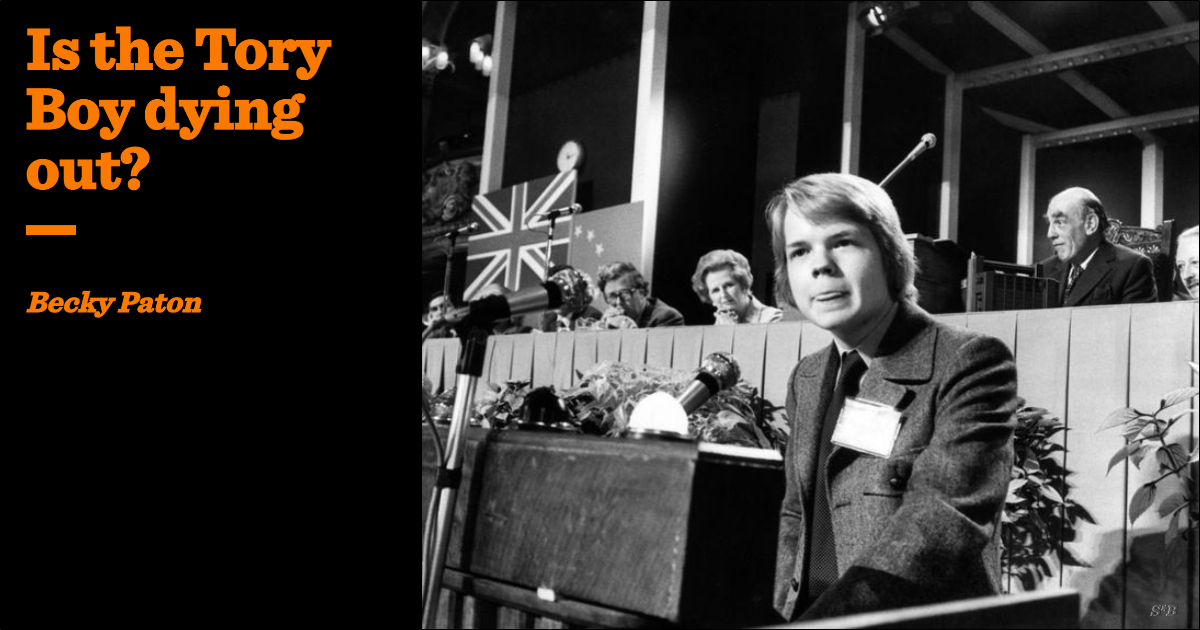
The aesthetic and social identity of the “Young Conservative” is instinctively recognisable. University Conservative clubs have a familiar fare of port, cravats, and a loyalty to tradition that would seem ridiculous to their Labour contemporaries. William Hague emerged fully formed in a tweed jacket and tie at 16 as the eidos of the aesthetic “Tory Boy” in 1977, and carried that brand with him through Oxford and Westminster. Compared with other campus politics, the “Young Conservative” is conspicuous to eschew the popular and the cool, confident in being bedecked in corduroy whilst trying to rehabilitate Stanley Baldwin. The “Tory Boy” aesthetic became a satirical trope in the eighties with Harry Enfield and Fry and Laurie, but even in mocking there was a deference that this was someone who had thought seriously about their political philosophy and social identity.
Reform’s aesthetics are intentionally brash. Events this week have included a boxing match in Essex, a mass rally at Birmingham’s NEC, and an announcement that revealed the “shadow cabinet” on stage like reality show contestants. All featured the signature Reform mix of the camp with the disruptive; smoke machines, confetti canons, an Elton John singalong followed by the National Anthem. A conscious aesthetic that rejects the conventions of a traditional political gathering. Even Reform’s turquoise signals their anti-establishment branding, a more garish hue than the darker Conservative Blue. In opposing the Conservative political culture, Reform visuals are unashamedly aspirational; this is their aesthetic pitch to Deano’s England, the working and lower middle class Leave voters that lay their path to victory.
The first blows in the Young Conservative brand may have already been struck. It’s been reported that members of the Cambridge University Conservative Association made their way this week to Reform’s Romford rally; Reform associations have encroached on the university Tory heartlands of Durham and Exeter, too. The question is whether Reform can replicate an aesthetic and social identity to rival that of the Conservatives, and become the effortless political home of the young right-winger. And, ultimately, whether winning is enough to persuade the last of the “Tory Boys”