“Painting is but another word for feeling,” the English landscape artist John Constable wrote to a friend in 1821.
In “Constable’s Year: An Artist in Changing Seasons,” art historian Susan Owens delves into the painter’s deep feelings for his native Suffolk county, which are reflected in his art. Owens’ compact, beautifully illustrated book is an illuminating introduction to a man who devoted himself to capturing the rhythms of the seasons in his beloved rural corner of England.
The publication of “Constable’s Year” coincides with the 250th anniversary of the artist’s birth, which is being celebrated with a blockbuster exhibition at the Tate Britain museum called “Turner & Constable: Rivals & Originals.” The show pairs the two landscape artists, who were born just a year apart but whose lives diverged markedly. After reading this book, you’re unlikely to confuse J.M.W. Turner and John Constable again.
Why We Wrote This
In “Constable’s Year: An Artist in Changing Seasons,” author Susan Owens delves into John Constable’s devotion to his beloved corner of England. He returned again and again to the landscape, painting it with delicacy, sensitivity, and an eye for detail.
Turner was born in sooty London in 1775 to a family of modest means, but his star rose much more rapidly than Constable’s. Turner, a prodigy, enrolled at the Royal Academy of Arts at age 14, and exhibited his first watercolor there in 1790, when he was 15. By 1802, he was elected a full Royal Academician. Turner traveled extensively in Europe, and earned a steady income from sales of his idealized, romantic landscapes and raging seascapes.

Constable, on the other hand, who was born in 1776 into an affluent merchant family in East Bergholt, stayed close to home and set out on a less assured path to acclaim. His father, Golding Constable, a gentleman farmer who had built a lucrative business milling and transporting grain, expected his son John to succeed him. It wasn’t until 1799, when John’s younger brother Abram agreed to take over the family business, that Constable could enroll in the Royal Academy of Arts. His first painting was accepted for the Royal Academy’s summer exhibition in 1802. But to his frustration, he was not elected a full Royal Academician until 1829 – three months after his beloved wife’s death, and just eight years before his own, in 1837.
Constable’s insistent focus on realistic, detailed farming scenes was not a popular move. “East Bergholt was to Constable what the Alps were to J.M.W. Turner,” Owens writes. Turner’s work was considered poetical; Constable, in contrast, was drawn to “the prose of the agricultural year.” His paintings were dominated by vast skies and ominous clouds, conveyed with thick lashings of oil paint to capture the weather in all its moods.
Constable’s landscapes were dotted with farm laborers plowing fields and tending locks and windmills. Much of his work failed to sell, yet he balked at taking on commissioned portraits or teaching jobs. He avoided tailoring his vision for the sake of a paycheck. When he did take a commission in 1814 from a wealthy neighbor as a wedding present for his fiancée, Constable produced “The Stour Valley and Dedham Village,” which featured a dunghill in the foreground. The artist was interested in all aspects of agriculture, even a heap of manure.

© Yale Center for British Art, Paul Mellon Collection
Constable met the love of his life, Maria Bicknell, in 1809, when she was 21 and he was 33. Alas, their marriage, like artistic success, was long delayed, because Maria’s grandfather, the wealthy rector of East Bergholt, vehemently opposed the union. His objections were financial and social: Constable had no steady income, and his family was not gentry.
The couple finally married in 1816. They settled in London proper and later Hampstead, with Maria giving birth to seven children in rapid succession. Constable returned to East Bergholt repeatedly to paint and sketch. Owens points out that the couple’s protracted courtship and seasonal separations had a silver lining: The reams of intimate letters they wrote to each other when apart are a gift to future biographers.
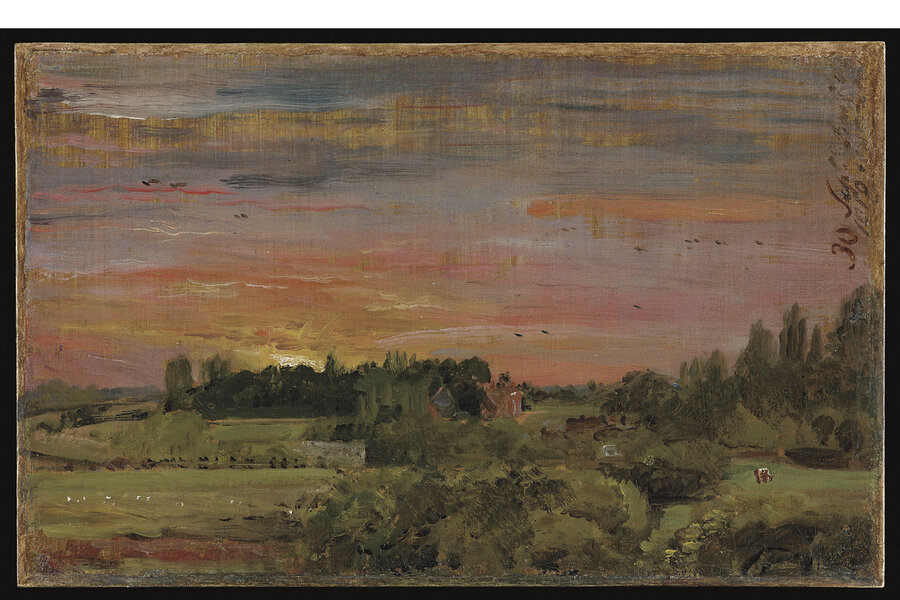
Owens’ close consideration of Constable’s paintings in the context of his life and times – and nature’s mutable seasons – is a gift to readers. For example, she enriches our appreciation of one of the artist’s most striking works, “The rectory from East Bergholt House, 30 September, 1810,” by pointing out that “Constable painted this view at dawn, from a back window of his family home,” looking out toward where Maria stayed when she visited her grandfather.
With that context, we come to understand that the dramatically streaked red-and-mauve sky over the darkened fields that separate the two lovers renders the artist’s emotions in paint.
Owens’ book is a testament to the emotional power and timelessness of great art.