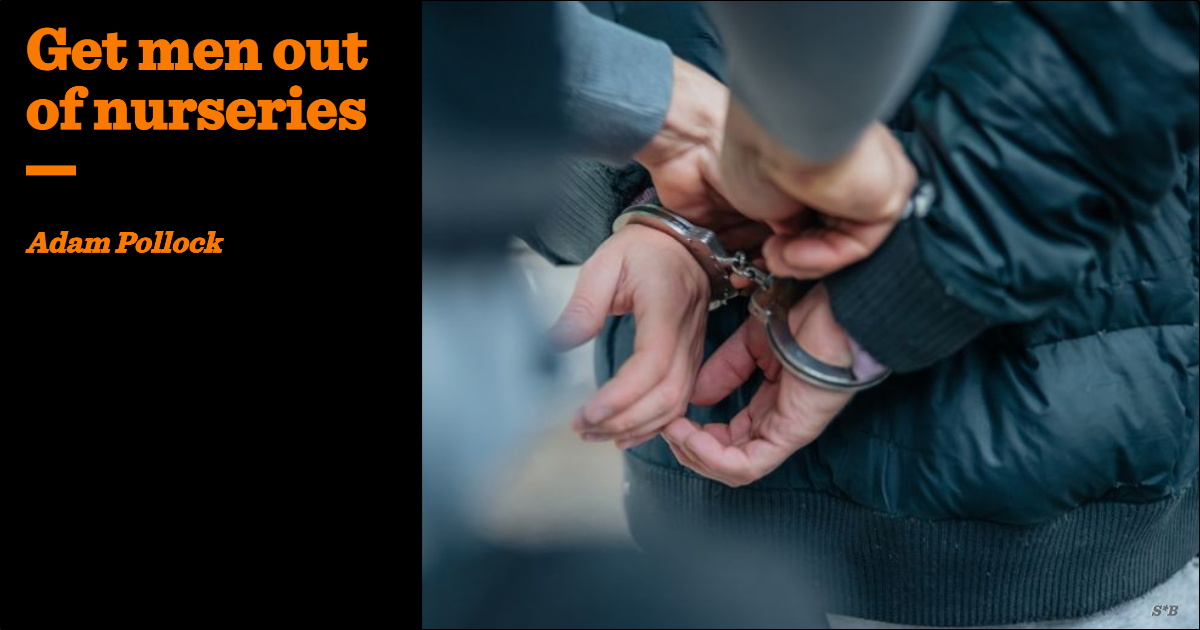
We have to be more realistic about gender differences — especially when children are at risk
This week, a man in Bristol has been found guilty of raping and sexually assaulting five young children at the nursery he worked at. The jury at Bristol Crown Court heard that Nathan Bennett would sit the young children on his lap for extended periods of time while wearing trousers with holes in the crotch. Bennett said these actions were intended to make the children “happy and feel better”.
Nathan Bennett abused his position of care and trust for horrific means, damaging some of our society’s most vulnerable people in the process. Whatever his sentence, it will be too lenient.
Unfortunately, this case is one of a number of similar that have played out recently in Britain. In December, another male nursery worker, Vincent Chan, pled guilty to sexually assaulting four young children at a nursery he worked at in London — as well as taking indecent photographs of these, and other, children. The Crown Prosecution Service found over 26,000 indecent images on his computer, yet he was working with children. Last month, he pled guilty to 30 additional sexual offences, including against children.
In November, a teenager, Thomas Waller, was sentenced to 15 years in a young offender’s institution for raping and sexually abusing two boys at a nursery he was working at — within several days of commencing employment. Similarly, in 2024, Craig Ordish was sentenced to 10 years in prison in relation to sexual offences he committed at a nursery school he worked at Burton-on-Trent.
At the end of last year, in Australia, a childcare worker was charged with 70 child abuse offences, in addition to a further 83 alleged offences, in a case so severe that authorities encouraged around 2,000 children across 20 facilities where the perpetrator worked to undergo testing for infectious diseases.
A hugely disproportionate number of those who have committed offences against children are men
The individuals who are convicted of committing these abhorrent acts from such positions of trust should face the harshest punishments that our legal system allows for, but it is a gross failure of civil society that allowed them to end up in these positions in the first place.
To protect young children from harm, in a society with safeguarding systems that clearly do not work, men should be banned from working in nurseries.
Of course, it is not all men, but that does not matter. A hugely disproportionate number of those who have committed offences against children are men — 91.3 per cent according to the latest figures from the Office for National Statistics — and, in Australia, these individuals have been found to be three times more likely to work with children than the average man.
The only comprehensive study dealing with child sexual offences by nursery staff dates from the mid-1980s in the United States. Looking at empirical data from 270 cases of abuse in nurseries, it found that men constituted 60 per cent of perpetrators in these cases, despite constituting only around 5 per cent of nursery staff. “It is … remarkable that men were still responsible for the majority of abuse in day care,” the author dryly commented. This study, and the wider evidence, suggests that, around the world and across decades, many men are actively seeking employment in the childcare sector specifically because it facilitates easier access to large numbers of children who they can then abuse.
All this comes in a context where His Majesty’s Government last year launched the “Do Something Big” campaign with the explicit intention to “encourage more men to join the early years workforce” to bring more “male role models in nurseries to help children thrive”. The campaign’s press release stated that just 3 per cent of the early years workforce in Britain are men. I doubt the “something big” they imagined happening was men committing a disproportionately large volume of the child sexual abuse offences in nursery schools.
Violence — including sexual violence — against children is prevalent in our society. The authorities often decry this violence, but little appears to ever happen. As the Independent Inquiry into Grooming Gangs takes place this week, many in the media and Parliament continue to be silent as evidence of large-scale sexual offences against children is revealed. The Inquiry heard that some victims alleged that they were raped by hundreds of men. There is no possibility that the abuse of children can happen on this scale without systems that are supposed to be in place to safeguard young people either failing or actively being subverted for these malign actions, let alone that few individuals have ever been prosecuted for their involvement in grooming gangs.
Children and young people need the systems in place in their society to have their best interests at heart. They are vulnerable and powerless, and rely on adults to protect them from any potential harm, wherever it may come from. For safeguarding systems not to pick up on several instances of child sexual abuse in early years care shows that these systems are failing. While they continue to fail, without anything seemingly being done to attempt to fix them, children who attend nursery schools are not adequately being protected.
None of this is to deny that many men working in nurseries are well-intentioned (as well as competent and hard-working). It will be sad to deny them employment. Alas, the risks created by a criminal minority outweigh this unfortunate side effect of its exclusion. It is regrettable to have to make such sweeping judgements — but not half as regrettable as child abuse.