
Here’s an odd thing: an exceptionally likeable production of an opera frequently accused of being most unlikeable these days ― if only by halfwits, but there are a lot of them around ― with its arrestable-offence message that women can be almost as ghastly as men.
The usual technique now is to do a lot of breast-beating about Mozart’s supposed misogyny, while excusing putting the show on at all by going on about how super the music is, pity he was such a dick, etc. Phelim McDermott’s staging, first seen here in 2014, insouciantly sidesteps everything “controversial” about the opera by just ignoring it. McDermott is not really an opera guy, though he’s put on some very successful stagings of Philip Glass here: his main thing in life is the theatre group Improbable, whose best-known production is probably My Neighbour Totoro. Anyway, he doesn’t care to delve much below the surface of operas, but the surface is attractive, and though there’s a lot of somewhat tangential business, it doesn’t obscure the piece, which gets to speak, in an unmediated sort of way, for itself. Which makes it a treasurable rarity, really, in days when directors insist on beating us round the head with their frequently silly opinions.
As we know, Così can do its speaking in different ways. The amazing thing is that this foolish story can still not only hold our attention but suddenly grab us by the throat and the heart — and can also simply be Thomas Beecham’s carefree, cloudless day by a southern sea: a jolly and harmless tale of four adolescents growing up, or alternatively something with terrifying implications about the fragility of love and our apparently unconquerable urge to wreck it. Nobody knows how Mozart does it; in the hands of any of his contemporaries it would be an amusing little fripperie, but somehow Mozart (armed with little more than a butter-wouldn’t-melt-in-its-mouth idiom, and the human voice) turns it into something that can reach deep into the human heart; even the sunniest staging can ambush you with some godlike perception rendered through a musical phrase, a moment of orchestration and phrasing, that looks like nothing at all on the page.
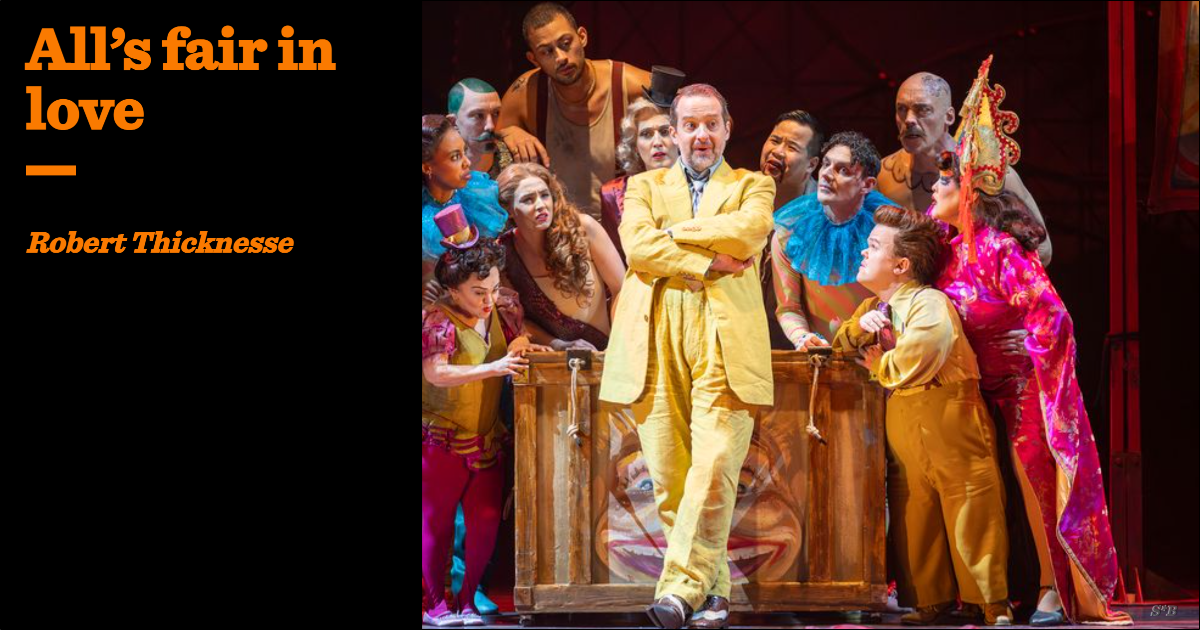
So, here we are in Coney Island, 1950, first greeted with a spangly curtain and a box of tricks, out of which clamber a dozen fairground performers to set out McDermott’s stall with a jokey routine during the scurrying overture. It’s a fairyland sufficiently distant in time and space to defang any carping about current politics ― though you can’t help noticing with a little pang the different impact of the freak-show posters (Sweet Marie ― 643lbs!; Daughter of Undetermined Sex!!) now from a decade ago.
Thereafter these guys do a limited amount of stuff (sword-swallowing, a decorous bit of contortionism, or simply being very small or very tall), but they’re handy for bulking up the chorus and shifting the furniture, of which there is quite a lot in Tom Pye’s entertaining designs (more than that: this is one of those shows in which the design more or less is the staging) of seaside fun-park and motel, beautifully lit ― you get a lot of visuals for your money here.
Possibly this fairground shtick was born as a solution to the more arrant idiocies of the plot ― eg, the sideshow quack makes a handy fake doctor to “cure” the two boys of the poison they pretend to drink when their overtures to each other’s girlfriend (basically the result of a drunken bet) are rebuffed.
Both girls eventually surrender to the supposed strangers, and the opera mulls over various degrees of love and betrayal as the experiment gets out of hand, before happy reconciliation. But that’s not really the concern of this manic staging, which zips from tunnel-of-love to motel (with much Whitehall-farce room-hopping and neat rotating walls) to Vegas-style wedding compered by line-dancing cowgirl preacher, with boundless energy.
A show like this is up for grabs ― by the singers; back in 2014, it was grabbed by Christine Rice (Dorabella) and Mary Bevan (Despina). This time ― no surprise ― it’s Lucy Crowe as Fiordiligi who does the grabbing, making it a completely different show. Ms Crowe has been our loveliest Handel-Mozart singer for ages, and I hear her as often as possible, but you forget how sheerly beautiful a voice it is until it gets to bloom in a space like the Coliseum. It’s also full of shades and colours and she knows absolutely how to deploy it, with a purity of focus that sends even the pianissimos to the back of the top circle. The second she starts singing you know this is going to be special, and of course it makes her late aria ‘Per pietà’ (‘I have sinned’, in Jeremy Sams’s lively translation) the absolute centre of the show. And thank God McDermott doesn’t have her charging around like a Ray Cooney chambermaid this time, unlike in her first aria, so she and Mozart get to do their thing without interference.
But what a thing… Mozart concentrates the loss of innocence, and all the joy and sadness that comes with it, into a few minutes of understated music, stately melody, an accompaniment that starts hymnlike and bursts into semi-sarcastic horns and woodwinds, and a final cadence, nothing special, nothing that hasn’t been written a million times, but with some magical, tiny turn of musical phrase it chokes you up with its untranslatable eloquence.
In the way of things, this tends to eclipse the rest of the show, which is effectively reclassified as straightforward “entertainment” ― a rare enough thing in the opera house, and to be greeted like a pop-up cocktail bar in the desert. Ensembles tend to be strung in tableaux across the stage, arias directed with a bit of more or less irrelevant business, which means it comes down to individual voices, to the skill and charisma of the singers: and the other five principals are all pretty good, and they all have their moments, growing into the roles.
Andrew Foster-Williams and Ailish Tynan are buzzing as the MCs of the partner-swapping shenanigans, with the various unconsciously-duped subjects of the experiment undergoing exactly the adolescent mood-swings you’d expect of people dimly aware they are not in control of what’s happening. Tenor Joshua Blue is altogether too forthright to do justice to the early “Un” aura amorosa’ (“The voice of an angel”), which so poignantly lays out exactly what is being risked in the way of smashed-up hearts, but it’s a great, strong Italianate voice that works much better when Ferrando melts down later on. With mezzo Taylor Raven, singing flighty Dorabella, there’s a very special voice in there, but it’s a bit fuzzy in its detail, and she was really just singing the notes rather than what’s behind them. Darwin Prakash was an impressive and fiery Guglielmo: his spiteful song about faithless women was strongly done, and very cutely undermined by the unimpressed females behind him at the hot-dog stand.
What I really should have said first is that this is all predicated on a bouncy, responsive, hugely attractive orchestral performance conducted by Dinis Sousa: beautifully paced ― the time flew ― and with an ear for Mozart’s phrasing and sound-world (particularly the woodwind) that is far from common. Some of the recits could have had more zip, but you can hear every word.
The ending is sweetly blithe, so Mozart’s uplifting coda is for once allowed its comedy and generosity. There’s plenty of room for future rancour in what has passed, no doubt, but it’s nice to see everyone being given at least the chance of forgiving each other for much pretty terrible behaviour. And who doesn’t need that?
At ENO until Feb 21