With bad news upon bad news for the royal family, why do its political opponents remain so obscure?

If you were a republican living in Anno Domini 2026, you would look at the current scandals enveloping the royal family and think that all your constitutional wishes and hopes had come true at once. The former Duke of York, Prince Andrew, who endeared himself to few, if any, in his pomp thanks to his consistent rudeness and arrogance, has had one hell of a downfall, which has included everything from his titles being stripped from him last year to being evicted from his home of Royal Lodge in the middle of the night last week.
His brother King Charles has been criticised for not taking decisive enough action against him until it was too late, and even their sainted mother, the late Elizabeth II, is now taking her posthumous share of blame for apparently enabling her son’s relationship with Jeffrey Epstein — not least in a £10 million pay-off that the most notable of all Epstein’s trafficked girls, Virginia Giuffre, received, in order to stop a potentially devastating civil court case against Andrew, that could have brought out all sorts of damaging disclosures into the public domain.
Well, thanks to the release of the Epstein files, these have now emerged and then some, with the sheer preponderance of grim and unsavoury detail related to Andrew being quite extraordinary. The American politician Ro Khanna, who has spearheaded the release of the unredacted Epstein files, has even announced, with no little drama and self-promotion, that these could be “the end of the monarchy”. Not since the Civil War and subsequent brief period of republican rule in Britain has such a thing been seriously contemplated. Yet now, with scandal breeding discord and a lack of trust in the very institution of the monarchy, surely it is the time that someone of republican sympathies might emerge to put the boot in, potentially to terminal effect?
There is still an overwhelming level of support for the British royal family
This is where the surprise comes. If you were visiting from any other country that had ditched their monarch for a republic — perhaps our neighbours in France — you might be shocked to find that there seems to be no greater appetite for President Starmer or the like than there was a few months or years before. While headline-grabbing figures can be taken from various YouGov polls and the like asking members of the public if they still support the monarchy, there is still an overwhelming level of support for the British royal family.
In the most recent large-scale poll, conducted after October’s scandalous revelations, 62 per cent of Brits have a positive opinion of the monarchy, despite everything. Of all the voters interviewed, only the Greens (who are rapidly establishing themselves, under avowed republican and breast-enhancer Zack Polanski, as the most left-wing game in town) display a clear antipathy towards the royals. A total of 72 per cent of those asked suggested that they were either neutral towards the monarchy, or actively embarrassed by it. This stands in distinct opposition to the majority of Britons, where a total of 77 per cent retain neutrality, with 45 per cent (including 80 per cent of Conservative voters and 61 per cent of Reform voters) declaring, despite everything, that they are still proud of having a royal family.
Polanski, for all his undoubted skill at rabble-rousing, has shown no particular interest in abolishing the monarchy, saying to the Observer last year that “It’s not a priority, but I am a republican.” It’s a classic politician’s answer — playing to his base without promising any action. Yet if the most popular and accomplished left-wing politician in Britain — not a high bar, admittedly, but there we go — has no interest in becoming the figurehead for any kind of republican movement, what hope does it realistically have?
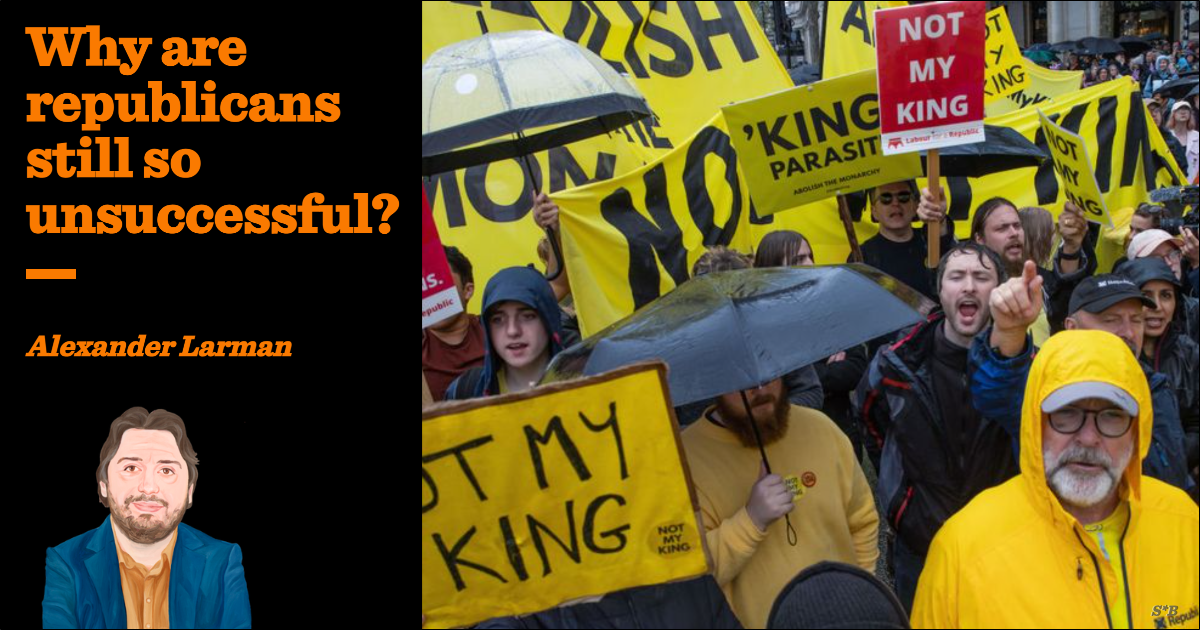
The Republic pressure group, led by Graham Smith, has achieved a degree of mild success with some of their stunts, many of which have involved them being led away from royal ceremonial occasions by heavy-handed police and gaining sympathetic news coverage that way. Yet few people have been inspired to become members of Republic — even at a time when there seems to be widespread anger at the privileged and indeed unaccountable actions of Andrew Mountbatten-Windsor.
Republicanism in Britain might have had its crowning moment in 2022, after the death of the much-loved Elizabeth II. The fact that it did not was down to a mixture of clever stage-management — the endless queue forming to visit the late monarch lying in state in London — and the absence of a popular (or populist) public figure who has ever declared themselves for the republican cause. Reform is not about to do so, despite some choice remarks that Nigel Farage has made about various members of the monarchy over the years, and neither the Conservatives nor Labour have shown any appetite for such a constitutional upheaval, despite or because of the unmitigated power and influence that such a shift would offer their executive.
In other words, despite the horror and anger many feel at the status quo — and a desire for systemic upheaval and change — the sheer lack of a compelling, charismatic figurehead for a republican movement means that it is currently foundering, without any likelihood that it is going to gain popularity any time soon. Yet we live in febrile times, where things once thought impossible are happening on a virtually daily basis. Should the Epstein story yield even greater horrors, the monarchy may yet implode on its own, unaided by the hand of a politician.
The question then is who would benefit from such an implosion, and who would be left forlornly waving a tattered Union Jack, humming “God Save the King”. Perhaps there would then be an appetite for a second Restoration, led by the Duke and Duke of Sussex, coming fresh from Montecito — but such things are best left in the realms of the fantastical, or horrific.