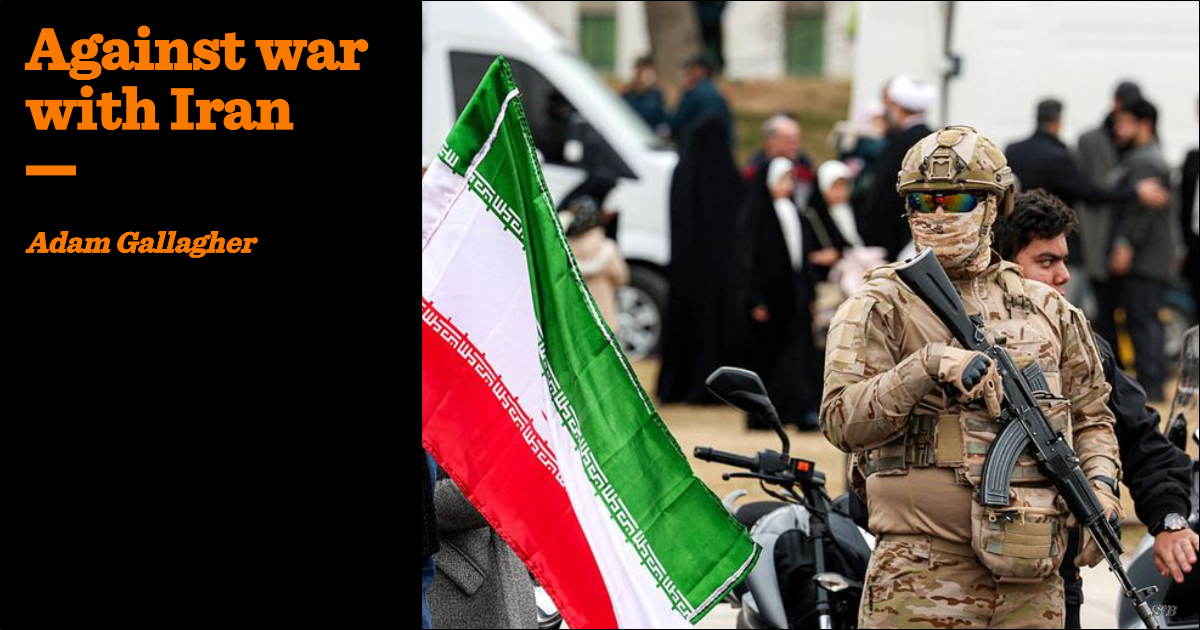
For weeks, the United States has publicly deliberated attacking Iran for the second time in less than a year. Iran responded in a largely symbolic fashion after attacks on its nuclear facilities in June 2025, ultimately leading to de-escalation. But the Islamic Republic is now weaker than ever, facing intense internal unrest on the heels of U.S. and Israeli moves over the last two years that have greatly weakened the regime. Given the existential stakes, Tehran has a strong incentive to respond in brutal fashion to a U.S. attack. Indeed, the country’s supreme leader has threatened to ignite a “regional war.” This is an outcome Washington should avoid, especially given the risks this would pose to U.S. troops in the region.
Military options against Iran have little strategic upside and threaten numerous unintended consequences that would destabilise the region and harm U.S. interests. On the other hand, diplomacy with Iran — which poses no threat to the U.S. — has very few drawbacks. The indirect talks held in Oman on February 6 were a good first step. But if diplomacy fails, the U.S. can simply walk away. While it would be better for U.S. interests to find a modus vivendi with Tehran, a stalemated status quo is certainly better than an all-out regional war.
In mid-January, President Trump told Iranians “help is on its way” amid the regime’s draconian repression of a widespread protest movement, suggesting an impending U.S. strike. At the time, the administration’s reasoning for using force was to help overthrow the regime. That rationale has shifted over the subsequent weeks amid a buildup of U.S. military assets in the region.
Regardless of the justification, the administration should recognise the limits of what can be achieved and be wary of how unintended consequences could dramatically damage U.S. interests. Washington’s illegal war on Iraq serves as case in point. That war resulted in the deaths of more than 4,600 Americans and tens of thousands of Iraqis, while costing upwards of $2 trillion dollars. To this day, the U.S. still has troops in the country. The war not only led to the rise of ISIS but also significantly strengthened Iran’s strategic position.
Meanwhile, 15 years after the U.S. intervention in Libya helped overthrow Moammar Qaddafi, the country remains deeply fractured. Libya’s collapse created fertile ground for ISIS to grow, prompting later U.S. anti-ISIS operations, and led to weapons proliferation in a region that is now a major breeding ground for transnational terrorism. Libya has also become a global hub for human trafficking networks and the vacuum there led to high levels of migration into southern Europe, resulting in security crises that have required NATO action.
Those who call for regime change in Tehran should be careful what they wish for. Iran is a vastly larger country than Iraq or Libya, and its military is far more capable than either of those countries. A civil war in Iran would destabilise the Middle East in untold ways. In the chaos of such an internal conflict, the country’s massive weapons stockpiles could fall into the hands of international terrorists. If the Islamic Republic were to fall, the likely successor regime would emerge from the Revolutionary Guard Corps and be as hardline, if not more, than the current one.
Beyond regime change scenarios, a regional conflagration set off by Iran in response to a U.S. attack would not only destabilise the Middle East, but risk the lives of the roughly 30,000 U.S. troops in the region and further entangle the U.S. in a region of declining strategic importance.
The Trump administration must also consider the costs. On February 3, the U.S. shot down an Iranian drone as it approached a U.S. aircraft carrier. The drone cost $20,000, and the missile used to shoot it down cost $2 million. With Iran’s flourishing drone industry, this type of asymmetric warfare would certainly be a feature of a U.S.-Iran conflict. The U.S. dealt with similar math against Yemen’s Houthis and decided the cost wasn’t worth it.
During the 12-day Israel-Iran war in June, the U.S. expended roughly a quarter of its supply of high-end missile interceptors. A longer-term war would seriously diminish the stockpile of this critical missile defence system.
Longtime adversaries of Iran, like Turkey, Saudi Arabia, and Egypt, have urged the United States to pursue diplomacy. They now see Israel — which is pushing for this war and seeking to add poison pills to the negotiations — not Iran, as the greatest threat to peace and fear yet another destabilizing regional war.
The Iranian regime is odious and the people of Iran deserve a better one, but so do many around the world. The U.S. can’t make that happen at gunpoint.
Those who have long called for the U.S. to start a war with Iran see this as a moment to deal a death blow to the regime, but they conveniently forget (or ignore) the horrific consequences of past interventions. If anything, Iranian weakness provides all the more reason for the U.S. to negotiate from a position of strength or walk away. But another Middle East war should be off the table entirely.