It’s hard to get more right-wing than Essex. England’s estuary county is home to both Nigel Farage (Clacton) and Kemi Badenoch (North West Essex). With Andrew Rosindell’s (Romford) recent defection, Essex is now the first place to have hosted three Reform UK MPs.
Of all the corners of the country, Essex was arguably the place that benefited most from the Thatcher revolution
What makes Essex so right-wing? It’s certainly not a new phenomenon. Writing for the Sunday Telegraph in 1990, Simon Heffer identified the “Essex man” as the core constituency of Margaret Thatcher. They were a new type of voter, he said, “young, industrious, mildly brutish and culturally barren”.
Of all the corners of the country, Essex was arguably the place that benefited most from the Thatcher revolution. The flagship right-to-buy scheme was launched in Romford, Essex, in 1980. The rejuvenation of the London Docklands, now the second most productive place in the country, is best accessed from Essex over any of the other home counties.
The City of London, too, which boasts two mainline railways to Essex, employed nearly 40 per cent more people by 1990 than in 1980, and has more Essex commuters than anywhere else. In fact, Essex has more London commuters in general — 150,000 people every working day. Essex, arguably, is what makes London work.
Unlike large swathes of the country, Essex had little to no collapse in heavy industry during the Thatcher years. This is mostly because Essex has few large conurbations and grew from a largely agricultural county in the post-war period. All three Essex cities — Colchester, Chelmsford and Southend-on-Sea — contain fewer than 200,000 people. Towns, more than any other type of settlement, have swung to the right in the past 20 years.
In comparison, Berkshire hosts Slough; Bedfordshire hosts Luton; and Cambridgeshire, Cambridge — all cities that lean considerably to the left. Essex has also avoided the large conglomeration of ethnic minority voters now common in most British cities. Ethnic minority voters, with the possible exception of Hindus and the Chinese, generally vote to the left.
Essex’s right-wingness, however, is not primarily due to economic prosperity. Essex’s £32,600 GDP per head is markedly lower than the English average of £40,400, or the London average of £69,000. Essex is, on the whole, far more working-class than its well-heeled neighbours of Hertfordshire or Kent. It has fewer private schools too — just 38 according to the Independent Schools Council, compared to 93 in Surrey or 52 in Kent. Essex then, is more of a grammar school county than a private school stronghold (albeit with a lot of bog-standard comprehensives).
Being a grammar-school county comes with a certain type of working and middle-class aspiration not common in private-school land. Thomas Skinner, the Romford-born pillow-seller and “bosh bombshell” is your typical entrepreneurial “Essex man”. Crucially, “Essex man” are not Tories for the status symbol like private school-land, but because they’re authentic, hard-working, and patriotic. Private school alumni, according to More in Common, are the most likely to vote Labour (38 per cent), whereas grammar school alumni are the least likely (14 per cent).
While many richer parts of Britain have deserted right-wing politics for the Liberal Democrats (think of the Guardian’s claim that the posh bakery chain Gail’s was the “most powerful political bellwether” for the LibDems), Essex has not. Along with Kent, Essex was the only home county to swing away from the Liberal Democrats in 2024, not towards them.
In fact, Essex’s working-class nature sometimes attracts snobbery from the liberal intelligentsia. The Times columnist Matthew Parris once wrote that the dilapidated seaside town of Clacton was a “friendly resort trying not to die, filled with friendly people trying not to die”. The Tories, he said (as a self-described one-nation Conservative), “should turn their backs on Clacton”. Clacton, shortly after the piece was penned, voted overwhelmingly for the UKIP candidate in a by-election.
Broader demographic shifts have also made Essex hostile to the excesses of unfettered immigration
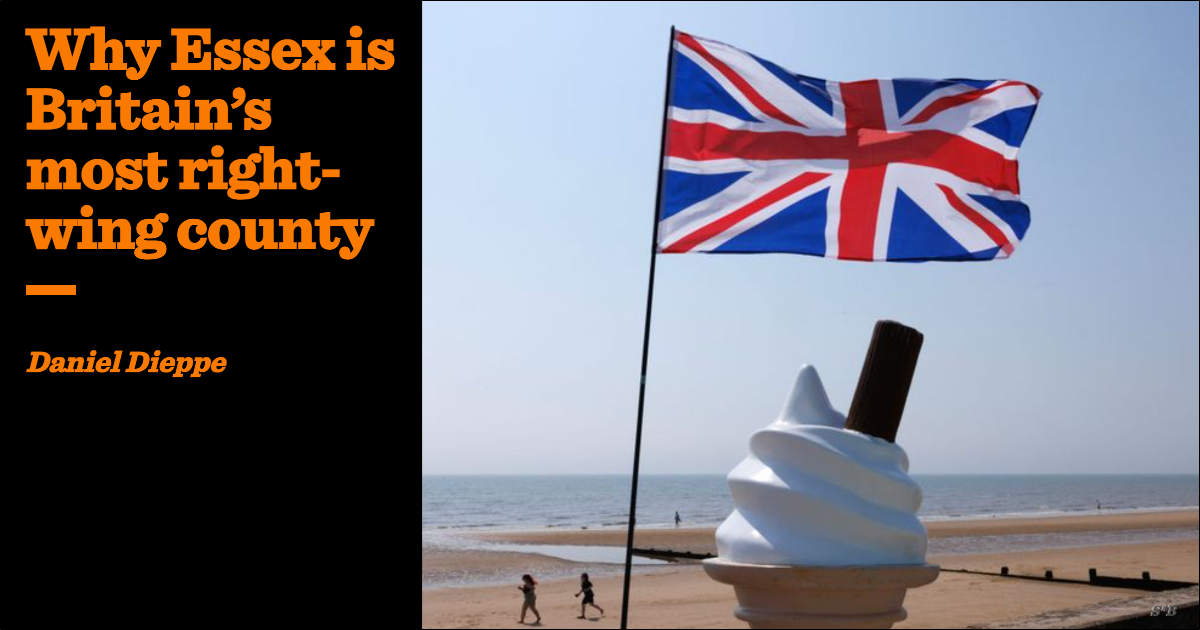
Since the 2024 general election, Essex has been at the heart of right-wing antagonism. Of all the hundreds of migrant hotels in Britain, it was The Bell Hotel in Epping, Essex that was the focal point of the anti-immigrant campaign. The raising of England and Union flags around the country coincided with locals’ objections to an Ethiopian asylum seeker’s sexual assault on a 14-year-old.
Broader demographic shifts have also made Essex hostile to the excesses of unfettered immigration. Essex is home to a diaspora (if that’s the right word) of Cockneys who left London. Forced out partly because of ill-advised Government slum clearances, partly because of gentrification, and partly because of Bangladeshi immigration into East London, the London Cockneys today hardly exist.
Moreover, unlike the more provincial parts of England, Essex is right on the border of the east end of London, which has been radically transformed by immigration. People from Essex are much more aware of immigration than, say, those from Norfolk or Hampshire.
I suspect that while immigration remains Britain’s most salient issue, Essex will remain Britain’s most right-wing county.