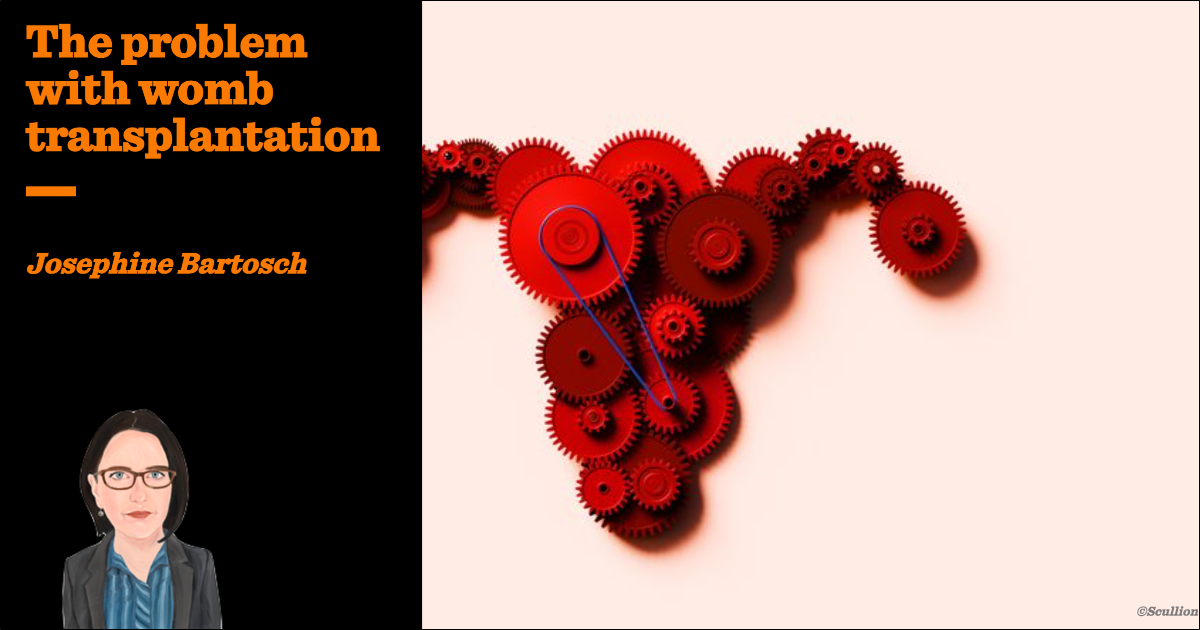

To our national broadcaster, the story was what tabloids call a TOT: a Triumph Over Tragedy. Grace Bell, born without a womb but with functioning ovaries, became a mother thanks to the wonders of modern medicine. The year before giving birth to baby Hugo, she underwent a transplant using the womb of a dead woman. “I think of my donor and her family every day,” she told the BBC, “and pray they find some peace in knowing their daughter gave me the biggest gift: the gift of life.”
On a personal level, it seems cruel to begrudge this new family their happiness. Bell endured major surgery and immunosuppressant drugs so her body would not reject the transplanted organ, as well as IVF. As a result, a child has been born who would not otherwise exist. That is, in the most immediate and human sense, something to celebrate.
Yet such things can have second order consequences, and it is impossible to ignore the ghoulish shadow. Organ donation is an act of generosity and faith — the known dead helping the unknown living. Hearts, kidneys and lungs preserve life. But the purpose of harvesting an organ whose sole function is gestation is to create a new life.
Womb transplantation remains a rare and experimental procedure. The first successful birth following a transplant took place in Sweden in 2014, and globally around 100 transplants have since been performed, resulting in roughly 70 births. In the UK, three transplants have been carried out to date, but this is the first to result in a baby born from a deceased donor’s womb.
Helen Gibson, founder of Surrogacy Concern, has reservations, warning that the development will “lead to further casualisation and detachment from the realities of our sexed bodies and experiences”:
Not all scientific developments equal progress, and we fear the development of a dystopian view where wombs are seen as ‘spare parts’ to share out. Women’s bodies are not resources to be mined.
The conception of fertility as a right is the culmination of decades in which medicine and consumer culture have converged, promising mastery over the limits of flesh. In vitro fertilisation turned conception into a laboratory procedure. Commercial surrogacy separated gestation from motherhood. Egg freezing encouraged women to bank their fertility like savings accounts. Each innovation was presented as liberation from biological constraint. Yet taken together, they reframe reproduction as a service that can be commissioned, purchased or engineered. As the emergence of forced surrogacy and egg donation rings has shown, when fertility is treated as a resource, the unscrupulous will attempt to extract it from the vulnerable for profit.
Womb transplantation is an extension of this consumer mindset. It suggests that if you lack a womb, one can be found — if not from a living relative, then from the newly dead. The fact that English law requires explicit consent from families — because the womb is not among the organs covered by presumed consent — only underscores how novel and ethically ambiguous this territory remains.
For most of human history, fertility was understood as a blessing — and a precariously uncertain one. Prehistoric figurines such as the Venus of Willendorf, carved more than 25,000 years ago, depict women with exaggerated hips, breasts and bellies. These figures are believed to represent the mysterious and fragile capacity to generate life. They speak of a time when the ability to conceive and bear children was regarded with reverence, even awe.
This reverence arose precisely because fertility was contingent, precarious, and bound to the rhythms of the female body. It could not be bought, transplanted or manufactured. Miscarriage, stillbirth and infertility were ever-present realities. Birth itself was dangerous.
Modern medicine is amazing. Even if we sometimes take it for granted, few of us would spurn it if we were seriously sick. But there is a difference between healing the body and redesigning it. The more we come to see organs as interchangeable and reproduction as a technical challenge, the more we risk losing sight of the limits that once structured human experience.
Underlying all of this is a broader cultural shift: the erosion of our acceptance of who we are
Inevitably, the existence of womb transplantation has prompted speculation about the possibility of male pregnancy. Last year, after the first UK transplant using a living donor, when a woman received her older sister’s womb, the online magazine PinkNews asked: “Can trans women get pregnant? The answer is… maybe, in the future, if all goes well.” For now, such possibilities remain in the realm of science fiction. But the demands of men who want to colonise the female body, in particular those who are driven by a fetish to experience the women’s bodies, are a powerful force. Indeed, they have already changed laws across the world.
Underlying all of this is a broader cultural shift: the erosion of our acceptance of who we are. Increasingly, we are encouraged to see our bodies as avatars to be upgraded. Yet the prehistoric fertility goddesses remind us that fertility was once regarded as a force beyond human control. In their crude, enduring forms lies a recognition we would do well to remember: some gifts are not ours to distribute.