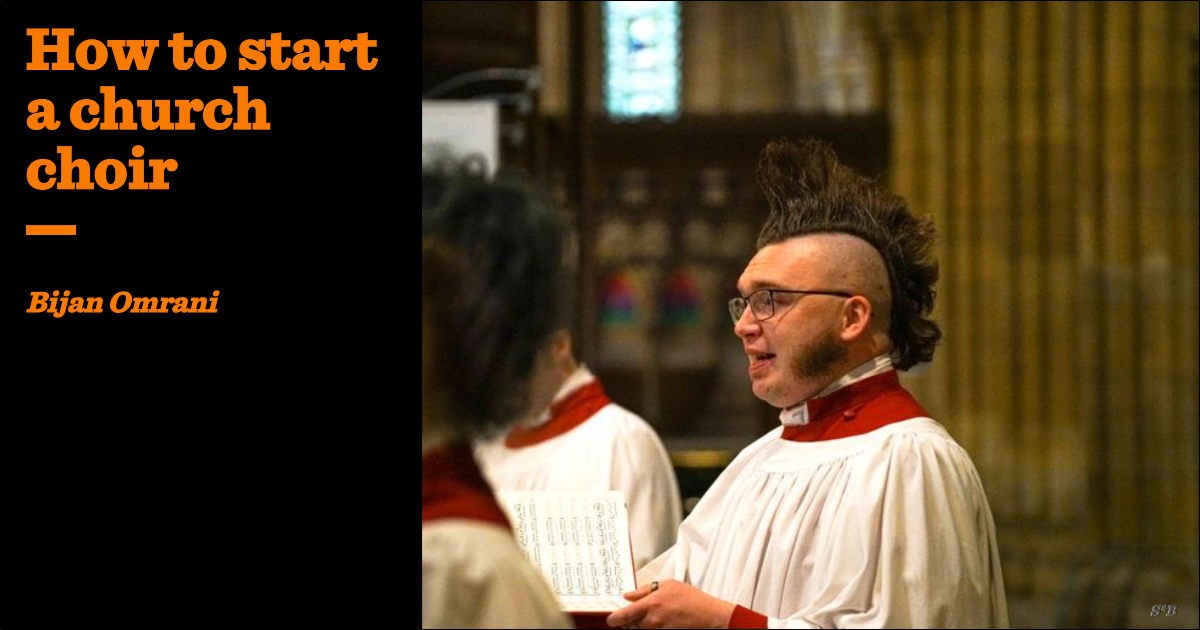
Sing hallelujah for the Royal School of Church Music (RSCM). They have just announced the launch of a new Choir Project, in the hope of reviving popular interest in hymn singing and engaging young people again with the tradition sacred of choral music.
This is essential work. Church choirs everywhere have been in decline for decades. Step into your average parish church, and you will probably find boxes of old choral music that haven’t been touched for decades, and dusty choir robes that have munched into lacy nothingness by generations of moths.
Whilst the moths grow fat, our knowledge of our own culture grows thin. The achievement of the great corpus of English hymnary, developed for the most part since the 18th century, and which did for the English “what opera did for the Italians” in the words of music historian Andrew Gant, is fading from common memory. The vast effort of building thousands of cathedral-style church choirs across the country even in the most out of the way parishes — another grand legacy of the Victorian visionaries, which trained local farm boys and tradesmen to sing and appreciate centuries’ worth of sublime liturgical repertoire of Tallis and Gibbons down to Stainer and Stanford — is now in widespread decay. Even the cathedrals themselves are struggling to keep up their daily services of evensong, particularly with ever-rising costs for education and cathedral choir schools.
Choral singing develops community and faith amongst not just those who sing, but those who come to church
The loss is not just cultural. In the words of Hugh Morris, director of the RSCM, choirs were one of the “most natural and joyful ways for young people to encounter faith… learn about worship, and grow in confidence and belonging.” Choral singing develops community and faith amongst not just those who sing, but those who come to church. Hearing choral music, especially in the context of traditional liturgy, is a brilliant introduction to Christian ideas and spirituality. It is not for nothing that at this time of the “Quiet Revival”, choral evensong is the most popular service in the Church of England, an area of real growth, not to mention being in the running (with English Choral Music more widely) for designation as having UNESCO World Heritage Status.
This being so, any parish church worth its salt would want to restart a choir. Hopefully many will, with the RSCM’s support. But while the Project has a budget of £400,000 (some of it – wonders will never cease — even given by the Church of England), it will only go so far. The RSCM hopes to support more than 200 churches — but there are over 11,000 parish churches in England. What to do if you can’t get any support?
I say that any parish church in England can start a choir under its own steam, and sing choral evensong as beautiful, dignified and spiritual as any of the great cathedrals.
No we can’t, I hear you cry. Look at us, you say. We have no experienced singers. There might be just three of us who would be up to trying to sing. We have no organist, and no-one who can conduct. When we have services, the vicar brings in a laptop and plays hymns off an MP3 over its tinny little speakers. How can you say that we could sing a cathedral-style evensong? We aren’t going to be cracking out Tallis’s 40-part Spem in Alium any time soon …
True, Spem in Alium might have to wait a bit, but there is still a repertoire which you can sing, and sing beautifully, even if there is just a tentative handful of you. It is entirely fitted to the tradition of Anglican worship and the Book of Common Prayer. It is simple, but spiritual, and contemplative. It can be developed without too much practice, and sung without too much stress. It is also highly attractive to congregations, who may have had a passing familiarity with it thanks to the one-time omni-presence of the saxophonist Jan Garbarek and late-80s New Age pop. That repertoire is Gregorian Chant.
In my own church, St Michael’s Shute in Devon, a scattered rural parish, we decided to start a choir just after the Pandemic. There were only a handful of singers, and certainly not enough to sing complex four-part polyphony. However, we were able to start a monthly evensong using the repertoire of Gregorian Chant. Unlike much of the normal evensong repertoire, Gregorian Chant is usually sung in unison; everyone can take comfort from being all together, and not have to face a daunting exposed solo line. The range of the notes is generally less than is required for four-part music — no warbling tenor or soprano top Gs. One normally keeps within a single octave. The line of the melody usually moves in a gentle, step-like fashion — again, generally no awkward leaps of a seventh or the like.
If you have an organist, it is possible to have a gentle accompaniment to the chant, but this is not at all necessary. Indeed, without an accompaniment, you can choose a pitch to sing at which suits all the singers. The chant has its own slightly different notation from modern music. It is rather simpler, with square-shaped notes for a full beat, and diamond-shaped for a short. There are a couple of ornamentations and abbreviations, but these are quickly learned. A useful guide to reading the notation is at this site.
All of the chants you would need for a basic Book of Common Prayer evensong can be found in the Stainer Manual of Plainsong 1902, which is available for free online. (The chants here are based on the medieval chants which were originally drawn from the pre-Reformation Sarum Rite, and are thus deeply grounded in an English tradition). As you start out, you can sing the Preces and Responses, the psalms, the Magnificat and the Nunc Dimittis. Aside from the Preces and Responses, which are very simple, the rest use a repertoire of easy repeated chants which do not offer a serious challenge to beginners. You can work out the notes on the piano, or else you could use the excellent YouTube videos recorded by Rev Canon Edward Carter of St Peter Mancroft. Rev Carter has recorded all, I think, of the psalm chant settings, and if you have no singing master to hand he can train you virtually. As an example, here is a link to him introducing and singing Psalm 139. There are also apps including SingtheOffice which can help with putting together chant services.
It is a great blessing to have someone with experience in leading a choir, and at my church we are lucky to have a brilliant organist, composer and choirmaster, Peter Lea Cox. But, even if you are without, it is still possible to get by. The chant is ultimately led by natural speech rhythms and the choir sensing how each other breathes, and when the right time is to move on, syllable by syllable, note by note. This is attained by practice, which will bring the choir together as a unified group deeply aware of each other and the music. This is an important part of the experience of chant.
If the chanted collects after the Responses — including the wonderful prayers “for that peace which the world cannot give” and “lighten our darkness we beseech thee, O Lord” — seem too much of a challenge at first, simply say them until one of you is confident enough to chant them in full.
Once you have grown in confidence and have been able to lead a service with these basic elements, you could then add in appropriate office hymns. A number of those which are of the pre-Reformation age were turned into English hymns in the Victorian times with the rediscovery of the earlier tradition, and can be found in the New English Hymnal, for example Creator of the Stars of Night (Conditor Alme Siderum) for use in Advent, or Come Holy Ghost (Veni Creator Spiritus) at Pentecost. These can be sung unaccompanied, and with the whole congregation if they are confident. Many have memorable melodies.
When even just two or three are gathered together in Christ’s name, that is still enough to get singing
As you progress even further in confidence, you can delve more deeply into the wider repertoire and try more challenging pieces. A huge amount of the inherited corpus of Gregorian Chant has been digitised, both as scores and as recordings. Excellent places to look are the GregoBase Database, Corpus Christi Watershed, and also for the distinctive English Salisbury pre-reformation chants of the Sarum Rite you can visit the compendium published by Professor William Renwick. You can sing this material in English or Latin (if your congregation has no objection, but do let them have English translations so as not to transgress canon law!), and use it as introits or anthems. Depending on where you fall on the Anglo-Catholic scale, you could even top and tail your services with the prayers of the Angelus and the Marian Anthems depending on the season (for example, the beautiful 11th century Salve Regina). You could also try the stirring Laudes Regiae (Christus Vincit) for the Feast of Christ the King.
When even just two or three are gathered together in Christ’s name, that is still enough to get singing. Gregorian Chant may not be what one is generally used to from visits to cathedral evensongs, but it is a wonderful and easy place to make a start for a new choir, and it may allow such a choir over time to grow in size and confidence enough to try the more familiar canticles and anthems of the post-reformation tradition. Everything you need to rebuild your local church choir is here: sing unto the Lord an old song …