
As everyone knows, Leos Janacek’s great late-years farewell to the world (finished in 1923) is a charming piece ― and, with a scattering of brats among the singers, dressed up as insects and fox-cubs, obviously runs the risk of being way too charming and cute, like some high-end school play. Luckily, Janacek also chucks a bunch of sex and death into the other pan; so, while (sadly) we don’t witness those fox-cubs actually being slaughtered on stage, a decent dollop of blood and guts lets director Sophie Motley wind the winsome up pretty high, without fear of making the audience throw up. Always hyper-alert to the possibilities of operatic nausea, my chilly-hearted date and I remained in good gastric health.
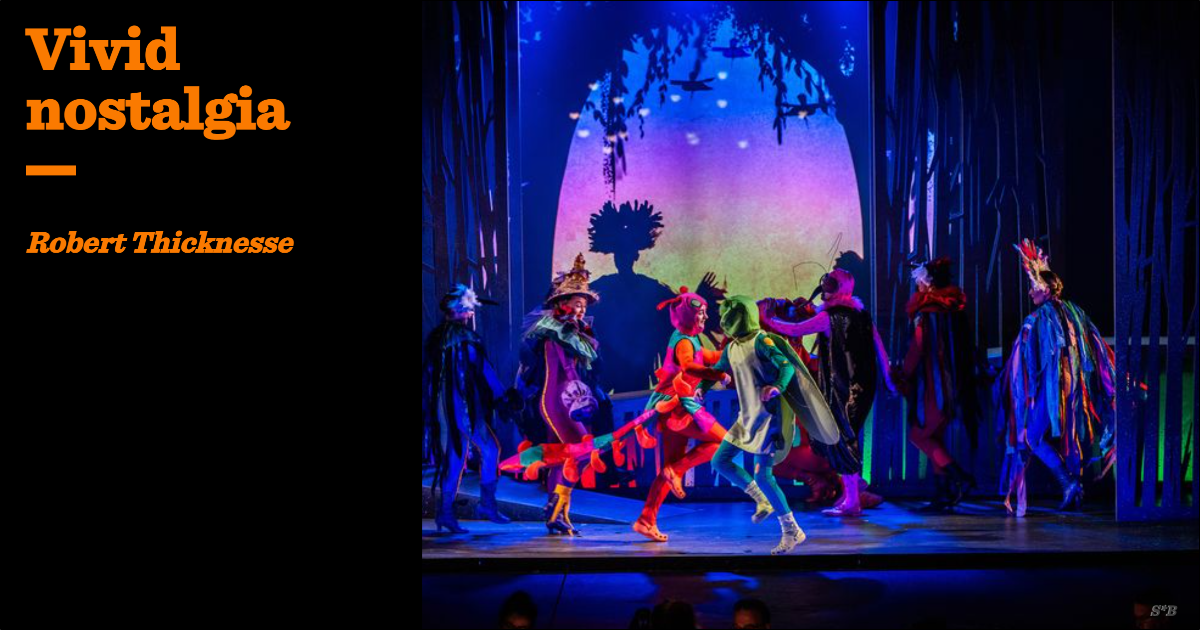
Nostalgia soaks through the piece, an atmosphere poignantly caught by Neil O’Driscoll’s silhouetty animations ― trees, wonky wooden buildings, monochrome or prettily pastel-lit ― together with a vaguely Japanese set of sliding latticed panels evoking the forest. Stick this together with the wistful string melodies that punctuate the chirrupping woodwinds of Janacek’s opening, and there you are, plunged into this old-time central European woodland ― with its modal scales and odd rhythms a very different place from the familiar German woods of Weber, Mendelssohn and Humperdinck, definitely further east, and with the animals still in charge.
This show is touring to some pretty bijou theatres across Ireland ― you can almost reach out and touch the performers, and the orchestra is sitting in your lap. So it’s all very intimate and cosy, and when one of the preliminary insects hails the conductor there’s no breach of theatrical decency: “Come on old lady, let’s get the show started!” ― and up the (young) conductor Charlotte Corderoy strikes with a spiky arthropod waltz. But (perhaps luckily) the idyll is cut short as the dozing Forester (Benjamin Russell) wakes up, takes a fancy to the fox-cub he finds sniffing around, and snaffles her.
This is a perfectly-pitched and directed show, vividly alive
Janacek, happily, was no sentimentalist, so the cycle-of-life drama he built out of the newspaper cartoon about Vixen Sharpears, while properly loving and observant about nature, is not some drippy Greenist sob-story of the baleful irruption of humans into the animal world: these humans are partners in the forest, sadder than the animals, but also (because of longevity and souls, the power of reflection, all that) the only ones capable of seeing meaning, or at least trying. On a practical level, we need to like the Forester since he’s the one who at the end delivers a kind of pantheistic, elegiac message, with Janacek in his most refulgent mode, full of a kind of almost joyful melancholy. The director is not quite so fond of the chap, more overbearing than bluff, and this knocks off the balance of the piece a bit, the pub scenes (always the same faces! ― Forester, Schoolmaster, Priest) more peevery and blokey bantz than the sympathetic drama Janacek sketches, plus a snarky aside in the programme about “standard rural alcohol dependence”.
That aside, this is a perfectly-pitched and directed show, vividly alive, decorously sexed-up in Robert T. Jones’s old translation, neatly balancing the comedy with sudden bursts of violence. Amber Norelai’s Sharpears is a sassy little number, her farmyard-Trotskyist carry-on in captivity leading to a satisfactorily bloody massacre of nervy, clucking hens, her triumphant return to the forest full of spirit and burgeoning romance with Jade Phoenix’s smoothie fox-of-the-world, their quickfire courtship watched with alarm by the more censorious beasts. It’s all pretty much by the book, but there’s a proper sense of enchantment, leading to the animal carnival of their hasty wedding.
Meanwhile the humans go rather sorrowfully about their business, unhappy in love, lonely, but with some flashes of joy and insight amid the melancholy of their lives: the priest who learnt to hate women (I don’t think Janacek liked priests), the schoolmaster yearning for the unattainable Terynka, who prefers the earthy poacher Harasta, with his fancy presents of fox-fur muffs. Wives of Forester and Innkeeper are even less jolly, disapproving of men in general in a rather gloomy way. This is all sensitively acted and very well sung, bass James Platt a forceful multi-tasking presence as Priest and Harasta, William Pearson the world-weary Schoolmaster, Heather Sammon making a lot of out a little as the Innkeeper’s wife (and sex-starved farm dog).
If there’s anything missing, I guess it’s much sense of the eccentric love-story between Forester and Vixen, lost in the general lip-pursing about (male) humanity. But these twin poles of the story need to be convincing, and Benjamin Russell sings it richly and with some depth behind the bluster. But the show belongs to sparky Ms Norelai, passionate, curious, and allowed by the conductor to indulge those blooming, arching lines where Janacek approaches Richard Strauss in sheer romantic indulgence. It’s a shame when she gets shot, of course, but after all everyone needs a nice muff.
It’s a great performance by the slimmed-down orchestra of thirteen, Brian Dungan’s Stakhanovite percussion the bedrock of a virtuosic display, beautifully controlled and phrased by Ms Corderoy, just the right amount of rubato indulgence in the swoony bits, a huge variety through the scenes and a great grasp of the score’s spiritual qualities amid the cartoon knockabout. Irish National Opera, which combines the roles of full-scale company in Dublin with these semi-skimmed touring productions, keeps putting on impressive, likeable and unpretentious shows without making a terrible fuss, and some of our companies over in GB could learn a thing or two from them.