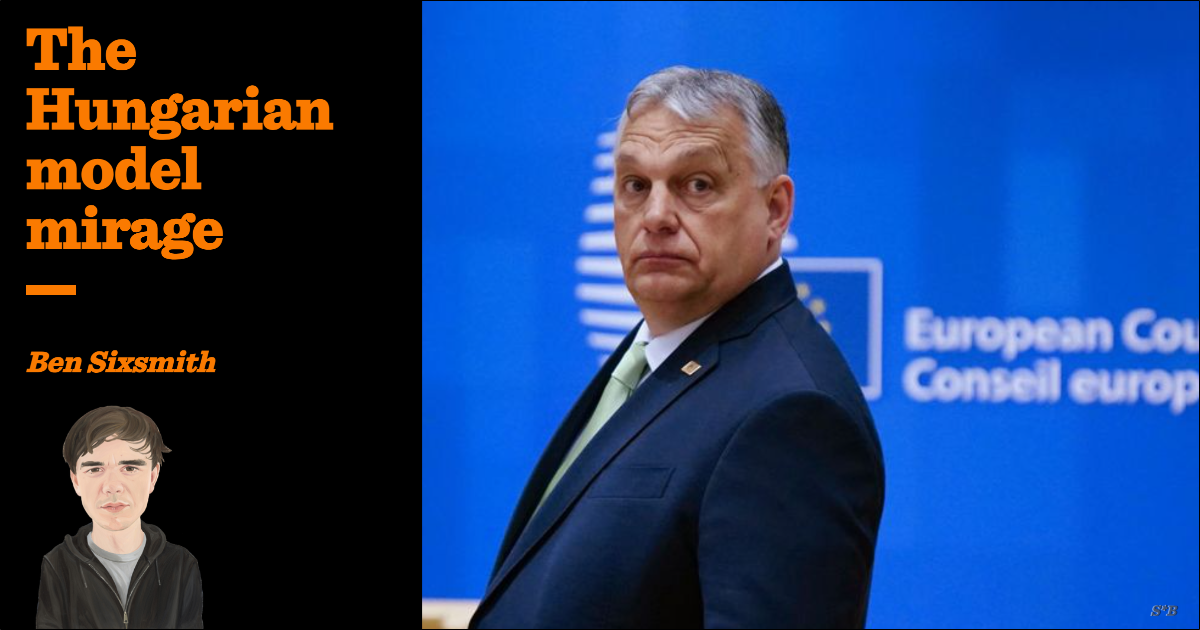

Last month, Miriam Cates MP advised British conservatives to look eastwards. Hungary, its ruling party Fidesz, and its prime minister Viktor Orbán, Cates argued, are sources of inspiration. Once, it was “widely believed that Orbán is an authoritarian leader whose hardline policies on immigration, social issues, and foreign press interference are just too spicy for British Conservatives to swallow.” Now, though, “some of the chief concerns of Britain’s two mainstream right wing parties echo those of the Hungarian government”. Yes, “British conservatives should be leaning in to our Fidesz cousins.”
This is a popular sentiment in Western conservative and reactionary politics. “Modern Hungary is not just a model for conservative statecraft,” said Kevin Roberts, head of the USA’s Heritage Foundation in 2022, “But the model.” Strong words!
It’s no surprise that British and American conservatives and reactionaries have been inspired by Viktor Orbán. The man has been the prime minister of Hungary since 2010 — winning four elections. In that time, the Conservative Party went through five PMs and lost. (Imagine if David Cameron was still the prime minister of Britain.
Orbán has also been smart in marketing himself abroad. State-linked think tanks and educational institutes have attracted a stream of intellectuals and journalists to see the grandeur of Budapest. Like Cates, this author has had the pleasure of going on a press tour in Hungary. It was an impressive experience. I can’t say enough good things about the Hungarian capital — and the Fidesz politicians I interviewed were engaging and smart.
I left with a lot of admiration for what I had seen — but there was also a lot that I hadn’t seen
Still, by its very nature, a press tour is designed to show the best of a country. I left with a lot of admiration for what I had seen — but there was also a lot that I hadn’t seen. So, I’d like to register a few words of scepticism about the “Hungarian model”.
To be clear, I don’t write them as an opponent of the Hungarian government. It is, frankly, none of my business who is in government in Hungary. My attitude towards who Hungarians should vote for in the elections in April is: good luck.
I am also very much supportive of the Hungarian approach towards protecting their borders, across which migrants have been attempting to enter Europe. If we are to have border policies at all — and I, like almost everyone, believe that we should — then we must uphold them firmly and consistently. The Hungarians have been taking lumps on behalf of all European nations to maintain this stance.
But beyond this, the “Hungarian model” seems like something of a mirage. Viktor Orbán has promoted what he calls “illiberal democracy” — a governmental approach which claims to uphold democratic standards while curbing social liberalism. But the Orbánite approach to social liberalism seems to have more bark than bite. Unlike nearby Poland, Hungarians have the right to abortion (if with new bureaucratic hurdles in place). Hungary, for reasons I don’t fully understand, is a European capital of porn production. To be clear, I’m not criticising Fidesz for its liberalism. I think to pursue illiberal politics within a European nation would — among other things — be to swim against the tide of human nature, and I don’t blame them for not doing it. But it makes the “illiberal democracy” branding seem performative.
“We should be paying attention to Hungarian ideas on increasing marriage and birth rates,” Miriam Cates advised. Increasing birth rates has been a major aim of Fidesz. Huge tax exemptions have been offered to parents. Caps have been imposed on housing loan rates. The result? Between 2011 and 2023, Hungarian birth rates rose from 1.23 to 1.38. In fairness, over a whole country that still means a fair few kids. But it isn’t what I’d call a striking success. Marriage rates did rise considerably in the first ten years of Orbán’s rule, but there has since been a significant decline.
I’m not saying this to bash Orbán and his government. Frankly, unless you establish some sort of theocratic dictatorship, I’m not sure that you can do a lot, as a government, to change how many people get married and have children. (Even then, I think people would justifiably pay more attention to removing you than to settling down.) But it makes it difficult to understand what Western governments would have to learn.
Cates was full of praise for the thoughtful and serious Fidesz politicians she encountered. I found them thoughtful and serious as well. The most impressive was the lawyer and politician Judit Varga. She resigned, along with President Katalin Novak, after it was revealed that they had both signed a pardon for a man who had been covering up child sexual abuse. This was the right thing to do, but amid other pardons that appeared politically motivated it had the whiff of scapegoating. (It would be unfair not to mention that Orbán’s leading opponent, Peter Magyar, is Ms Varga’s ex-husband and that she has accused him of domestic abuse.) My point is that Hungarian politics, like politics in every country, is a dirty business. One should not confuse foreign-facing intellectualism with the reality of how politics is conducted.
I emphasise this because the Orbánite hosting of right-leaning journalists and intellectuals has led to some Western commentators not just gaining interest in Hungarian politics but feeling inspired to throw their polemical weight behind Fidesz. Foreign guests of Hungarian institutions can be found trash talking Orbán’s opponents online. Their opinions are no doubt sincere — but the expression of such opinions seems uncomfortably symptomatic of the sort of dislocated cosmopolitanism that we otherwise dislike. Granted, it should be noted here that European and American managerialists have made tremendous efforts to interfere with the politics of countries which divert from US or EU ambitions. The temptation towards mirroring the formula is understandable. But it seems hypocritical for opponents of imperious internationalism to be doing the same.
Again, my point in this article is not to slag off Fidesz. I’m not an authority on Hungarian politics and I’m certainly not Hungarian. It is very possible that this or that idea can be learned from. But Westerners who drink a glass of wine by the Danube and announce that they have seen the promised land should ask themselves if they have in fact just had a lovely holiday.
This piece has been edited for clarity.