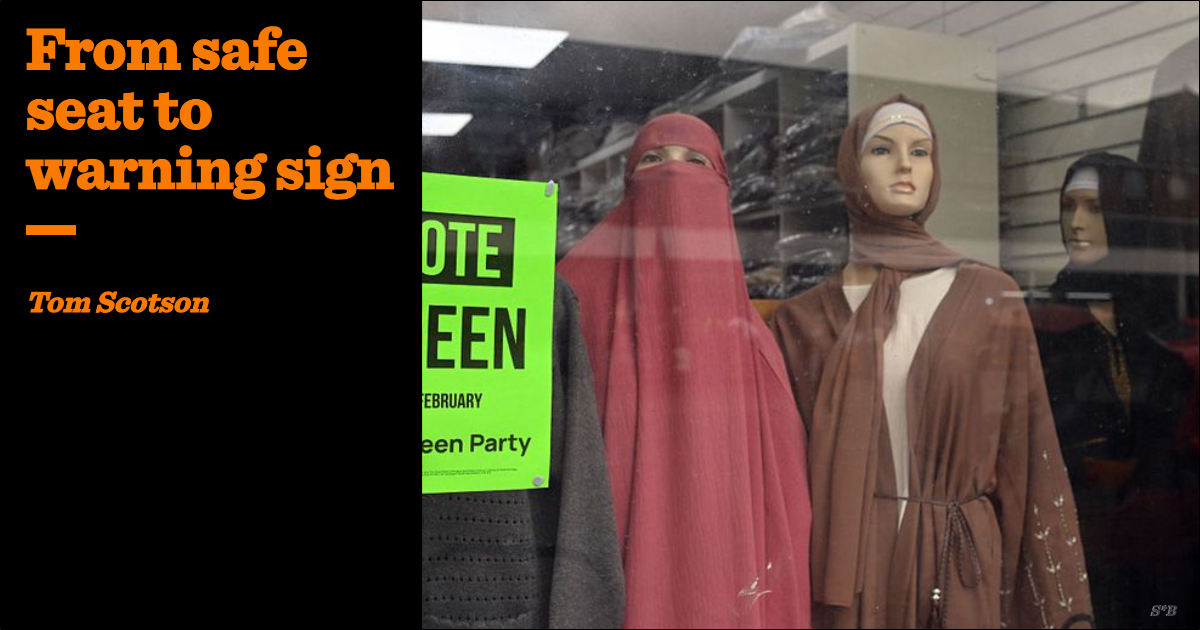
Gorton and Denton could expose how far Labour’s once-reliable Muslim vote is splintering
Labour has controlled Gorton and Denton since the days of Ramsay Macdonald. To date and at the last election, it was one of 70 constituencies Keir Starmer’s party won with an outright majority, securing 50.8 per cent of the vote.
Defeat in Greater Manchester would be symbolic of the party’s national collapse. More profoundly, however, it will indicate the further bleeding of Muslim voters to the Greens and anti-Israel parties.
For context, Muslim voters have represented the core infrastructure of Labour’s electoral machine for decades. With a few exceptions, all 20 UK constituencies with the largest Muslim populations solidly voted Labour at every election.
But the horrors of October 7 and the war in Gaza fractured this coalition and weakened the party’s iron grip on minority voters, with Muslims in some seats deserting Labour en masse. As a result, four independent candidates in heavily-Muslim seats were elected to Parliament in 2024 and defeated the incumbent Labour MP.
Gorton and Denton incidentally has one of the largest Muslim populations in the country, making up 30 per cent of the seat.
If a progressive party is to defeat Reform UK — who are popular with the constituency’s white-working class population — both the Greens and Labour will have to fight it out to covet Muslim voters to win the seat outright.
The Muslim Vote, an organisation which urges people to vote on religious lines, suggests there is growing enthusiasm within the community for Zack Polanski’s party. Abubakr Nanabawa, head of media at the Muslim Vote, told The Critic more Muslim voters are backing the Greens but was cautious they would do in their droves. “Broadly speaking the Greens have made major inroads into the Muslim community and they have had the most positive response of all the major political parties when you talk to people,” he said.
Polling also found Pakistani and Bangladeshi voters — who are the predominant Muslim group in Gorton and Denton — prefer the Greens to Labour in nationwide surveys.
Having visited the constituency during the by-election campaign, reasons for Muslim voters to back the Greens are clearly put.
The party has an uncomplicated message that it is the only group who will stand up to the government’s alleged complicity in the “two-year genocide” taking place in Gaza. Data on the ground from sources suggest the two main reasons Muslim voters are switching from Labour to the Greens is because of the NHS and Gaza.
It should not therefore be surprising the Greens are trying to capitalise on this momentum by printing leaflets in Urdu, with the literature claiming they are the only party to stop Islamophobia, punish Labour at the ballot box and act as a solid voice for Muslims.
The party, meanwhile, seems sanguine about such practice, viewing themselves as the only party talking the language of all communities literally and metaphorically. It was telling that Zack Polanski, the leader of the Green Party, welcomed the endorsement of the Muslim Vote to PoliticsHome last week:
I think any organisation that wants to back the Green Party because they align with our values is something that I applaud and welcome.
The Greens’ decision to court Muslim voters, while frustrating Labour figures, makes perfect sense electorally for two reasons.
The first is their coalition is broadly made up of students and minority voters, the former group which is more unreliable. Labour MPs report that they have turned up outside homes in student areas with Green Party posters, only to find that no-one in the house is registered to vote. On the other hand, Muslim voters are far more likely to turn up on election day and back a party.
The second is that the Greens face no anti-Zionist opposition to the Left of them. Both George Galloway’s Workers Party of Britain and the Jeremy Corbyn and Zarah Sultana and/or Jeremy Corbyn-fronted Your Party are not standing. This increases the number of voters on offer who will naturally support the Greens who may not normally vote for the party.
Labour for now is refusing to cede electoral territory. Within the Muslim community they are bullish that they are finding voters who are more socially conservative and weary of the Greens’ policies on drug decriminalisation and legalisation. Labour sources suggest that this is one of the reasons they are finding less “slippage” from their more loyal pool of Muslim voters.
But more worryingly, this whole trend is showing that Labour MPs have been far too complacent about sectarian voting for too long.
Many have understandably focused on the immediate threat of Reform, who may be the direct challenger in their seat. But meanwhile they have failed to notice the splintering of their own coalition of voters who are more regularly voting on religious lines — a trend not seen in Britain outside of Northern Ireland.
The last general election showed that Muslim communities had more power to swing elections than they ever thought they previously could.
It was only ever believed talented politicians such as Galloway or Lutfur Rahman, the mayor of Tower Hamlets, had the charisma and power among minority voters to defeat Labour incumbents. Now, it is becoming commonplace for groups to consciously leverage their power to defeat parties along religious lines.
As one Labour MP portends: “There could be a bigger point where, as with white working-class communities, we may struggle to win this community back forever”.
The by-election is not a slam dunk for the Greens. Strategists believe there could be hundreds of votes between the winning candidate and the party who finishes in third place. Whatever the result, voting on religious lines is only likely to become more relevant and the power it yields over parties will only soar.