This article is taken from the February 2026 issue of The Critic. To get the full magazine why not subscribe? Get five issues for just £25.
We have the broadway writer Hugh Wheeler to thank for a perfect nutshelling of the Kurt Weill problem: “All that 1930s pissy-assed socialism”.
It wasn’t even one of Weill’s Bertolt Brecht collaborations Wheeler was trying to rejig for an audience not generally composed of juvenile commies at the New York City Opera, but rather a piece Weill had written in 1933 with Georg Kaiser called The Silver Lake — a very decent work, in fact, hardly pissy-assed at all, certainly way less so than that stuff Kurt produced with Bert, The Threepenny Opera, Mahagonny and The Seven Deadly Sins.
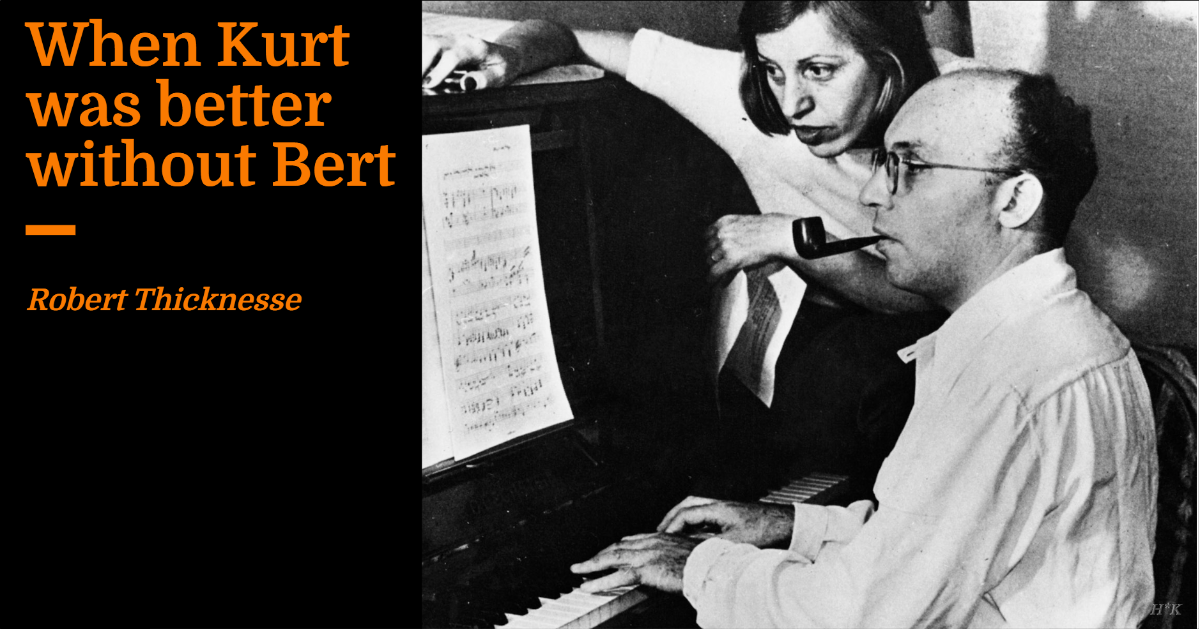
Actually, Weill got sick of “setting the Communist Manifesto to music” pretty quickly: his collaboration with Brecht lasted only three years, though thanks to a certain warped (i.e., German, opera-snobby, anti-American) strand of musical historiography Bert’s is the only name anyone links with Kurt’s.
In reality, much more of his (often better, certainly less limited in range) show music was written after his 1933 emigration, with Ira Gershwin, Alan Jay Lerner, Maxwell Anderson and Ogden Nash — but, unlike necrophiliac opera, languishing in its sicko fever-dream of dead centuries, musical theatre instantly forgets all but the smashiest hits from its past.
And of course it’s the pissy thing that endears Kurt ’n’ Bert to the fashionably Spartist Oxbridge types who infest our opera house managements (and the rest of the arts), who secretly dream of burning down those fancy theatres with all the “fucking rah-rahs” inside, and merrily doing democratic singalongs with gangs of Peckham schoolkids and Your Party members in the Drill Hall and working men’s clubs (do they still exist?).
But despite school-leaver politics, those Brecht–Weill collaborations were really an argument about the future of opera — and one that has hardly progressed since. Brecht determined that opera was over, creating The Threepenny Opera as a kind of anti-opera (much as its 1728 original, The Beggar’s Opera, was a demotic torpedo aimed at Handel’s London Italian opera fooflah).
Knowing the bourgeois audience’s cute ability to take everything that Bolshevik writers and directors could throw at them, and to laughingly neutralise and own it, he realised they would never magically turn into the vanguard of the revolution, however much he carpet-bombed them with agit-propera.
Brecht was also driven mad by Weill’s insistence on writing actual music rather than some sort of pure leftist prole-balladry (calling Kurt “that phony Richard Strauss”).
The somewhat less maniacal composer understood that opera badly needed to change musically to stay alive: to factor in not only the movies, which did melodrama so much better (and had effectively finished off Italian opera by this time), but also the explosion of popular musical styles that people actually liked, without which new opera would condemn itself to irrelevance and the tiniest, marginal audience.
Well, hey ho and oh look, guess where we wound up, down that exact dead-end where everyone has to pretend to find the poshed-up pseudo-modernist soundtrack to a perverted film (Mark-Anthony Turnage’s Festen) amaaazing. Whatever became of Weill’s dream of a place where opera and musical theatre would meet, mate and procreate, to the general benefit of mankind? Well, not a lot, but on the rare occasions it’s actually been tried — Porgy and Bess, Candide — it hasn’t done too badly at all.
In fact there is a class of American musical theatre — including bits of Sondheim, various works by Gershwin and Bernstein, even some of Richard Rodgers — where a law of increasing returns applies: sure, they work brilliantly as “musicals”, with a scratch band and theatre singers, but once you confront them with operatic ambition they can become something else entirely (and I’m not talking about the West Side Story fartbomb with Kiri and Carreras — just horrible), with musical and moral power on a different scale.
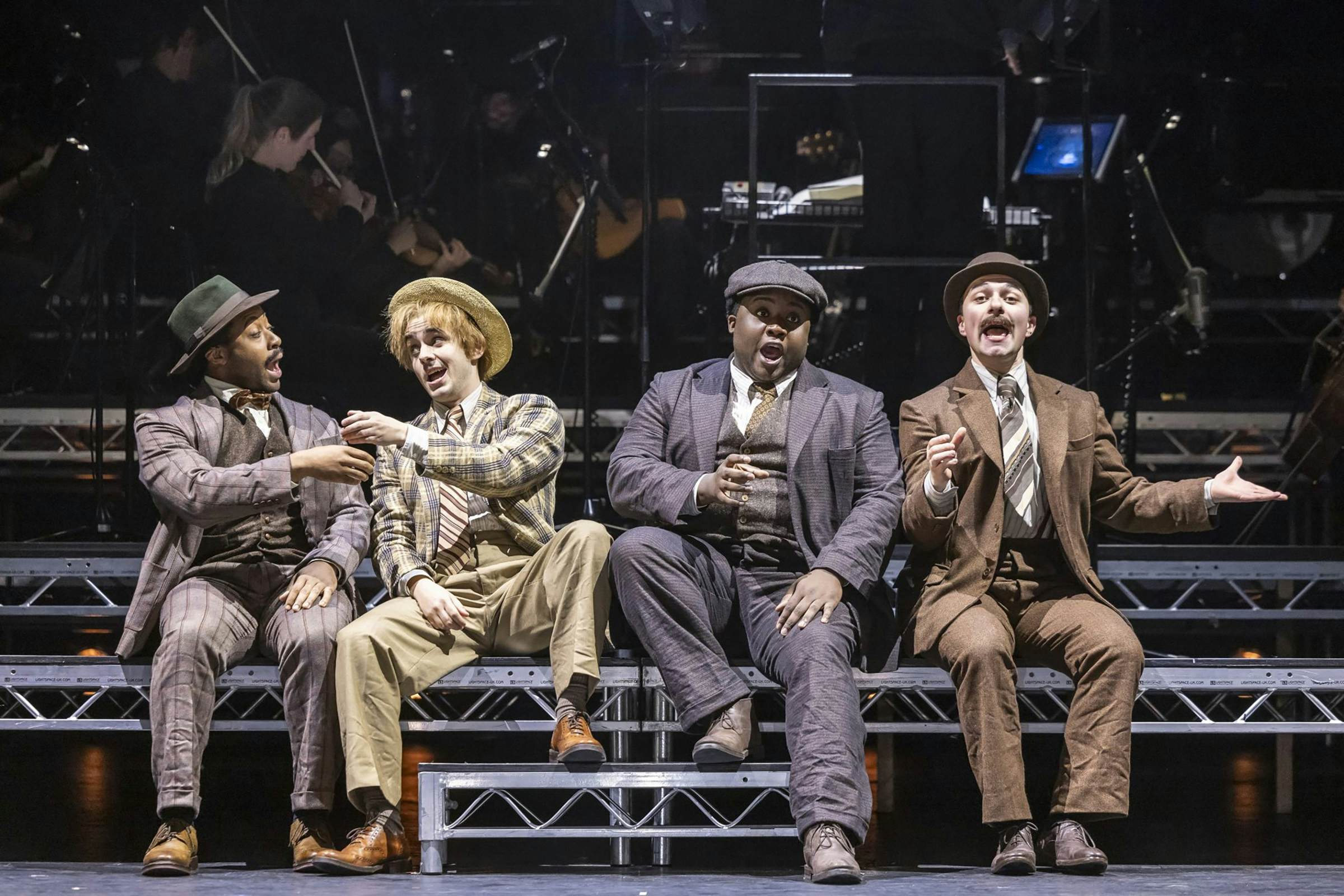
This is where a lot of Weill’s American shows fit in, the only hitch being that nobody performs them, with the exception of Opera North, which over the years has toyed divertingly with many works on this cusp — including two of Weill’s, the delirious One Touch of Venus and, last year, the touching and ambitious “vaudeville” Love Life, written with Lerner just before the latter did My Fair Lady.
Once you hear Weill’s music played (and importantly, sung) properly, you understand that we are talking about a lot more than “Mack the Knife” and “September Song”: not just what a fabulous, Rodgers-level songwriter — with more sophisticated scoring and musical texture — he was, but what a great and unique composer altogether, in both German and American works: the sly, biting, jazz-inflected orchestration, the pastiched dances warping into acerbity with their off-kilter, vampy accompaniments, the schmoozing strings and the gorgeous tunes Weill could spin out of very little.
That sarcastic Weimar edge slipped away in his American works, but the cool irony of the words he worked with later makes a pleasant adult change, after the GCSE-level social-justice stuff of Brecht.
But that Berlin work still gives us a bracing, exhilarating ride: Kurt’s music brings humanity, heart, pathos, to the clichés and cut-outs of The Rise and Fall of the City of Mahagonny, coming up at ENO this month. And who knows? Maybe the ENO audience, disgusted by themselves and capitalism, will stagger to their feet and torch the town. As Brecht would have said, hope dies last.