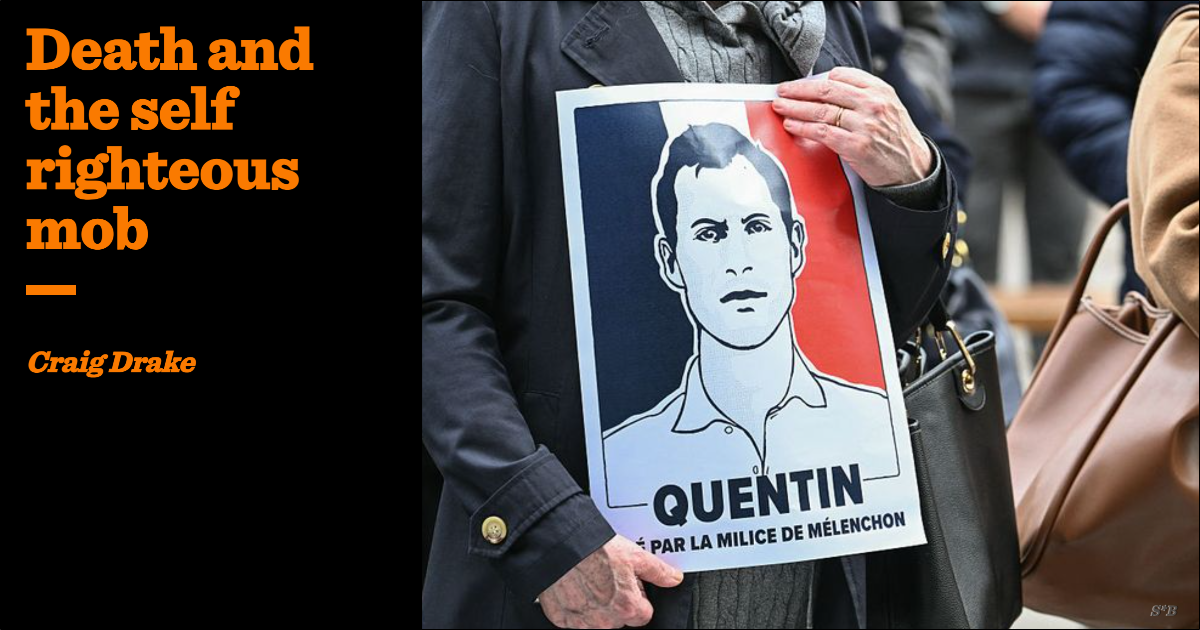
My intention before writing this article had been to attend a meeting in hommage of Quentin Deranque, the 23-year-old mathematics student slain by a gang of violent leftist activists at the fringes of an event in Lyon. I am not somebody involved in French politics, but I had hoped to report on the ambiance of this vigil being held on Tuesday in Toulouse — one of many being held across the country. All of the news headlines pointed to the perpetrators being closely aligned to one of the main political parties, with one even working for a member of parliament. What would be said at the hommage, and what would be the emotions?
Unfortunately, this plan was scuppered by the city’s prefecture prohibiting the event from going ahead. Turning up to the Palais de Justice, there was a heavy police presence, with armoured vans from the CRS — France’s Compagnies républicaines de sécurité riot police — lining the streets. Despite the dramatic police presence, the small numbers of people arriving unaware of the ban and being turned away were just regular citizens. Most of the people I saw being told by the police that the event had been banned were middle aged, rather than students.
The reason given by the préfet for the ban was the risk of a presence of what it labelled as “far-right groups” such as Collectif Némésis, a feminist and identitarian group for young women, and Action Francaise, a Catholic monarchist group, and the risk that their presence could pose to public order.
Toulouse wasn’t the only town to ban public vigils: Nantes too placed a banning order on events taking place on Wednesday, and the Mayor of Lyon has expressed his desire to ban events from happening this Saturday.
None of this was of particular help in my aim to talk to people at an event and try to better understand their sentiments following this brutal killing, but it nevertheless tells a story about which flavours of political activity are permitted — and which flavours are forbidden.
I regularly walk past La France Insoumise offices — the party of the left’s strongest challenger to Emmanuel Macron, Jean-Luc Mélenchon. It’s a frequent assembly point for activists setting off to protest, and whichever firm of glaziers holds the contract to replace the windows of the nearby bank branches does good business when they are inevitably systematically smashed at least once a year during protests permitted by the authorities — the most recent payday for commercial shopfront glazing firms being the protests against retirement entitlement reforms. It’s hard not to feel a sense of double standards.
Collectif Némésis are a feminist movement founded by Alice Cordier, and promote the view that women’s safety is being eroded by immigration — specifically Islamic — and that Islam’s growing cultural power in France is a threat to women’s liberties. As such, the group’s protests have often met with organised opposition using intimidatory tactics with the menace of violence.
On Thursday 12 February, the controversial MEP and member of La France Insoumise, Rima Hassan, was speaking at an event at Sciences Po in Lyon. It is reported that Quentin Deranque attended a Collectif Némésis demonstration that was happening at the fringes of the event – in solidarity, and to lend support to female friends that could likely face leftist intimidation for their views. In doing so, he was engaging his civic duty to participate in political life, and exercising his liberty to freely assemble with others.
He was engaging his civic duty to participate in political life, and exercising his liberty to freely assemble with others
According to witnesses and in line with video footage, he was ambushed and set upon by a gang of masked individuals. They knocked him to the ground, and, by striking his head, they beat him unconscious before leaving him for dead. He fell into a coma from which he never awoke. While there were those on the left that attempted to spin the events as retaliation for provocation from the anti-violence Collectif Némésis protesters, Fabien Rajon, the lawyer representing the young man’s family was quick to release a statement that he was “neither a security guard nor a member of any security service and had no prior criminal record.” Furthermore, he ruled out “the theory of a simple ‘brawl’ between two rival groups.”
Among the eleven suspects arrested for the attack was Jacques-Elie Favrot, cited by many witnesses, and employed as an assistant to militant LFI Member of Parliament, Raphaël Arnault. Arnault was the founder of the hard left militancy group La Jeune Garde. Despite having been formally dissolved following a ban by the Conseil des Ministres in June 2025, the group remained reportedly linked with LFI, and in particular with MEP Rima Hassan – something that the MEP now denies, despite the photos circulating of her posing with Raphaël Arnault and other members of La Jeune Garde.
In addition to Jacques-Elie Favrot, a certain Robin Chalendard, employed by Arnault under the pseudonym “Robin Michel” at the National Assembly, was also arrested for “making available means to evade the investigations”.
La Jeune Garde are no strangers to violence. Its founder, the now sitting MP Raphaël Arnault, was sentenced in February 2022 to four months suspended imprisonment by the Lyon correctional tribunal for aggravated assault after participating in the attack of an 18-year-old man by a group of six people. LFI colleagues such as fellow deputy Manuel Bompard were quick to suggest he was unfairly charged, but the courts rejected appeals.
In 2024, eight of its members were charged following an anti-semitic attack on a 15-year-old boy — as with Quentin Deranque, the assault happened on the fringes of an event held by Rima Hassan.
Despite the investigations into La Jeune Garde’s involvement in the brutal killing of a young man, La France Insoumise’s leader and presidential hopeful Jean-Luc Mélenchon has done little to distance himself from the group he described last year as his comrades, with encouraging cries of “bravo jeunes gens !”. In a nearly two-hour speech to the party faithful on Tuesday night, he bombarded every opponent under the sun with blame: media, law enforcement, government agencies, and his political opponents Emmanuel Macron, Prime Minister Sébastien Lecornu, the President of the National Assembly Yaël Braun-Pivet, and MEP Raphaël Glucksmann. Everybody but the Jeune Garde organisation closely linked to his party.
In leftist rhetoric there are right wing monsters under every bed and around every corner
His attitude towards the actions of La Jeune Garde may be arrogant and dismissive of their tragic consequences, but they are nevertheless formed by the culture of mythbuilding on the left. In leftist rhetoric there are right wing monsters under every bed and around every corner. Despite wearing black uniform clothing and going street to street with violence to enforce political will, anybody who opposes them is a target and fair game. As a case in point, the police were reported to have chased off antifa protesters waiting outside an Ash Wednesday mass in Toulouse, seemingly with the intent of causing trouble.
It should also be remembered that part of the reason that groups like Collectif Némésis carry out campaigns the way they do is that political speech is tightly regulated in France — more so even than in Britain. It may have taken far too long to get there, but in Britain there is now fairly open discussion about the racial nature of the grooming gang atrocities. It is hard, as the law currently stands, to imagine such a frank discussion about race and religious violence in France. Let us not forget that the recently deceased Brigette Bardot was fined twice for public insults, and five times for inciting racial hatred for her criticism of Muslims in France, with much of it stemming from fairly anodyne criticism of Halal slaughter practices. Much of debate of the kind engaged in by Collectif Némésis happens at the fringes of politics because of the nature of French speech laws. While borne out of a desire not to upset the apple cart and create conflict, it’s clear that there is something broken in the way that people are able to engage with politics.
Of course, Quentin Deranques’ tragic death is important in and of itself. But the entire structures around his death matter too. In a country where the political framework is strongly defined by the state, it matters incredibly deeply that those that committed this horrendous act were seemingly so connected to a powerful political party. With or without benediction from police and authorities, protests and counter protests will take place in France. I hope that they are peaceful, but they should also be a time for deep soul searching about liberty of expression, and the climate of fear created by a left that believes all of its actions to be unquestionably justified.