
Sir Terence Rattigan believed that Man and Boy, his 1963 play about the downfall of a crooked Eastern European financier, was the drama that was going to restore his fortunes, which had been badly damaged by the rise of John Osborne and the Angry Young Men. Unfortunately, both for Rattigan’s and for theatre’s sake, he was wrong about this. While the first production, which starred Charles Boyer on Broadway as his protagonist Gregor Antonescu, was short-lived and swiftly forgotten, it has found a minor place in the theatrical canon, thanks to its truly titanic lead role. The play has variously seen David Suchet, Frank Langella (who was in the audience on the first night) and now Ben Daniels assume the part of Antonescu, a figure who now has rather more contemporary resonances than Rattigan ever intended.
When Man and Boy was first announced as part of new National Theatre artistic director Indhu Rubasingham’s debut season, heads were scratched. Rattigan hasn’t exactly been persona non grata at the NT lately — Carrie Cracknell staged The Deep Blue Sea with Helen McCrory there in 2016, early on in the Norris regime — but nor have directors been falling over themselves to bring his works back into the repertory. It is more likely than not that director Anthony Lau and Daniels did some arm-twisting in order to persuade Rubasingham to let them stage this play in the National’s smallest and most intimate theatre, the Dorfman — but then it had the good fortune to open at the same time that the Epstein files were released, and all of a sudden it has become the most coruscatingly up-to-date drama in London.
Antonescu isn’t exactly Epstein, of course, but he is a similarly manipulative and cruelly calculating master of the universe, who is adept at reading the weaknesses of others — whether it’s for sex or money — and then exploiting them accordingly. When the play begins, he has finally exerted himself too far, and the merger between his company and another, which will net him $75 million, is imperilled because of his dodgy business practices. Nemesis beckons. Yet just as Epstein was able to maintain his place at the top table by alternately sucking up to and cajoling the powerful around him — and, of course, shamelessly bullying those who he perceived as weaker — so Antonescu manages, in the play’s superior first half, to pull off the near-impossible and reverse the apparently hopeless situation that he finds himself in, much to the delight of his right-hand-man Sven and to the horror of his estranged son Vassily, who now goes by the name of Basil Anthony.
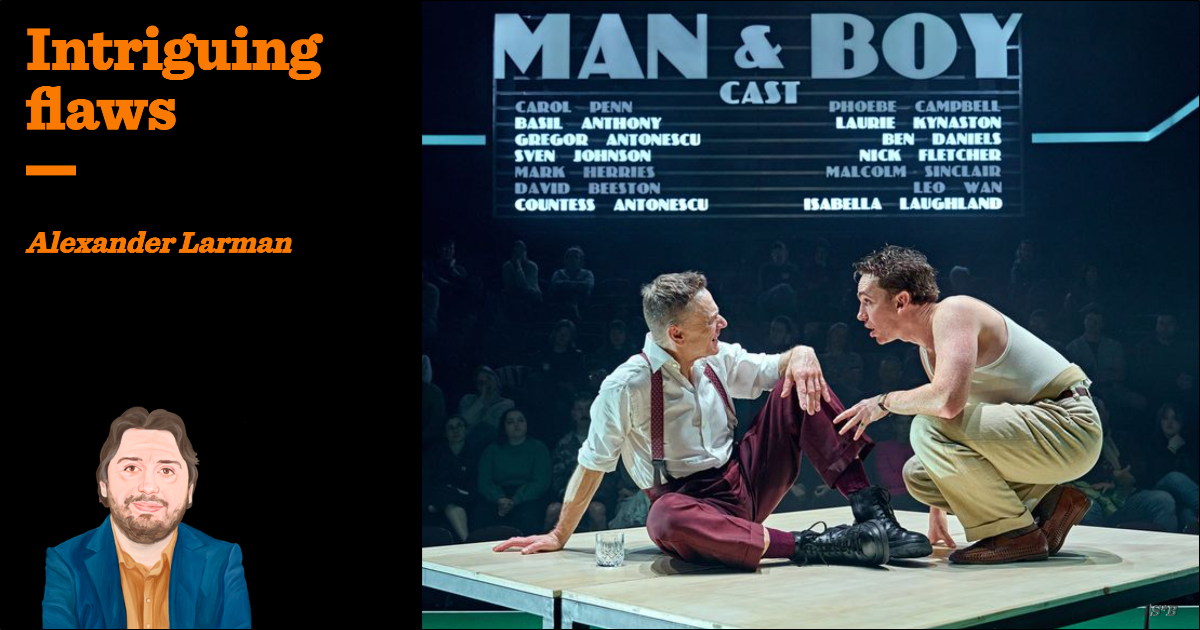
It is doubtful that there will ever be a drama about Epstein, so oddly Man and Boy is about as close as theatre will get. Strangely, if an actor was to be cast as the billionaire paedophile, Ben Daniels bears a passing facial resemblance to him, but it is unlikely that he would embody that satanic figure as compellingly as he does with Antonescu here. Rattigan always understood that the worst characters are the most fascinating, and not only does his protagonist have all the best lines, but Daniels manages to get the audience on his side, even as he is doing the most appalling things to impress the closeted tycoon Mark Herries. It’s a stunning lead performance, complete with note-perfect accent work, that is hugely charismatic and even sexy in its provocations. Suchet two decades ago was stately and calculating, but Daniels leaps about, sometimes squatting on his haunches like a grasshopper, and at other times slinking about the stage as if he is going to forcibly seduce every single member of the audience. It is worth the price of admission by itself.
Unfortunately, much of the rest of Lau’s production fails to live up to Daniels. Despite a hugely enjoyable, richly camp performance by the great Malcolm Sinclair as Herries, and a nicely judged Nick Fletcher as Sven, there is an irritating modishness that gets in the way. My spirits rose when I entered the Dorfman to see the cast’s name spelt out in lights, as if in a Golden Age of Hollywood movie — these spirits sank somewhat when there was the continued device of the on-stage characters’ names remaining illuminated. This is as nothing, however, compared to the insanely annoying tic of the actors being compelled to jump around on tables, which they are perennially climbing on to show their characters’ respective superiority or inferiority over one another. At least, that’s what I think they’re doing; it might just be that Lau wanted them to have some exercise in the two and a half hours they’re on stage.
Rattigan’s play is probably not the masterpiece that he thought it was. It drags in the brief moments that Antonescu is not centre stage, and the character of Basil is a largely colourless foil to his far more entertaining father; no offence to Laurie Kynaston, who does a perfectly respectable job, but he is one of those stock figures, like Frank Hunter in The Browning Version, who never really comes alive but instead has to serve as the primary model for exposition. But it does offer a hell of a role for a talented lead actor, and the brilliant Daniels seizes it and devours it for all he’s worth. Would that Lau had trusted the play, and his star, a little more, and his own directorial flourishes a little less, and this would have been a masterly revival on every level, rather than an intriguingly flawed resurrection of a drama that at least feels far more relevant than it must have done when Rubasingham first announced it.