The debate over the Chagos Islands has been clouded by fantasy about Beijing, obscuring the far more consequential role of New Delhi
Much has already been written about the planned handover of the Chagos Islands to Mauritius, and much of it wrong. While the government’s moral and legal arguments for surrendering sovereignty have been persuasively dismantled by others, opponents of the deal have themselves lapsed into occasional nonsense. The teary-eyed pleas on behalf of the so-called Chagossian People have been taken apart in the Pimlico Journal. Another popular canard is that the newly Mauritian islands would, somehow, come under the control of China. This is a story that reveals more about its proponents than the geopolitics of the Indian Ocean.
The Conservative leadership, having started the handover process under the brainless Liz Truss, have taken up the Chagos issue with the typical zeal of a recent convert. Priti Patel, the Shadow Foreign Secretary, described the arrangement as the “Chagos-China Surrender Bill” and accused Starmer of “kowtowing to China”. Mauritius is so frequently described as a puppet of China that you would imagine its prime ministers were appointed in Zhongnanhai. Exciting as these ideas are, they are deficient in one respect: they are completely untrue.
What is true is that Mauritius is the close ally of a rising Asian republic, deeply suspicious of Britain. Mauritius is dependent for its defence and economy on a nationalist, anti-colonialist regime that wants the Brits kicked out. A rival power does indeed plan to develop bases in the archipelago — but that power is India.
A leaked American cable described their relationship with India as “willing subordination”
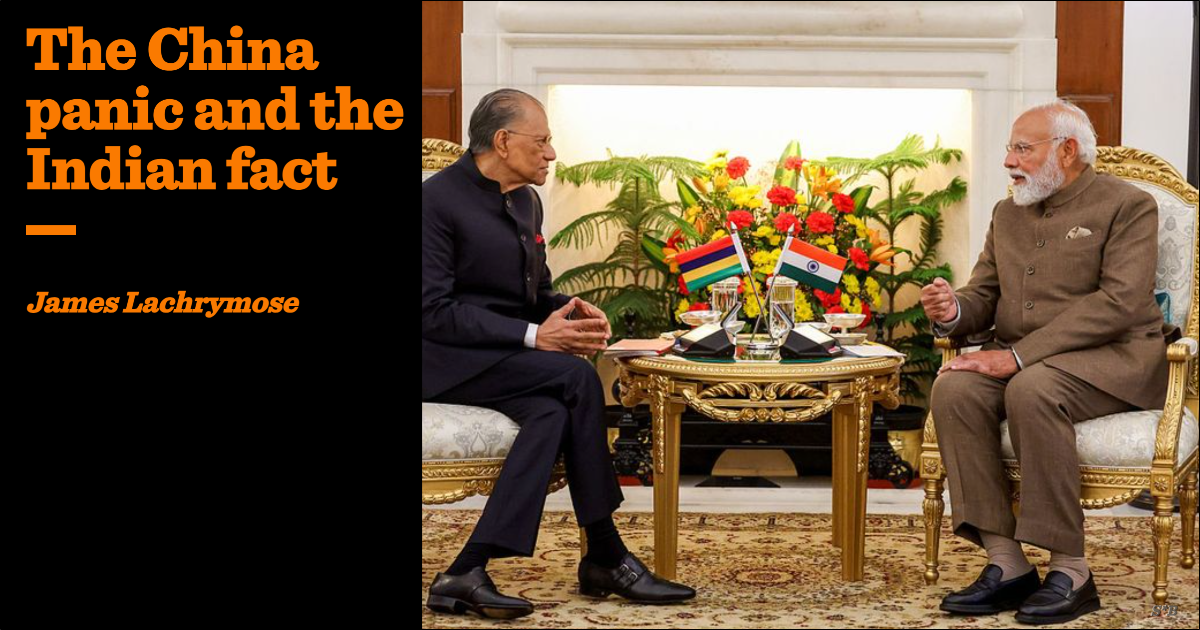
Mauritius’s closeness to India has been neglected in the Chagos discourse, but is hard to overstate. The former Prime Minister, Paul Bérenger, described the relationship as “sacred and umbilical” (two decades earlier, India had planned to invade Mauritius to prevent Bérenger taking office, lest he disadvantage the island’s Hindus; in the end, they simply intervened politically to prevent him taking office). Narendra Modi described Mauritius as “Little India” in 2015. 70% of Mauritians are of Indian descent, and a leaked American cable described their relationship with India as “willing subordination”. Mauritius is completely, and explicitly, dependent on India for control of its territorial waters. For decades, Mauritius’s National Security Advisor, the commander of its coastguard, and the head of its helicopter squadron have been Indian citizens and officers in the Indian armed forces. Mauritius has no navy or army, and its police are trained in India. The ships of its coastguard and the aircraft of its airforce are provided by India. When the surrender of the British Indian Ocean Territory further expands Mauritius’s territory, it will be India who is depended on to protect it. In the words of Mauritius’s Foreign Secretary, the expanded Exclusive Economic Zone “needs maritime resources, and to be able to fully develop and exploit those resources, it will need assistance, and India is a preferred partner in providing that assistance”.
China has barely shown an interest in the British Indian Ocean Territory, beyond occasional platitudes. The People’s Republic actually abstained on the 2017 General Assembly resolution which referred the matter to the International Court of Justice (India voted in favour). India has backed Mauritius’s claim from the outset, and Mauritius has promised New Delhi a naval base on the islands since the 1980s. No wonder that Mauritius wants India closely involved in the handover process: as Prime Minister Navinchandra Ramgoolam said last year “We want to visit the Chagos Islands, including Diego Garcia, to plant our flag. The British offered us a vessel, but we said we preferred one from India because, symbolically, it would be more meaningful”.
Indeed, while the claims about China negotiating a lease on one of the islands – expounded by Nigel Farage – were completely unfounded (and seemingly originated from misreading vague speculation in The Times) India has already constructed a base in Mauritius. Indian media have reported on plans to build a satellite monitoring station in the Chagos Archipelago itself, once handover is complete. While Mauritius is not a member of China’s Belt and Road Initiative, it is a key part of India’s comparable MAHASAGAR strategy.
Keir Starmer’s motivations for supporting a handover are uncomplicated: he is a human rights lawyer. In his own words, there is no version of his life that does not revolve around being a human rights lawyer. He believes international law requires him to follow this course, and all other decisions are rationally downstream of that.
So why then the mass hallucination of Chinese influence? In part, it is psychologically easier to process. Our issues with an authoritarian Communist regime can be smoothly analysed through the old Cold War lens (they just hate our freedom!). Hostility from a democratic republic has more discomforting explanations. We want to forget that much of the third world views us still as a former colonial overlord, to be shaken down for money and territory whenever the chance arises (see also: the rest of the world’s positions on the Falklands and reparations).
But a more important factor is that Chinese nationals and descendants have a marginal position in British elections. Nobody in Britain will lose votes by carping on about the need to confront Beijing. India, however, is a different matter. The Indian diaspora now makes up a noticeable part of our electorate — indeed, some Tory MPs only hold their seats thanks to the Indian vote. Try to imagine, for a moment, a Conservative MP hosting a celebration of Xi Jinping’s birthday in the House of Commons.
To return to Priti Patel, it is hard to understand why our Shadow Foreign Secretary is trying to conjure a Chinese mirage in the Indian Ocean. Why has she overlooked the role of her “dear friend” Narendra Modi, and his outspoken support for the deal? Why does the “India Diaspora Champion” seem ignorant of the influence of India in pushing the matter forward? On this we can only speculate.