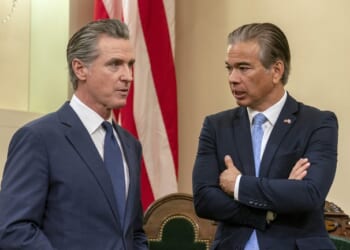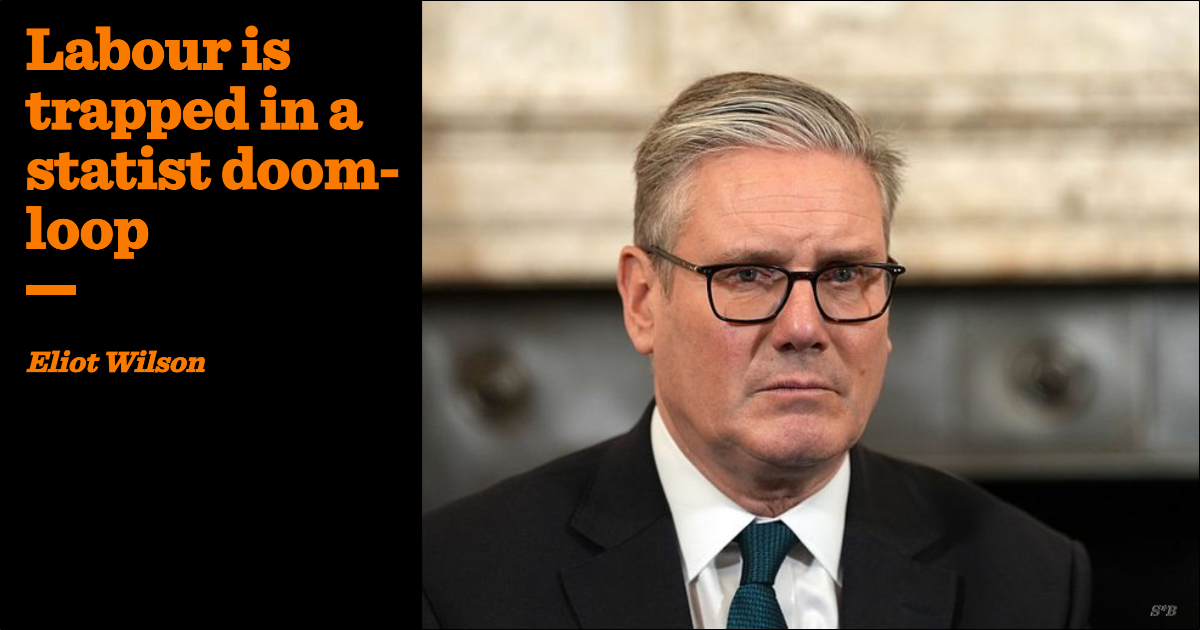
Sometimes politicians are required to say preposterous things. One of the most obviously outlandish arguments recently came when Sir Keir Starmer spoke from outside 10 Downing Street for the first time as Prime Minister. He lacks Sir Tony Blair’s eye for the dramatic flourish, the impromptu lyricism of 1 May 1997: “A new dawn has broken, has it not? Isn’t it wonderful?”
The words Starmer did find were dramatic in their implausibility. He promised “to deliver change, to restore service and respect to politics, end the era of noisy performance, tread more lightly on your lives”. Anyone who has been awake for the last 20 months will know how little of that has come to pass — service and respect are on extended sick leave, while noisy performance would at least be better than muffled stasis — but it was the pledge to “tread more lightly on your lives” that caused eyebrows to raise and jaws to drop.
This has never been how “progressive” politics works. In 1889’s Fabian Essays in Socialism, Sidney Webb, co-founder of the London School of Economics, from whose pen had flowed the old, long-cherished Clause IV of the Labour Party Rule Book, had seen the future. He foresaw the “unconscious abandonment of the old Individualism, and our irresistible glide into collective Socialism”.
The phrase-making changed but the underlying methodology did not. In Liverpool in October 2023, at the last party conference before the general election, Sir Keir Starmer rallied his troops:
“We’re here to make government more dynamic. More joined-up. More strategic. Focused at all times and without exception on long-term national renewal… not state control… but a genuine partnership, sleeves rolled-up, working for the national interest.”
The promise to tread more lightly was an absurd one
The common thread was that the state was always the answer, not only providing direction and efficiencies of scale but also a veneer of moral purpose. Everything we had learned about Starmer told us that he saw the public sector as good, and private enterprise as somehow compromised, flashy, worthy of suspicion.
The promise to tread more lightly was an absurd one, borne out by government policy since July 2024. There were the few fragments of Rishi Sunak’s legacy which Labour picked up — overbearing, controlling, measures which should never have been embraced by a Conservative administration.
The Football Governance Act 2025 grew out of the Fan-Led Review of Football Governance chaired by Dame Tracey Crouch. It established a statutory Independent Football Regulator and powers to prevent football clubs from making “any material changes”without first consulting fans to—this genuinely now the law of the land—”any emblem or crest” and “the predominant home shirt colours”.
The Tobacco and Vapes Bill, about to begin Report Stage in the House of Lords, broadly reiterates the provisions of a bill introduced in 2024 by the Sunak administration. It will gradually raise the minimum age for buying cigarettes until they are illegal and significantly tighten controls on the sale of vapes. The Soft Drinks Industry Levy has been extended “to protect children” and a ban is being discussed on under-18s buying non-alcoholic beer and wine.
The Prime Minister remains almost quaintly devout in his belief in state power. Recently he said that the government “need to look at” regulating “some of the addictive features on social media”. What he means is using the sledgehammer of statute to control the way in which people navigate content on their mobile phones: government-mandated scrolling.
This insane level of micromanagement of people’s lives threatens two distinct mischiefs. The first is encouraging performative legislation. If you embrace the mindset that laws can and should tackle any problem, you will seek to introduce them more and more. It will continue to be a useful demonstration of how seriously the government is taking an issue: it has introduced new legislation!
This is bad because it is an exercise in electoral prestidigitation. While voters are watching the government enshrine yet another law, they are distracted from whether or not anything is actually achieved. A recent egregious example is the Crime and Policing Bill, scheduled for Report Stage in the Lords imminently; Clause 73 of the bill gave the government an aura of responsiveness and responsibility because it creates a specific offence of spiking someone’s drinking. That is commendable, except that it is already illegal under section 61 of the Sexual Offences Act 2003.
The broader danger is perpetuating the belief in the state as the principal and best agent of change and regulator of personal behaviour. I instinctively shy away from big government anyway, in favour of individual choice and personal liberty. But it should be clear to anyone now that the model of an overarching, even if benevolent, state is coming rapidly to an end because it is simply unaffordable.
The government currently spends 45 per cent of our GDP, of which a third is consumed by welfare benefits and a quarter by healthcare. Excepting a spike in 2020/21 caused by the Covid-19 pandemic, that figure is comparable to or higher than at any time since the end of the Second World War. Still everywhere we hear of “austerity” and public services “starved of cash”.The Parliamentary Labour Party’s threatened rebellion over the Universal Credit Act 2025 showed its unwillingness to contemplate major welfare reform.
Yet we know that GDP has grown vastly over the past 80 years and the proportion of it being spent by the government is near-record levels. We are spending more and more to less and less effect. The Prime Minister appointed Sir Chris Wormald as Cabinet Secretary to undertake “the complete re-wiring of the British state” and identified a number of key questions. But he generally came to the wrong answers, saying he had “always believed in the power of government”, but in the form of “what I call active government, on the pitch doing what is needed”. This month he dismissed Wormald after only 14 months in post.
Change is coming, because our current model is so clearly unsustainable. I suspect there could be some first-mover advantage for a politician who was willing to set out some unvarnished and uncomfortable truths about Britain, but who also had plausible, considered, ambitious and optimistic plans about how we can not rewire but remake and reimagine the nation.
It becomes more and more obvious by the day that Sir Keir Starmer is not that kind of catalyst or visionary; but the Labour Party is not intellectually ready to produce and support such a figure. It is stuck in a statist doom loop, haunted by questions but unable to produce any answer except more government.