“Great power competition and ethnic tensions in the Balkans; what could go wrong?” — Tsar Nicholas II to his cousin Kaiser Wilhelm II, probably.
It’s not exactly original to observe that the post-Cold War international order is in pretty bad shape. After a decade-and-a-half of appeasement, Russia launched its full-scale invasion of Ukraine for daring to stray from its influence. Major European countries are grappling with illiberalism from the left and right, as is the European Union. America’s seizure by MAGA in 2017 gave us the entree of a trade war. The second iteration has given us the full menu. Not only that, but Donald Trump has proudly surrendered US leadership of the liberal democratic world and, with his designs on Greenland and pathetic posture towards Ukraine, actively sabotaged it.
Communist China has been both threatened and emboldened by all this and stands to benefit from Russia’s weakness, America’s abdication, and Europe’s directionlessness.
This chaotic period of global events has the potential to reap plenty of misery and destruction before it gives way. As middle and small powers scramble to align their foreign policies with the new circumstances, potential flashpoints are appearing all over the map. But amid the chaos, don’t overlook the tensions brewing in one of the world’s most notorious and long-standing conflict zones: the Balkans.
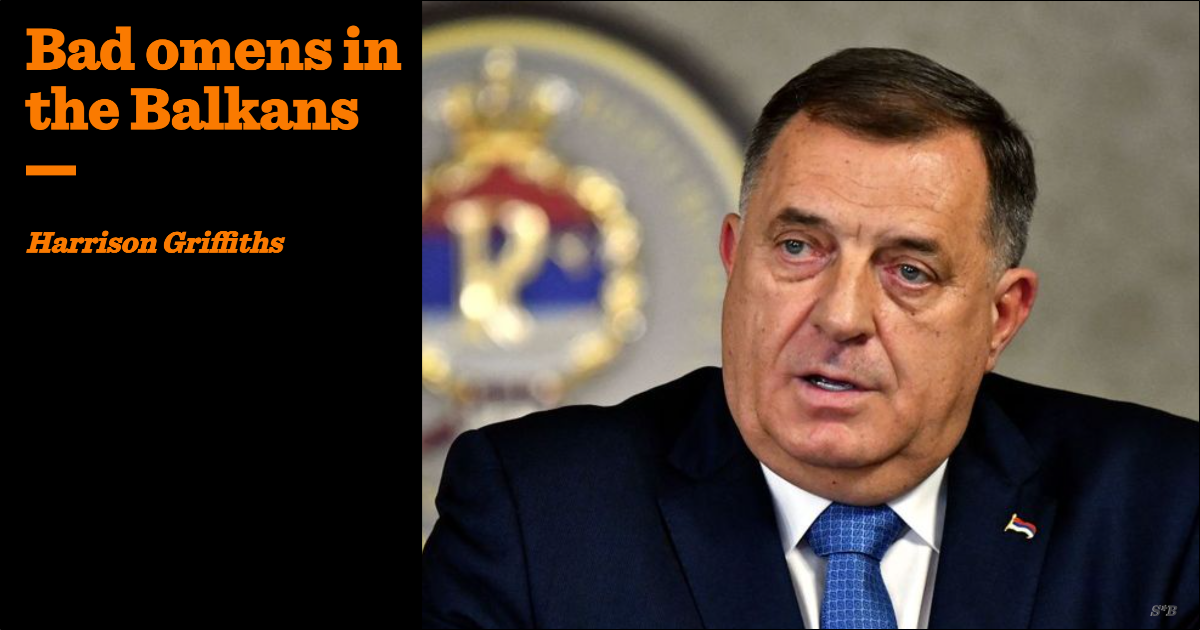
Over the last few weeks, Milorad Dodik, the de facto leader of the Serb entity in Bosnia and Herzegovina, travelled to Israel and the United States. There, in front of powerful and sympathetic audiences, he proclaimed that the time has come for the right of Bosnia’s Serbs to full self-determination to be recognised. To Dodik, this means scrapping the Dayton Accords, which have underpinned Bosnia’s uneasy peace since 1995.
This is nothing new for Dodik. He has long advocated for Republika Srpska’s (RS) secession, while denying and downplaying the mass war crimes committed by Bosnian Serb forces in the 1990s. He is merely RS’s de facto leader because he was finally removed from office last year for taking his secessionism too far.
What made Dodik’s trip so significant was the sympathy he garnered from members of Israel’s ruling coalition, who even took the step of placing Republika Srpska’s flag behind Dodik, rather than that of the sovereign state of Bosnia and Herzegovina. Naturally, the Trump administration lifted Dodik’s well-deserved persona non grata status and permitted him to do a circuit of powerful administration officials and prominent MAGA influencers earlier this month.
All of this has a geostrategic component. Dodik understands that Israel’s historic sympathy for the Serbs can be harnessed given how untethered its government has become from the liberal democratic West since Hamas’ attack and the subsequent war. Republika Srpska and Serbia itself are integral to Russia’s strategy in Europe as well. Both Serb governments are suspicious of the West, increasingly authoritarian, and, unlike the Russia-friendly states in Hungary and Slovakia, are not members of the European Union or NATO.
Dodik’s audience is not just external, however. He understands stoking nationalism and renewed secessionism among Bosnia’s Croats is crucial to his efforts to break away. Unlike the Serbs in RS, Bosnia’s Croats do not have their own entity but share Federation Bosnia and Herzegovina (FBiH) with Bosniak Muslims. This has increasingly become a point of contention within Bosnia’s fragile institutional framework.
Dodik is undeniably right about one thing: Bosnia and Herzegovina as currently constituted is a fundamentally fake sovereign state. It has been held together by fragile institutions and the implied threat of NATO intervention to quell any attempts to undermine them. A period of great power competition and cold hard realism might be a unique opportunity for Serb and Croat politicians to realise the dream of Bosnia’s disintegration.
The wider Balkan context shows potential for escalation as well. Alexander Vučić’s government in Serbia is still plodding along despite mass protests over corruption and authoritarianism triggered by the tragic collapse of a canopy under construction in the new bus station of Novi Sad, Serbia’s second city, in December 2024. In early February, Serbia’s parliament passed judicial reforms which critics argue weakens anti-corruption enforcement and checks on Vučić’s power. This appears to be the final nail in the coffin for Serbia’s doomed and interminable effort to join the EU under Vučić.
Amid this, Serbia’s state appears determined to undermine Montenegro’s accession path, which is progressing quickly and likely to make it the EU’s next member before 2030. This month, another spat has emerged between Serbia and Croatia over the latter’s handball team celebrating recent success with the notorious singer Marko Perković “Thompson”. Thompson and his music were prominent symbols of anti-Serb, anti-Bosniak, and pro-nationalist ideology in Croatia during the wars of the 1990s.
Despite opposition from residents and the local government of its capital Zagreb, the Croatian state appears to have helped host the celebratory concert. Thompson has since played another concert in the Croat-dominated city of Široki Brijeg in western Bosnia. This concert was replete with salutes and chants associated with the Ustaše, the Croatian fascist group which was responsible for the genocide of Serbs, Jews, and Roma during the Second World War.
As any Balkan historian will attest, things in the region tend to look okay until they’re not
These diplomatic incidents may seem minor and they are, for now. But they fit a broader pattern. With Dodik sensing a unique opening to advance his dream of dismantling Bosnia-Herzegovina, each boundary he pushes will further escalate regional tensions. Each new display of Croat nationalism deepens the (not entirely unreasonable) feeling among many Serbs that Croatia got off comparatively lightly from its crimes and nationalism in the 40s and 90s, when Serbs were vilified for theirs. Every petty accusation against Montenegro further distances Serbia from Europe and confirms its status as a weak spot in the continent’s back yard.
None of this is to say that dramatic escalation is imminent. But as any Balkan historian will attest, things in the region tend to look okay until they’re not. If the weakness of Bosnia-Herzegovina’s political system proves to be a catalyst and focal point for escalation, the consequences could be severe. It is crucial that the international community does not take its eye off the ball.