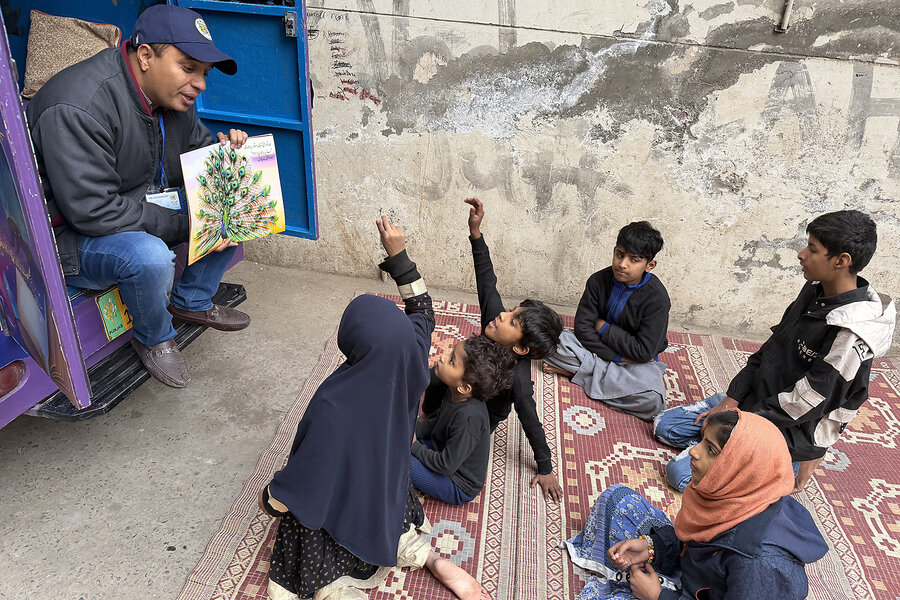
No sooner has the motorized purple rickshaw turned into the alleyway than a girl in a headscarf begins to run from door to door.
“Come outside!” she shouts, with a jump and a skip.
Within moments, the vehicle with a unicorn and a dragon painted on its back is surrounded by neighborhood children.
Why We Wrote This
Mobile libraries operated by Alif Laila Book Bus Society have grown into a nationwide phenomenon, upending the belief among many Pakistanis that reading is a pastime reserved for the elite.
Rickshaws are a ubiquitous sight in Lahore, a sprawling Pakistani metropolis of 13 million people. Whether parked in alleys or wobbling through bazaars, they form an essential part of the city’s chaos. But with the arrival of this particular rickshaw in Bihari Ahata – a working-class neighborhood in Lahore’s teeming center – Alif Laila Book Bus Society announces itself with unusual aplomb.
When the driver opens the back door, the reason for the children’s delight becomes clear. The interior is lined with shelves of colorful picture books.
“The thinking was that if children couldn’t come to the library, the library had to go to them,” says Basarat Kazim, now in her fifth decade as the head of Alif Laila, the nonprofit that sponsors the mobile library.

“A tremendous boost”
Alif Laila was founded in the 1970s by American expatriate Juanita Baker, who created a library for children out of a decommissioned bus donated by the local government. It was only under the stewardship of Mrs. Kazim, who became president of the nonprofit in 1985, that Alif Laila began to operate traveling libraries.
These days, the libraries have grown into a nationwide phenomenon, bringing books to children who sorely need them – and upending the belief among many Pakistanis that reading is a pastime reserved for the elite.
Tahir Mehmood is the principal of a school in Nabipura, one of Lahore’s poorest neighborhoods. Most of the students’ parents are domestic workers for well-to-do households.
“These are kids whose parents can’t even afford to buy the notebooks they need for class, let alone books to read,” he says. “When Alif Laila sends its buses and rickshaws to this area, the children become very excited, and it gives them a tremendous boost in their learning.”
His sentiments are echoed by Sadia Bibi, a third-grade teacher at the school.
“My students have become much better at reading because of Alif Laila,” she says. “I can tell the difference.”
Learning becomes fun
Pakistan, a country of approximately 250 million people, has a literacy rate of around 60%, the second-lowest in South Asia, after Afghanistan. Education funding often falls below 4% of gross domestic product – the United Nations’ minimum recommended benchmark – and an estimated 25 million Pakistani children don’t attend school, according to UNICEF.
There is also a large geographical divide in the literacy rate, with rural Pakistanis lagging 22 percentage points behind their urban counterparts.
As Alif Laila has expanded, it has increasingly sought creative ways to bring books to children in challenging locations. In remote parts of Sindh and Baluchistan provinces, for instance, the nonprofit frequently uses camels to transport books. Two of its mobile libraries, meanwhile, are housed in boats.

But libraries are just one part of the nonprofit’s work. In one of its buses, called the Techno Savari, the interior is kitted out with robots and gadgets. The traveling science lab goes from school to school offering demonstrations in electronics and other technologies.
“What we’re trying to do is to give these kids the sort of exposure to STEM-based learning that they’re not getting in their schools,” says Muhammad Kashif, a staff member at Alif Laila.
Twelve-year-old Mehtab Waris is one of these children. On the day a Monitor contributor visited, she watched a demonstration on the solar system in the Techno Savari bus.
“When I grow up, I want to be an engineer,” she says. “The things I see here make learning fun.”
Opening doors
The nonprofit also trains teachers and publishes books of its own, in addition to hosting a brick-and-mortar library near the site in Lahore where its first bus was parked starting in the 1970s.
Muhammad Hussain Alam remembers visiting that library as a child from a lower-middle-class background in the ’80s. Now a professor of history at Government College Township, Lahore, he credits Alif Laila with making him the person he is.
“To find a place with so many books and so many things to learn was like a door opening up to a different world,” he says. “It put wings on my imagination.”
Mrs. Kazim says such stories bring tears to her eyes. But what makes her proudest is when she sees the concept of a mobile library being adopted by other nonprofits.
“Ours was the first rickshaw library. Eighteen organizations are now running rickshaw libraries,” she says.
“What we want is for this movement to spread throughout Pakistan. Because the work we have done does not belong to us. It belongs to the children of Pakistan.”