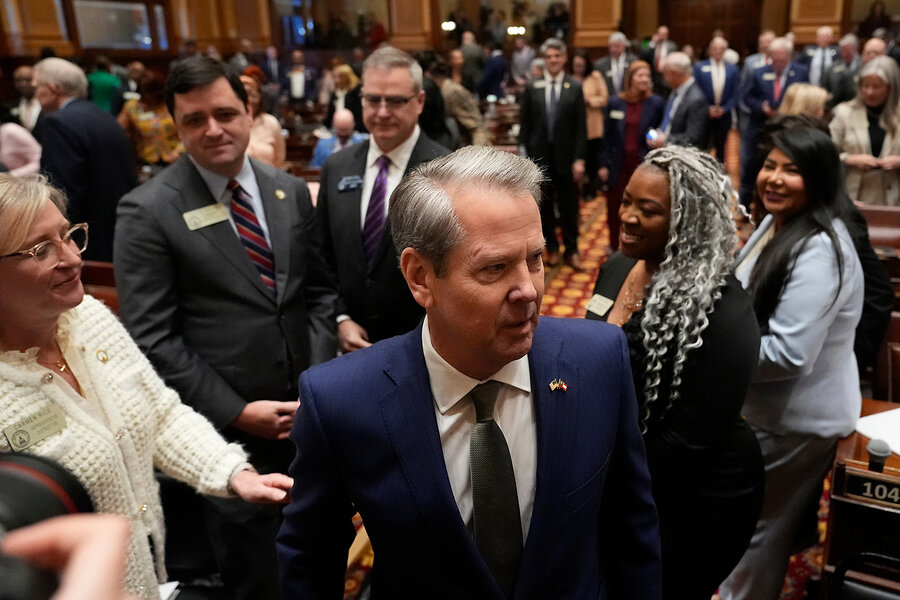
As Georgia lawmakers grind through their legislative session in Atlanta, one issue has stood out as their priority: voters’ wallets.
Republicans have been looking to regain ground on Americans’ “affordability” concerns, an issue Democrats have capitalized on nationwide. Newly elected Democratic figures – from Mayor Zohran Mamdani of New York City to Govs. Mikie Sherrill in New Jersey and Abigail Spanberger in Virginia – successfully campaigned on voters’ cost-of-living worries.
And here in the Peach State, President Donald Trump last week endorsed Lt. Gov. Burt Jones, who has made ending the state income tax the main promise of his run for governor. While eliminating the tax is seen as an effective way to address voters’ concerns about rising grocery and utility bills, during a visit to Rome, Georgia, on Feb. 19. Mr. Trump called talk of “affordability’’ part of a “con job” by his opponents.
Why We Wrote This
Income taxes pay for nearly half of public services in the U.S., from health care to schools to police. But some economists see them as a drag on productivity, holding back the power of workers and capital.
Democrats have also started tapping traditional rural GOP strongholds. And, in some cases, it’s working. Here in Georgia, Democrats recently won two coveted seats on the state’s Public Service Commission by protesting utility rate hikes.
Now, in a potential counter volley, Republicans in Georgia and four other traditionally conservative states – Missouri, Mississippi, Iowa, and Kentucky – are moving to abolish personal income taxes.
In mid-February, the Georgia Senate passed a bill to increase the standard deduction for married couples to $100,000, which, if enacted, would effectively eliminate income taxes for roughly two-thirds of Georgia households. In the same swoop, the Senate ended some corporate tax breaks to make up for the difference.
If those efforts bear fruit, Georgia would eventually join nine other states with no income tax. Those states – Alaska, Florida, Nevada, New Hampshire, South Dakota, Tennessee, Texas, Washington, and Wyoming – typically rely more heavily on sales, property, or other taxes for revenue. (Washington and Tennessee also tax some investment income.)
In Georgia, state Sen. Blake Tillery of Vidalia, a Republican candidate for lieutenant governor, is leading the push for change. The goal, he says, is to ease stress on family budgets and compete with neighboring states for investment and economic growth.
Following in the footsteps of Alaska and Mississippi
If the bill is enacted, Georgia would join Mississippi to become the first states to begin phasing out income taxes since Alaska abolished them in 1980.
“Republicans in the state have long wanted to cut taxes, so that’s nothing new,” says M.V. (Trey) Hood III, a pollster at the University of Georgia in Athens. “What’s new is putting it under the affordability moniker. And [it] does provide pretty broad tax relief for a lot of people.”
The issue is coming up nationally as well. President Donald Trump has hinted at using tariffs to lower or abolish the federal income tax. But amid these tax-cut proposals, state budgeteers are struggling to fill revenue gaps to maintain legislated services.
Since most of the federal COVID-19 funding to states has ended, some states, including Georgia, now face headwinds as the Trump administration moves to curb any additional federal funding for social services, education, and emergency management.
The proposed plan in Georgia is designed to be implemented in $3 billion increments to cover the $16 billion in income tax revenue the state collects annually.
A $4,000 jolt to the wallet
The first step of Georgia’s multiyear proposal would allow married couples to deduct the first $100,000 of income ($50,000 for single filers). A typical two-income couple making around $120,000 a year would, for example, have nearly $4,000 extra in their checkbook (based on the current 5.19% tax rate, plus a standard deduction). Other states are using an incremental approach to avoid shocking their budgets and risking downgrades from credit rating agencies.

To pay for the first phase of the cut, Senator Tillery pointed to a nearly $1.9 billion surplus from the previous budget year and to savings from financially savvy moves to fund capital projects. The rest, he says, could be gleaned by cutting the state’s $30 billion in special interest tax credits by 10%.
In the second phase, lawmakers would trim 10% of the state’s $30 billion in special interest tax credits. The final phases would rely on continued revenue from the state’s budget surplus, a transition from cash to bond funding for projects, and an economic “multiplier effect” to get to zero personal income tax by 2032.
Some economists see income taxes as a drag on productivity and say that cutting or removing these taxes boosts economic activity. But there are other potential upsides to scrapping income taxes as well, economists say, such as enticing newcomers, particularly business owners and investors, to become residents.
Recent population movements may back up this theory. The nation’s demographic center has been shifting in recent years toward the South and away from high-tax states. Some research suggests that tax reforms can be effectively used by states to compete for workers and capital.
“The classic lesson in public finance is simple: Tax things that don’t move,” says Aaron Yelowitz, a University of Kentucky economist and a fellow at the libertarian Cato Institute. “That logic matters a lot for Georgia. Atlanta is far from state borders, so most consumers can’t realistically avoid higher sales taxes. By contrast, high-value jobs and investment income are much easier to shift on paper.” But it’s a risk. For especially poor states, abolishing income taxes could affect public services and raise equity concerns.
Varying state endowments
Under Mississippi’s plan, signed into law last year, the top 5% of earners would get 40% of the benefit, according to research by the liberal-leaning Institute on Taxation and Economic Policy (ITEP) in Washington. And in Georgia, according to Democratic state Sen. Nan Orrock of Atlanta, over $11 billion of the total proposed tax cuts would go back into the pockets of the state’s top 26% of earners. Everybody else would split $4 billion.
“Is that what the citizenry is calling for?” asked a skeptical Senator Orrock during a Senate committee meeting on Jan. 7. “Helping the rich get richer? I don’t think so.’’
Of the nine U.S. states that don’t collect personal income taxes, some are specially endowed. Texas and Alaska sit on oil and gas reserves that generate revenue for their coffers. Florida floats its budget on tourist dollars.
“The only state that has ever repealed a broad-based personal tax is Alaska,” and they did it after a windfall, says Matthew Gardner, a senior fellow at ITEP. Alaska repealed its income tax in 1980, following the completion of the Trans-Alaska Pipeline System. “You can’t wish those kinds of unique endowments into existence.”
And given federal tax cuts and the prospect of leaner federal grants to states, it feels to some policy analysts like the wrong time for states to take away a critical tool for raising revenue.
Lessons of the cornfield revolution
“It’s like getting rid of your umbrella as the rain is starting,” says Kim Rueben, a public finance economist in Washington.

Kansas stands out as a cautionary tale. In what was dubbed “the revolution in the cornfield,” Gov. Sam Brownback in 2012 brought the tax rate to near zero for many Kansas wage earners. He promised the effort would boost the state economy.
But by 2017, the Republican-led legislature overrode Governor Brownback’s veto to scrap some of the tax cuts, which had not improved employment or wages and instead led to missed state payments, a sense of constant fiscal crisis, and unfixed potholes.
Kansans elected Democratic Gov. Laura Kelly in 2018 and reelected her in 2022.
The political risks are evident in Georgia, too. The state has a robust, diverse economy, built partly on the “new south” model that offers corporate tax breaks, inexpensive land, and social benefits including schools and health care. But the state is also a political battleground, having elected Democrats in statewide elections in 2020. Republican Gov. Brian Kemp has championed cutting rather than eliminating the state income tax, and has indirectly warned lawmakers against repeating the Kansas mistake.
In a none-too-subtle swipe at the plan during his final State of the State speech in January, Governor Kemp said his more modest proposal “doesn’t promise to pay for itself years down the road or create future budget holes with today’s one-time money.”
So far, Republicans in the House and Senate have vowed to work together to lower tax burdens for Georgians. But questions about how and where to shift the burden of funding the commonweal without an income tax remain unanswered.