A breakthrough daily pill that slashes ‘bad’ cholesterol more powerfully than statins has been unveiled by US scientists – raising hopes of a major new weapon against heart attacks and strokes.
In a major global trial, the drug cut LDL cholesterol by more than 57 per cent in patients already taking standard treatments – the biggest reduction ever seen from a standard oral medication.
Experts say the pill could transform care for millions of people who struggle to control cholesterol levels or cannot tolerate statins.
The drug, called enlicitide, was developed after decades of research at UT Southwestern Medical Center and works by helping the liver clear harmful cholesterol from the bloodstream more efficiently.
Crucially, it targets a metabolic pathway previously only accessible via injections – making it the world’s first effective oral pill to work in this way.
Alongside the cholesterol-lowering benefits, the drug also improved a wide range of other blood fat measures linked to heart disease.
Importantly, patients did not experience higher rates of common statin-related side effects, such as muscle pain, liver problems or an increased risk of type 2 diabetes.
Dr Ann Marie Navar, a cardiologist at UT Southwestern and leader of the study, said: ‘Fewer than half of patients with established cardiovascular disease currently reach their LDL cholesterol goals.

A breakthrough daily pill that slashes ‘bad’ cholesterol more powerfully than statins has been unveiled by US scientists – raising hopes of a major new weapon against heart attacks and strokes
‘An oral therapy this effective has the potential to dramatically improve our ability to prevent heart attacks and strokes on a population level.’
Despite the wide availability of statins, which can lower LDL by between 20 and 60 per cent, depending on the drug used and dose, around half of patients fail to get their cholesterol levels into safe zones.
Part of the reason is that between a quarter and a half of patients stop taking statins within a year.
The most common concern is side effects, particularly muscle aches and cramps, which patients frequently report.
Raised LDL cholesterol significantly increases the risk of life-threatening heart attacks and strokes, and without effective long-term treatment that risk remains high – even when people feel otherwise well.
Enlicitide binds to a protein called PCSK9 in the bloodstream, which in many people with high cholesterol is overactive and interferes with the liver’s ability to remove LDL from the body.
By blocking PCSK9, the drug allows the liver to keep clearing cholesterol efficiently.
Because it does not interfere with cholesterol production in the liver – the way statins do – experts believe enlicitide is less likely to cause common statin-related side effects such as muscle pain, as well as rare issues such as liver enzyme changes or a small increase in diabetes risk.
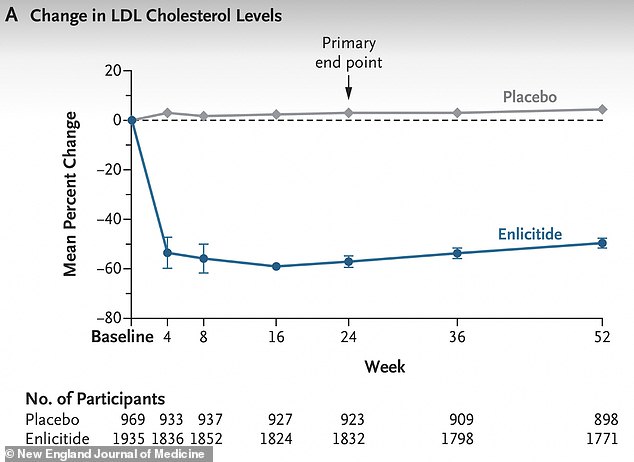
After 24 weeks, participants taking the pill saw their LDL cholesterol levels plummet by more than 57 percent compared to a minimal three percent change in the placebo group.
Until now, drugs that block PCSK9 required injections or infusions.
The trail of enlicitide involved more than 2,900 adults with either established heart disease or a high risk of it.
All were already taking standard cholesterol-lowering therapy – mainly statins – but still had elevated LDL levels.
Commenting on the findings, Dr Navar said: ‘These reductions in LDL cholesterol are the most we have ever achieved with an oral drug since the development of statins.’
A separate trial is now underway to confirm whether these dramatic cholesterol reductions translate into fewer heart attacks and strokes.
Heart disease affects around 128 million Americans and causes roughly 805,000 heart attacks every year – a burden researchers say this pill could help substantially reduce.
In the UK, heart disease affects around 7.6 million people and causes roughly 100,000 heart attacks each year – a toll experts say more effective cholesterol treatments could significantly reduce.