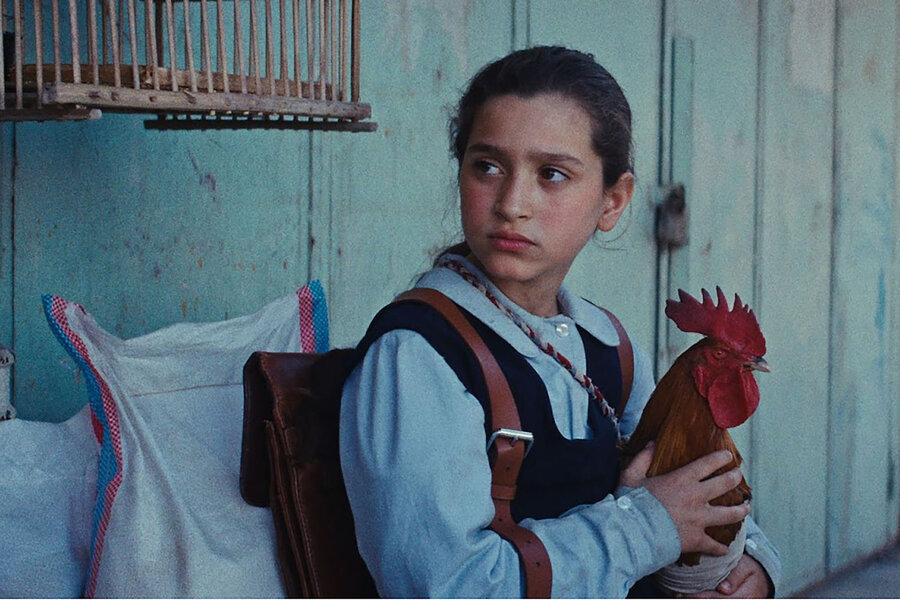
“The President’s Cake,” set in early 1990s Iraq during the brutal regime of Saddam Hussein, is a fable with a startling, real-world immediacy. Watching it, we are aware that the odyssey of its 9-year-old protagonist, Lamia (the remarkable Baneen Ahmed Nayyef), represents something much larger. And yet we never lose sight of the fact that Lamia’s story also belongs to her alone.
Written and directed by Hasan Hadi, who grew up in Iraq before studying film at New York University, “The President’s Cake” was the first Iraqi film to compete in the Cannes Film Festival, in 2025. There it won both the Caméra d’Or for best first feature and the Audience Award. A crowd-pleaser in the best sense, it overflows with empathy for its beleaguered people.
Lamia lives with her grandmother, Bibi (Waheed Thabet Khreibat), in a tight-knit, marshland community. Paddling a canoe to school each day, Lamia is extraordinarily resilient and yet still very much a child. Her closest companion, apart from her mischievous, conniving classmate Saeed (Saja Mohamad Qasem), is her beloved pet rooster, Hindi. Like Lamia, Hindi is eye-catching and headstrong.
Why We Wrote This
“The President’s Cake” follows a girl, who, along with her friend, and her pet rooster, searches for the ingredients to make a birthday cake for Saddam Hussein. While the movie is fully her story, it also demonstrates how Iraqis survived a brutal and dehumanizing dictatorship.
The United Nations sanctions in the wake of the first Gulf War, along with the American aerial bombardments, have severely impacted the general population. Despite all this, Saddam requires his people every year to shower him with birthday gifts. Lamia is tasked with baking the president a cake in less than two days, though her village doesn’t have all the necessary ingredients. If she doesn’t carry out the assignment, she could be expelled and placed in harm’s way.
She and Bibi venture into the city ostensibly to barter for eggs and baking powder and sugar. When Lamia discovers that the weary Bibi secretly plans to leave her to be raised by a sympathetic city couple, she flees, Hindi in tow, and meets up with Saeed at a local fairground. Evading the authorities, they become petty thieves, although neither will admit that is what they are. And so begins an odyssey that takes Lamia through a series of scrapes that demonstrate both her unquenchable spirit and the corruptions of the society that enfolds her.
Hadi, the filmmaker, doesn’t underscore those corruptions for us, although the city is plastered with posters and murals of a broadly smiling Saddam. The children in Lamia’s classroom may be instructed to belt out chants of “Long live our leader,” but it’s clear that the ritual means little to her, or to Saeed.
What’s so poignant about Lamia’s plight is that, without being aware of it, the war she is caught up in has taken a toll on her innocence – as it is with all wars in which children are embroiled. The adults she encounters in her journey all have their own agendas; they cut her no slack. The one exception is Jasim (Rahim Alhaj), a kindly postal carrier who goes in search of the errant Lamia when Bibi frantically reports her missing to the unconcerned police. If not for Jasim, the society we see might resemble a congregation of con artists. He humanizes the clamor and makes us aware that, even in the direst circumstances, goodness can somehow still prevail.
Hadi’s unsentimental treatment of his key players is especially sensitive. These are no lovable Hollywood tykes. Their street smarts are integral to their being. Lamia and Saaed have a favorite game: They stare into each other’s eyes and wait for the other to blink first. It seems harmless enough, but the game represents something more profound – a way to lock souls as the adult world, and the bombs, rain down upon them.
In a sense, Lamia lives her entire life as if it were a kind of glorified staring game. She is cognizant of all that surrounds her, both out of fear and an intense curiosity about how her world works. But she is also open to enchantment. Early on Bibi tells her that, if you look deeply into the river, God promises the pure in heart that they shall see the image of their loved one. In the film’s most heartrending passage, when her odyssey has ended, this little girl, in a moment of quiet grace, sees just that.
“The President’s Cake” is in Arabic with English subtitles. The MPAA rates the film PG-13 for strong language, mature thematic elements, some suggestive material, and smoking.