The last remaining nuclear weapons treaty between the US and Russia has expired, unleashing the threat of a ‘runaway arms race.’
At midnight on Thursday, the New Strategic Arms Reduction Treaty (New START), signed by both superpowers in 2010, ended as no agreement on an extension was reached, allowing the US and Russia to now build up their nuclear stockpiles without restriction.
Russia has already blamed the US for walking away from the treaty, with Russian politician Alexei Zhuravlev issuing a chilling warning about his nation’s ability to single-handedly cause a nuclear apocalypse.
Zhuravlev, First Deputy Chairman of the State Duma Defense Committee, said: ‘Russia currently possesses weapons capable of wiping out any country, or even completely destroying the entire planet.’
The New START treaty had limited both sides to no more than 1,550 deployed strategic nuclear warheads each, while also allowing mutual inspections and data sharing for transparency.
A limit was also set on the number of long-range delivery systems the US and Russia could have, restricting each nation to 700 active platforms capable of carrying nuclear warheads, including missiles, submarines, and bombers.
Now that New START has expired, both countries are free to build up and deploy more of these weapons without any binding limits or required verification.
Daniel Holz, a member of the Bulletin of Atomic Scientists, warned that the world has never been closer to Doomsday than it is today, fearing that the end of New START will trigger ‘a runaway nuclear arms race’ involving multiple countries.
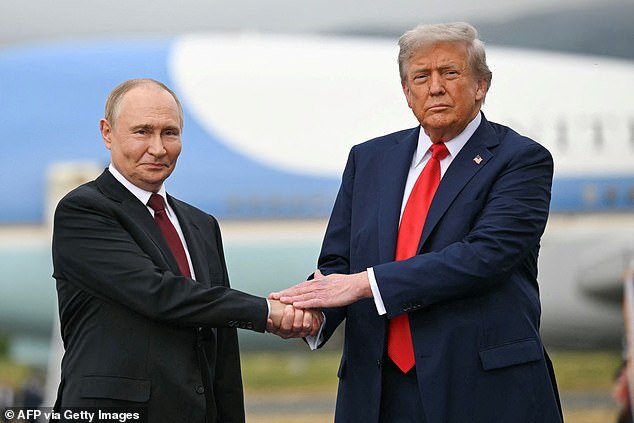
Russian President Vladimir Putin (Left) and US President Donald Trump (Right) allowed the New Strategic Arms Reduction Treaty to expire on Thursday
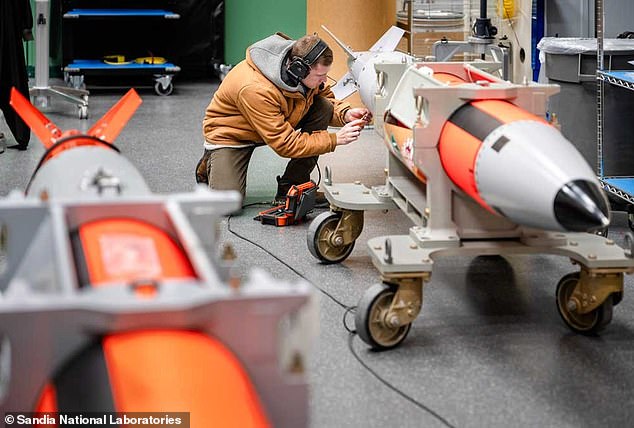
A worker prepares the B61-13, a nuclear ‘gravity bomb’ being produced by the US that is 24 times more powerful than the atom bomb dropped on Hiroshima, Japan in 1945
Zhuravlev claimed that Russia was willing to extend New START for another year, but the Trump Administration has demanded that any nuclear arms treaty include restrictions on the country with the third-largest nuclear stockpile – China.
‘Moscow is playing the role of peacemaker,’ Zhuravlev told Russian online news outlet news.ru.
‘Washington, however, has often linked this issue to the inclusion of Beijing, which is rapidly nipping at everyone’s heels, in the agreement.’
The politician said that China, a close ally of Russia, ‘flatly refuses’ to be part of any nuclear treaty, as tensions between the communist nation, the US, and America’s allies in Asia remain high.
The first New START treaty was signed in 1991 and cut the number of deployed strategic nuclear warheads.
START II in 1993 aimed to significantly reduce strategic nuclear weapons, banning multiple warheads (MIRVs) on intercontinental ballistic missiles (ICBMs) and eliminating Russian SS-18 missiles.
However, it never fully entered into force due to Russian delays related to the US withdrawal from the Anti-Ballistic Missile (ABM) Treaty, and Russia formally repudiated it in 2002, with later agreements like New START eventually taking its place.
New START was the only treaty that effectively held the US and Russia accountable for reducing their arsenals.
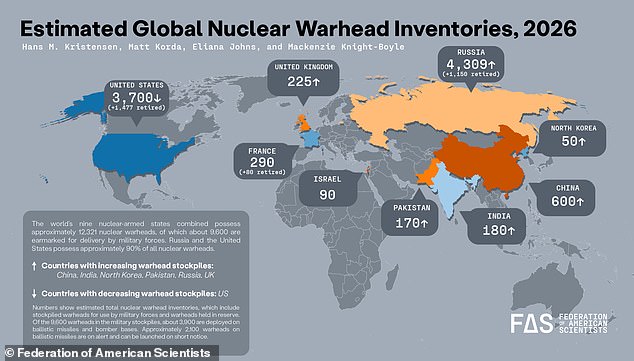
Researchers with the Federation of American Scientists claimed that both the US and Russia exceeded the limits of the New START treaty before its expiration on February 5, 2026
Moscow and Washington, both focused on the war in Ukraine, have not conducted formal talks on a successor to New START.
A new report by the Federation of American Scientists (FAS), a nonprofit global policy think tank, found the US and Russia still possess 86 percent of the world’s total inventory of nuclear weapons.
Overall, researchers estimated that nine countries possessed 12,321 nuclear warheads as of this year, with Russia having the world’s largest military stockpile of more than 4,300 weapons of mass destruction.
The US followed closely behind with 3,700 warheads in the current military stockpile, a number that includes both active weapons on long-range delivery systems and inactive bombs kept in storage.
China, the UK, France, India, Pakistan, Israel, and North Korea are the other seven nations believed to have an active stockpile of nuclear bombs.
In terms of the weapons ready for launch in a nuclear war, scientists with FAS claimed that both countries had already violated the New START limit of 1,550 deployed strategic nuclear warheads at the start of 2026.
Their report alleged that Russia had 1,718 nuclear warheads deployed worldwide while the US had 1,670.
‘The exact number of nuclear weapons in each country’s possession is a closely held national secret, so the estimates presented here come with significant uncertainty,’ FAS said in a statement.
FAS added that the Biden Administration and the Russian government both elected to stop publicly sharing data about their deployed strategic warheads and launchers in 2023, despite it being mandated by the New START Treaty.
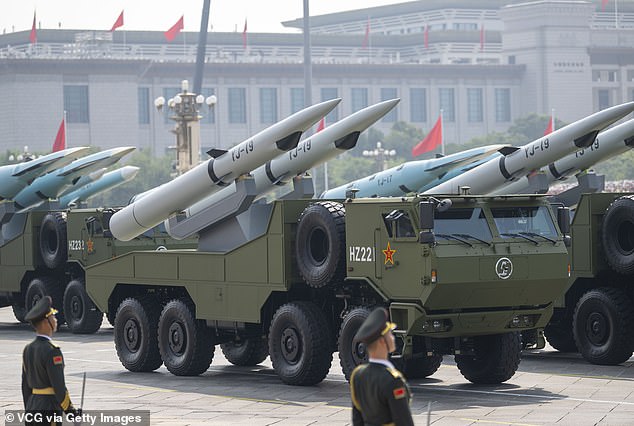
President Trump has insisted that a replacement to the New START treaty must include new restrictions on China, which is believed to have 600 nuclear warheads
China currently has approximately 600 warheads in its arsenal, with a recent warning from the Pentagon stating that the country was arming dozens of long-range nuclear missiles.
President Trump said in January that a replacement for New START will need to curb China’s rapid and unchecked expansion of nuclear arms.
‘If it expires, it expires,’ the president told the New York Times. ‘We’ll do a better agreement.’
Dr Jim Walsh, Senior Research Associate at MIT’s Security Studies Program, warned that the treaty’s expiration won’t immediately unravel nuclear restraint, but it could trigger a chain reaction with far-reaching consequences.
‘There’ll be a turn of events a month from now, a year from now, five years from now,’ Walsh told the Daily Mail. ‘Things always happen in international affairs. There’ll be a war, there’ll be a crisis.’