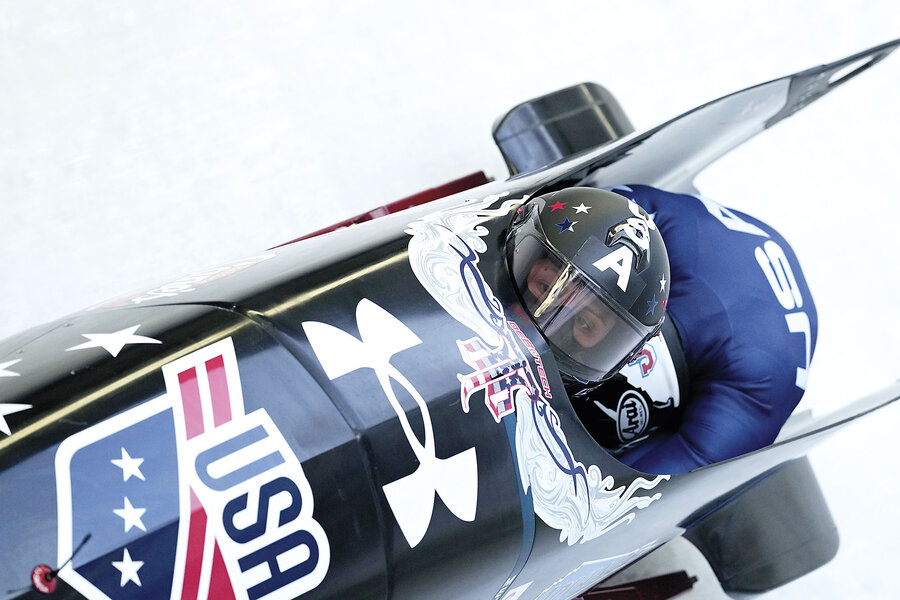
Elana Meyers Taylor, the most decorated Olympic bobsledder in American history, was about to speak her mind.
The Winter Olympics legend tends to talk a little like she drives her bobsled: She’s not afraid of the curves, and if she crashes, she’ll learn from it. And this was definitely a swerve from the typical hot take.
“People say the world is so divided, but I don’t see it,” she told assembled media in a Zoom news conference in October.
Why We Wrote This
Olympians aren’t immune to the political divisions that kindle social media, but they often find a higher purpose through their sport, fostering cooperation, hope, and support.
The sentiment reflects the mission of the Olympic Games: to unite the world through sport, promote peace and mutual understanding, and build goodwill among athletes from different nations in the spirit of friendly competition.
Olympians like Ms. Meyers Taylor can, of course, see the political divisions that kindle social media into a bonfire of anger and inhumanity. Some use their Olympic platform as a means of protest during a moment of particular unrest around the world – both between nations and within nations themselves.
But Ms. Meyers Taylor is describing her experiences. The mother of two young boys, both deaf and one diagnosed with Down syndrome, Ms. Meyers Taylor said she always sees people ready to help – to grab some luggage on the plane or simply share a kind word of encouragement.
Some of her experiences are because of the athlete herself. A woman of faith, Ms. Meyers Taylor said Christianity has taught her: “You put people first, and you have to take care of people before all else.”
But as a five-time Olympic medalist, she has also had special experiences others haven’t. She recalls sitting with Iranian athletes at the 2018 Games in Pyeongchang, South Korea, trading pins.
“Where else in the world could you be doing that?” says Ms. Meyers Taylor, who also became a world champion in 2015. “And you realize, people are just people. You realize how beautiful that diversity really is.”
The most decorated Black Winter Olympian in history, male or female, with three silvers and two bronzes, she has been confronted with opposing coaches who considered her incapable of driving a sled at an elite level because of her race. One British coach was reported as saying in 2013: “Black drivers do not make good bobsleigh drivers.”
As a former president of the Women’s Sports Foundation, Ms. Meyers Taylor has led the campaign for gender equity in sport. And as a mother of two children with disabilities, she has seen how society struggles to support and value those who do not fit the narrow template of “normal.”
Still, all U.S. Olympians are, to some degree, required to see America through a different lens. Coaches and teammates come from every point on the political spectrum. The communities that are essential to supporting an Olympic athlete are, each in their own way, America in miniature.
Meanwhile, fans don’t come dressed only in red or blue, but the red, white, and blue of Team USA. Many Americans will find the spirit of the Winter Olympics a welcome balm to the toxicity of today. But perhaps there are deeper lessons here, too.
When one has bumped and thumped their way down an icy track as much as Ms. Meyers Taylor has, the desire to learn how to steer away from crashes becomes instinctive. And what the bobsledder has learned about America is that, just maybe, we aren’t the worst we so often see in one another.
“To view it like cheering for one team or the other is missing the point,” Ms. Meyers Taylor says during an interview with the Monitor in the days before a January race in Altenberg, Germany. “When I’m just walking around, that’s not what I see with the kinds of people willing to help and go the extra mile.
“I’ve found the goodness of people in my daily life,” she adds.

Kendra Nordin Beato/The Christian Science Monitor
“It’s about hope”
On an arctic day that could freeze the tail off a fisher cat, Adam Benjamin found his way to New Hampshire’s Waterville Valley last month to watch a World Cup competition in the run-up to the 2026 Winter Games in Milan Cortina.
His efforts to brave the cold deserved a medal in itself. But his real reward, he says, is witnessing the spirit Olympians and others display during today’s competitions.
“I mean, the Olympics, it’s about hope,” Mr. Benjamin says. “To see these athletes do what they do and know how much commitment and time and training that they put into their sport and their skills is – it’s inspiring. And, today, we need that.”
Skiers from around the world, some still vying for a spot on their Olympic teams, dropped into the course to soar off aerial jumps with backflips. Then they pound through a relentless mogul course to the beat of techno music blasting at the bottom in front of dozens of cheering fans.
After placing sixth, mogul specialist Charlie Mickel, a two-time national champion, reflects on what it would mean to represent the United States at a time of intense national conflict.
“I’ve traveled all around the world for competitions,” says Mr. Mickel, who, at 20 years old, is considered a rising star in his sport. “I’ve been to Kazakhstan. I’ve been to China, places that are very different,” he says. “And still, the people I meet there ultimately are the same humans as here, you know?”
Top U.S. mogul skier Jaelin Kauf was already looking ahead to the Olympics after a disappointing bobble kept her from reaching the final round and a spot on the podium at this World Cup event.
Olympic athletes are primarily focused on executing their runs with precision and speed. When things don’t go as planned, support from family members, friends, and fans at the bottom of the run can be a salve.
“Being at home with this World Cup in the U.S., you really feel the love and support from everyone,” says Ms. Kauf, a painted American flag and flecks of glitter on her cheeks. “I’m just so stoked to watch us compete here, and then represent the U.S. on the world stage in a couple of weeks. It’s such an amazing honor to be able to represent the country doing what I love most in the world.”
The broader the support network, the better
Yet the Olympic experience goes beyond being a melting pot of nations. Just as important, it is a melting pot of Americans.
Being a member of Team USA does not mean leaving your political opinions at the door. But the mutual respect that binds team members changes how those conversations happen, when they inevitably do.
“As a team, we have to come together. That’s something that sport offers,” says Ms. Meyers Taylor, adding this is part of being an Olympian. “In a work setting, you don’t always have to interact, but as a team, you have to. You have to have common ground.”
“For me, it’s important to be the best representative of Team USA possible, and that means being united,” she says. “It’s a microcosm of the greater society.”
That is a lesson drilled into virtually every Olympian over a lifetime of competition. Without a broader support network, no one makes their dream come true.
Ms. Meyers Taylor, again, focuses on her experiences. She recalls holding a spaghetti dinner at a church in Lake Placid, New York, to raise funds. Her little Lutheran church in Douglasville, Georgia, too, has held fundraisers to pay her expenses.
As a child growing up dreaming of playing Olympic softball, she needed to get rides from neighbors or stay at other people’s houses during tournaments.
“We got where we are because of our communities,” she says. “Your community makes you or breaks you, especially with the Olympics, because the sports are so niche.”
And that support comes in different political flavors.
In her bid to become president of the International Olympic Committee, Zimbabwe’s Kirsty Coventry, a former competitive swimmer, wrote: “The Olympics go beyond elevating sport and athletes, influencing society by upholding values, promoting unity and peace, and nurturing global culture in an increasingly divided world.”
Ms. Meyers Taylor has seen that in her own life. Today, even as she prepares for her fifth Olympics at age 41, her greatest campaign is for people with disabilities. Fighting for her sons has changed her.
“There is so much beauty in humanity that we lose because of labels,” she says. “I’ve seen more beauty in the past five years working in the Down syndrome community than I’ve ever seen in my life.”
It was the Olympics that prepared her for that, she says.
“I’ve always had a sense that sport will prepare me for the rest of my life. That was made real when I had Nico [her first son]. I felt so much more prepared with what I’ve been through in my life.”
“That’s part of the story of my life: Just keep fighting through things,” she adds. “It’s not whether you find a way, but how.”